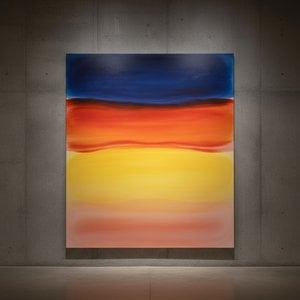
A Window Into Rothko’s Inner World
Mark Rothko's Untitled 74 stands as a testament to Color Field painting—a movement that sought to transcend representational art and delve directly into the realm of emotion. Created sometime between 1950 and 1960, its precise date remains elusive, adding to its mystique and prompting ongoing interpretation. This piece isn’t merely pigment on canvas; it's an invitation to contemplate profound existential questions about life, death, and consciousness—themes central to Rothko’s artistic vision.
The Essence of Color Field Painting
Rothko revolutionized painting by rejecting traditional perspective and form in favor of vast expanses of color. Unlike artists preoccupied with depicting the external world, he aimed to evoke internal states through pure hue and tone. This approach aligns perfectly with the broader cultural climate of postwar America—a period marked by disillusionment following World War II and a burgeoning interest in psychology and spirituality. The artist himself famously stated that his paintings “are not about things; they are about feeling.”
Technique & Materiality
The painting’s execution showcases Rothko's masterful technique involving layering oil paint on canvas with meticulous care. Visible brushstrokes contribute to a sense of dynamism, hinting at the artist’s physical engagement with the material—a deliberate contrast to the smooth surfaces favored by many contemporaries. The application isn’t precise; rather, it’s gestural and intuitive, allowing the colors to bleed into one another, creating soft edges and atmospheric effects. This technique emphasizes the materiality of the paint itself, reminding us that Rothko wasn't simply applying color—he was sculpting with pigment.
Historical Context & Artistic Evolution
Rothko emerged from the formative years following World War II, inheriting a legacy of trauma and uncertainty. Influenced by Surrealism and Expressionism, he initially explored figurative works imbued with mythological symbolism – tales of heroes and gods grappling with fate. However, he swiftly moved toward Color Field painting, abandoning representational imagery for an uncompromising focus on color alone. This stylistic shift reflects a deeper philosophical preoccupation—a desire to capture the intangible essence of human experience beyond rational thought.
Symbolism & Emotional Impact
While Rothko resisted definitive interpretations of his work, the colors and forms within Untitled 74 resonate with powerful symbolic associations. The dominant hues – shades of pink, orange, purple, and gold – evoke feelings of passion, warmth, and luminosity, yet they are tempered by underlying layers of muted tones that hint at melancholy or introspection. The hazy, amorphous shapes—particularly the central vertical element—suggest brokenness, memory, and perhaps even a yearning for transcendence. Ultimately, this painting’s emotional impact is deeply personal, inviting viewers to engage in a contemplative dialogue with their own subconscious. It's a piece designed not just to be seen but felt—a timeless exploration of human emotion rendered in breathtaking color.
Preguntas y respuestas
¿A qué artista se le atribuye "Sin título 74"?
"Sin título 74" fue creada por Mark Rothko. La información en esta página describe la obra original de Mark Rothko.
¿Dónde puedo encontrar estadísticas sobre "Sin título 74" de Mark Rothko?
Las estadísticas sobre "Sin título 74" de Mark Rothko se encuentran en la página de Estadísticas de la obra: visitas mensuales de la obra, visitas a las obras del artista y desgloses por país e idioma de los visitantes recientes.
¿Cómo se describe la atmósfera de "Sin título 74" de Mark Rothko?
"Sin título 74" tiene una atmósfera Místico.



 Vista previa
 Encargar reproducción pintada a mano
 Compartir
 Compartir
 Ver detalles
 Guía
Guía

 Descargar
 Ver artículos similares
 Radiografía
 Presentación de diapositivas
 Estadísticas

 Leer más






































 La opción de vidrio solo está disponible en tamaños inferiores a 110 cm.