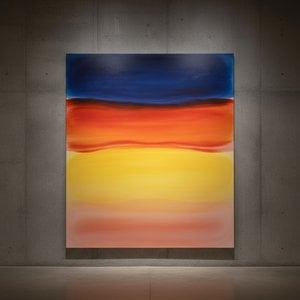
Mark Rothko’s ‘No. 24’: A Deep Dive into Color and Emotion
WahooArt.com presents an exquisite hand-painted reproduction of Mark Rothko's “No. 24,” a seminal work from 1949 that embodies the artist’s revolutionary approach to abstract expressionism. This piece, dominated by intense reds and greens, immediately draws the viewer into a realm of profound emotional resonance – a hallmark of Rothko’s mature style. The canvas itself is not merely a surface for paint; it's a textured landscape, built up in layers of thick impasto, creating a palpable physicality that invites tactile engagement. Subtle hints of orange peek through, adding to the complexity and dynamism within the seemingly simple color field composition.
The Genesis of Color: Rothko’s Exploration
Born in 1903 in Daugavpils, Latvia – then part of the Russian Empire – Mark Rothko's early life was profoundly shaped by displacement and a sensitivity to human suffering. His family’s experiences within the volatile political landscape of Eastern Europe instilled a deep awareness of mortality and existential questions, themes that would become central to his artistic vision. This biographical context is crucial to understanding “No. 24.” Rothko wasn't simply applying color; he was channeling deeply felt emotions, attempting to evoke a visceral response in the viewer. The layering technique, achieved through repeated applications of paint, builds up these emotional layers, creating an almost meditative effect.
Color Theory and Spiritual Resonance
Rothko’s use of color wasn't arbitrary. He meticulously studied color theory, particularly the work of Josef Albers, to understand how colors interact and influence each other. The juxtaposition of red and green in “No. 24” is particularly significant. These colors are often associated with primal emotions – red representing passion, anger, or danger, while green symbolizes nature, growth, and sometimes, decay. Rothko aimed to create a spiritual experience for the viewer, suggesting a connection between the individual’s inner world and the vastness of the universe. The thick application of paint, almost sculptural in its presence, further enhances this sense of depth and weight.
A Legacy of Emotional Intensity
"No. 24" represents a pivotal moment in Rothko's career, solidifying his reputation as one of the foremost figures in abstract expressionism. This reproduction captures not just the visual elements of the original but also its emotional core – the profound sense of melancholy, contemplation, and perhaps even spiritual yearning that defines Rothko’s work. A hand-painted reproduction offers a unique opportunity to experience this artwork's power firsthand, bringing Rothko’s intensely personal vision into your space. This piece is more than just decoration; it’s an investment in art history and a gateway to exploring the depths of human emotion.



 Vista previa
 Encargar reproducción pintada a mano
 Compartir
 Compartir
 Ver detalles
 Guía
Guía

 Descargar
 Ver artículos similares
 Radiografía
 Presentación de diapositivas
 Estadísticas

 Leer más






































 La opción de vidrio solo está disponible en tamaños inferiores a 110 cm.