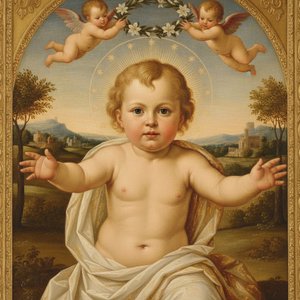
The Pietà: A Venetian Masterpiece of Sorrow
Lorenzo Lotto’s 1545 rendition of the Pietà stands as a profoundly moving testament to human suffering and divine grace, a cornerstone of his distinctive artistic vision. Far removed from the idealized beauty often associated with Renaissance sculpture, Lotto's interpretation plunges directly into the heart of grief, offering a raw and intensely personal portrayal of Mary cradling the lifeless body of Christ. This isn’t merely a depiction of a religious scene; it’s an exploration of sorrow, loss, and the enduring power of maternal love—a characteristic that cemented Lotto’s reputation as one of Venice's most psychologically astute painters.
The painting immediately commands attention with its dramatic use of light and shadow. A deep, enveloping darkness dominates the background, creating a sense of claustrophobia and emphasizing the vulnerability of the figures within. Lotto masterfully employs chiaroscuro – the stark contrast between light and dark – to draw our focus to Mary’s face, etched with an anguish that is both palpable and heartbreaking. Her expression isn't one of serene acceptance, but rather a visceral reaction to unimaginable loss; her eyes are closed, suggesting a profound stillness born not of peace, but of overwhelming grief. The folds of her garments cascade around Christ’s body, mirroring the weight of his suffering and her own sorrow.
A Venetian Soul: Lotto's Unique Style
Lotto’s artistic journey was anything but conventional. Unlike many of his contemporaries who established themselves within specific schools or courts, he embraced a nomadic existence, moving between Venice, Treviso, Rome, Bergamo, and Loreto. This constant movement profoundly shaped his style, exposing him to diverse influences while fostering an independent spirit that set him apart. While early training undoubtedly involved the lessons of Giovanni Bellini – evident in the rich colors and atmospheric perspective – Lotto quickly transcended simple imitation, forging a style uniquely his own—a blend of High Renaissance grace and nascent Mannerist sensibiliti. His work is characterized by a nervous energy, an almost palpable sense of unease that reflects the emotional depth he sought to convey.
The painting’s composition itself is notable for its unconventionality. Lotto deliberately avoids the idealized beauty often associated with depictions of Mary and Christ. Instead, he presents them as ordinary people overwhelmed by tragedy. The figures are rendered with a remarkable degree of realism, their faces bearing the marks of age and hardship. This departure from traditional iconography reflects Lotto’s commitment to portraying human emotion with honesty and sincerity. The subtle details – the delicate veins visible beneath Christ's skin, the slight tremor in Mary’s hand – contribute to the painting’s overwhelming sense of immediacy.
Symbolism and Context
The Pietà transcends a simple narrative; it is laden with symbolic meaning. The pyramidal composition, reminiscent of works by Botticelli, anchors the scene while simultaneously directing our gaze towards the central figures. The dark background symbolizes death and despair, while the light that illuminates Mary’s face represents hope and redemption. Crucially, Lotto's choice to depict Mary not as a passive recipient of grief, but as an active participant in Christ’s suffering underscores her role as co-redeemer—a concept central to Christian theology. The inclusion of John the Baptist, standing to the left of Mary, further emphasizes this theme, linking the sorrowful scene with the anticipation of salvation.
The painting was commissioned for a Dominican nunnery in Treviso, and its creation coincided with a period of intense religious fervor in Italy. Lotto’s Pietà reflects this atmosphere of piety and devotion, while also offering a deeply personal meditation on mortality and faith. The fact that the church itself was later destroyed adds another layer of poignancy to the work—a reminder of the fragility of human endeavors and the enduring power of art.
A Timeless Masterpiece
Lorenzo Lotto’s Pietà is more than just a beautiful painting; it's a profound exploration of the human condition. Its raw emotion, masterful technique, and rich symbolism continue to resonate with viewers centuries after its creation. Whether viewed as a devotional object or a work of art for its own sake, this masterpiece offers a glimpse into the soul of a remarkable artist and a timeless meditation on sorrow, loss, and the enduring power of love.



 Vista previa
 Encargar reproducción pintada a mano
 Compartir
 Compartir
 Ver detalles
 Guía
Guía

 Descargar
 Ver artículos similares
 Radiografía
 Presentación de diapositivas
 Estadísticas


 Leer más






































 La opción de vidrio solo está disponible en tamaños inferiores a 110 cm.