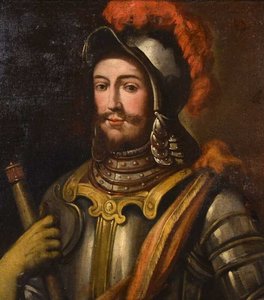
Biografía del artista
Peter Lombard
Peter Lombard (c. 1096 – August 21/22, 1160) was a Italian painter and theologian who bridged the gap between Late Gothic and Renaissance art styles. He is primarily remembered for his magnum opus, *Magister Sententiarum*, which established him as the cornerstone of scholastic theology—a tradition that profoundly shaped medieval intellectual life.
### Early Life and Education
Peter Lombard’s origins remain somewhat obscure, but he was born in Lumellogno (then a rural commune, now a *quartiere*of Novara), Piedmont, Italy, to a family of modest means. His formative education commenced at the cathedral schools of Novara and Lucca—institutions renowned for their rigorous curricula focused on Latin grammar, rhetoric, and theology. Recognizing his exceptional aptitude, Bishop Odo of Lucca championed Lombard’s ambition to pursue advanced studies in Paris, securing him patronage that enabled him to embark on a transformative intellectual journey. Around 1134, he arrived in Paris, where he immersed himself in the vibrant academic atmosphere fostered by Peter Abelard and Hugh of Saint Victor—figures who spearheaded the burgeoning scholastic movement. These mentors instilled in Lombard a methodical approach to philosophical inquiry and theological reflection, shaping his worldview and scholarly trajectory.
### Theological Contributions: *Magister Sententiarum*
Lombard’s legacy rests principally upon *Magister Sententiarum*, commonly known as “The Four Books of Sentences.” Published in 1148–51, this monumental work represents a watershed moment in theological scholarship—a systematic distillation of the teachings of Church Fathers and prominent medieval masters. Unlike preceding treatises that often fragmented doctrinal discussions into disparate fragments, Lombard meticulously organized his arguments around seven fundamental propositions—each representing a core element of Christian belief. He championed the concept of “love” as the animating force behind genuine faith, asserting that divine grace operates not merely through intellect but also through compassion and benevolence. Furthermore, Lombard’s meticulous analysis of sacraments—Baptism, Confirmation, Eucharist, Penance, Anointing of the Sick, Holy Orders, and Matrimony—provided a detailed exposition of their biblical foundations and sacramental efficacy. His insistence on discerning the “cause” and “intention” underlying human actions distinguished him from earlier thinkers who prioritized abstract reasoning over practical moral considerations.
### Artistic Style and Notable Works
Lombard’s artistic style reflects the stylistic transition occurring during his lifetime—a movement away from the ornate, stylized forms of Late Gothic art toward the more restrained elegance characteristic of Early Renaissance aesthetics. His paintings are distinguished by their harmonious compositions, uniform gold grounds—a technique reflecting Byzantine influence—and remarkably lifelike figures imbued with psychological depth. Among his most celebrated works are *Cleopatra / Eurydice*, a captivating depiction of Cleopatra before her tragic demise, and *Saint Anthony Abbot*, housed in the Museo Poldi Pezzoli in Milan—a poignant portrayal capturing Saint Anthony’s contemplative devotion. These paintings exemplify Lombard's artistic vision—characterized by meticulous detail and imbued with spiritual significance.
### Influence and Legacy
Peter Lombard’s influence extended far beyond his immediate scholarly circle, shaping theological discourse for centuries to come. His *Magister Sententiarum* served as the definitive textbook in universities across Europe until the 16th century, fostering a tradition of reasoned argumentation underpinned by Scripture—a legacy that continues to resonate within Christian theology today. Moreover, Lombard’s pedagogical approach championed the integration of intellect and emotion—a perspective that anticipates humanist ideals emerging during the Renaissance. His enduring contribution to Western intellectual history underscores his position as one of the foremost thinkers of his era—a figure whose profound insights continue to inspire contemplation and scholarly inquiry.



 Encargar reproducción
 Enviar
 Compartir
 Detalles

 Descargar
 Similares
 Radiografía
 Presentación de diapositivas

 Ver más






































 La opción de vidrio solo está disponible en tamaños inferiores a 110 cm.