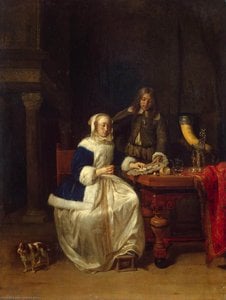
Jean Antoine Laurent: A Whisper of Sentiment in Ivory
The world of 18th-century portraiture is often dominated by grand gestures, opulent displays of wealth and power—a theatrical representation of status. Yet, within this landscape of bold statements, Jean Antoine Laurent offered a quieter, more intimate perspective. Born in Baccarat, France, in 1763, Laurent wasn’t a painter of sweeping historical scenes or dramatic allegories; instead, he carved his legacy into the delicate surfaces of ivory and parchment through exquisitely rendered miniature portraits. His work isn't about proclaiming grandeur; it’s about capturing the subtle nuances of human emotion—a whisper of sentiment preserved in meticulous detail.
Laurent’s early life was steeped in artistic tradition. He studied under Jean-Baptiste Claudot and Jean-François Durand in Nancy, absorbing the regional style known for its refined elegance. However, it was his move to Paris in 1785 that truly ignited his career. The bustling salon scene provided a fertile ground for experimentation, and Laurent quickly established himself as a respected miniaturist, exhibiting regularly at the Salon from 1791 until his death in 1832. His success wasn’t merely based on technical skill—though undeniably impressive—but also on an astute understanding of how to convey personality through miniature scale. He possessed a remarkable ability to distill a subject's essence into a remarkably small space, creating portraits that felt both intensely personal and universally relatable.
The Pre-Romantic Palette
Laurent’s artistic style is often described as “pre-romantic,” a term that speaks volumes about his approach. He rejected the rigid formality of Neoclassicism, favoring instead a softer, more expressive palette. His portraits aren't idealized representations; they reveal vulnerability and introspection. He was deeply influenced by the writings of Jean-Jacques Rousseau, whose philosophy emphasized the importance of feeling and emotion over societal conventions. This influence is evident in his subjects’ expressions—a gentle melancholy, a quiet contemplation, or a fleeting hint of joy—all rendered with remarkable sensitivity. Laurent's use of light and shadow further contributes to this emotional depth, creating an atmosphere that invites viewers to connect with the subject on a profound level.
Unlike many portraitists of his time who focused solely on external appearances, Laurent paid close attention to the inner lives of his subjects. He sought to capture not just their likeness but also their character—their hopes, fears, and dreams. This is particularly evident in portraits like “Portrait of a Young Woman,” housed at The Metropolitan Museum of Art, where the subject’s gaze holds an almost palpable sense of longing. His technique involved working on ivory, often employing the "fixé sous verre" method – painting on fine silk fabric adhered to the back of the ivory panel—a process that allowed for greater detail and luminosity.
Technique and Materials
Laurent’s mastery lay not only in his artistic vision but also in his technical skill. He was a meticulous craftsman, employing delicate brushes and painstaking attention to detail. His portraits are characterized by their exquisite rendering of textures—the softness of skin, the sheen of silk, the folds of fabric. He utilized watercolor on ivory with remarkable precision, layering colors to create subtle gradations and achieving an astonishing level of realism within the confines of miniature scale. The choice of ivory itself was significant; it provided a luminous surface that enhanced the brilliance of his colors and allowed for exceptional detail.
The materials themselves were carefully selected. Ivory, sourced from Africa, was prized for its whiteness and smoothness—a blank canvas upon which Laurent could create his miniature masterpieces. He often used fine silk fabrics for backgrounds, adding depth and richness to the portraits. His meticulous approach extended beyond the technical aspects of painting; he paid careful attention to the framing of his miniatures, selecting frames that complemented the artwork and enhanced its overall impact.
Legacy and Influence
Despite not achieving widespread fame during his lifetime, Jean Antoine Laurent’s work has gained increasing recognition in recent decades. His portraits are now celebrated for their intimate beauty, technical brilliance, and profound emotional resonance. He stands as a significant figure in the history of miniature portraiture, demonstrating that even within the constraints of a small format, it is possible to create works of extraordinary depth and complexity.
Laurent’s influence extends beyond his own artistic output. His emphasis on capturing human emotion—a hallmark of pre-romanticism—prefigured many of the trends that would emerge in subsequent generations of artists. His work continues to inspire admiration for its delicate beauty, quiet introspection, and enduring appeal.



 Vista previa
 Cambiar a formato impreso
 Compartir
 Compartir
 Ver detalles
 Guía
Guía

 Descargar
 Ver artículos similares
 Radiografía
 Presentación de diapositivas
 Estadísticas
 Leer más