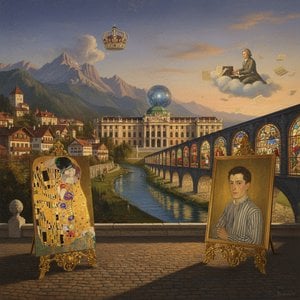
The Enigmatic Beauty of Koloman Moser’s Ornamental Box
Koloman Moser's "Ornamental Box," crafted in 1906 for the esteemed Wiener Werkstätte, is more than simply a decorative object; it’s a miniature world brimming with intricate detail and symbolic resonance. This exquisite piece, now meticulously reproduced, offers a captivating glimpse into the heart of Vienna Secession art – a movement that sought to elevate design beyond mere functionality, embracing instead a holistic approach where every element contributed to a unified aesthetic experience. The box itself is a testament to Moser’s genius, showcasing his mastery of both geometric precision and organic flourish, creating a harmonious blend of classical restraint and Art Nouveau exuberance.
At first glance, the box presents a striking visual feast. Its rectangular form, rendered in gleaming silver, immediately draws the eye. However, it's the surface ornamentation that truly captivates. Moser’s design is a symphony of meticulously crafted elements: stylized leaf tendrils, delicately embossed and chased to create a tactile sense of depth; vibrant cabochon gemstones – blues, reds, and greens – embedded within these leafy patterns, adding flashes of jewel-toned brilliance. But the true magic lies in the front panel, where a series of charming young men, rendered in enamel paint, are depicted engaged in playful activities. These figures aren’t merely decorative; they represent a deliberate nod to classical mythology and humanist ideals, suggesting themes of youth, vitality, and the pursuit of pleasure – values central to the Viennese artistic spirit of the era.
A Masterpiece of Wiener Werkstätte Design
The "Ornamental Box" stands as a pivotal work within the history of the Wiener Werkstätte. Founded in 1903 by a collective of artists and designers, including Josef Hoffmann, Adolf Drahcs, and Emil Hellenthal, the Werkstätte aimed to create a comprehensive design environment encompassing furniture, textiles, ceramics, jewelry, and more. Moser’s contribution was particularly significant, as he served as the workshop's chief graphic designer and played a crucial role in establishing its distinctive visual identity. The box exemplifies the Werkstätte’s core principles: an emphasis on craftsmanship, innovative use of materials, and a commitment to creating objects that were both beautiful and functional.
The choice of silver is deliberate, reflecting the Werkstätte's fascination with precious metals and their association with luxury and refinement. The intricate embossing technique employed by Moser demonstrates a remarkable level of skill and patience – each leaf, each gemstone, painstakingly rendered by hand. Furthermore, the incorporation of enamel paint adds another layer of complexity to the design, allowing for vibrant colors and detailed imagery that would have been difficult or impossible to achieve with other materials. This combination of techniques showcases the Werkstätte’s dedication to pushing the boundaries of traditional craftsmanship.
Symbolism and Artistic Context
To fully appreciate the "Ornamental Box," it's essential to understand its historical context within Vienna at the turn of the 20th century. The city was a vibrant hub of artistic innovation, attracting artists, architects, and designers from across Europe. The Secession movement, spearheaded by Gustav Klimt and other prominent figures, challenged traditional academic art practices and advocated for a new aesthetic that embraced modernity and experimentation. Moser’s work reflects this spirit of rebellion, as he sought to create designs that were both visually striking and conceptually sophisticated.
The depiction of youthful figures on the box can be interpreted through several lenses. Some scholars suggest they represent an idealized vision of human potential, while others see them as a subtle commentary on the social conventions of the time. The inclusion of a clock within the design adds another layer of symbolism, perhaps representing the passage of time and the fleeting nature of beauty. The overall effect is one of carefully orchestrated visual poetry, inviting contemplation and sparking the imagination.
A Timeless Treasure – Reproduction and Legacy
Today, Koloman Moser’s “Ornamental Box” remains a highly sought-after piece of art history. Its exquisite craftsmanship, striking design, and rich symbolism continue to captivate collectors and interior designers alike. WahooArt is proud to offer meticulously crafted reproductions that faithfully capture the essence of this iconic masterpiece. Each reproduction utilizes the highest quality materials and printing techniques, ensuring that you can enjoy the beauty and artistry of Moser’s work in your own home.
Whether you are an art enthusiast, a collector seeking a unique addition to your collection, or simply someone who appreciates exceptional design, the "Ornamental Box" is sure to be a treasured possession for years to come. It's a tangible link to Vienna’s golden age of artistic innovation – a reminder that beauty and creativity can flourish when they are pursued with passion and precision.



 Ver en contexto
 Comprar pintura hecha a mano
 Enviar
 Compartir
 Detalles

 Descargar
 Similares
 Radiografía
 Presentación de diapositivas
 Estadísticas


 Ver más






































 La opción de vidrio solo está disponible en tamaños inferiores a 110 cm.


![Decorative Fabric [“bird Bülow”] — Koloman Moser, Secessionism](/media/artworks/images-thumb/fd/12/fd12986dc9b8c66b01e8a0df45e366d6.jpg)