Kazimir Malevich: A Pioneer of Abstract Art
Kazimir Severinovich Malevich (February 23, 1879 – May 15, 1935) stands as a monumental figure in the history of art, recognized globally for his groundbreaking contribution to abstract expressionism and his unwavering belief in the transformative power of pure artistic feeling. Born in Kyiv Oblast, Ukraine, to Polish parents, Malevich’s formative years instilled within him an appreciation for Ukrainian folk culture—a heritage that subtly influenced his artistic vision. His pursuit of formal training began in Kyiv but quickly propelled him toward Moscow and, ultimately, into the vibrant crucible of European avant-garde movements. This journey exposed him to Impressionism, Symbolism, Cubism, and Fauvism, experiences that served as stepping stones towards forging his distinctive style—a style characterized by radical simplicity and uncompromising dedication to geometric abstraction.
## Early Life and Influences
Malevich’s upbringing fostered a deep connection with the rural Ukrainian landscape and its traditions. These influences subtly permeated his artistic sensibilities, shaping his understanding of visual language and informing his later explorations into non-representational art forms. His fascination with Russian folklore and mythology—particularly tales of heroic figures and mystical landscapes—provided inspiration for recurring motifs in his oeuvre. He was particularly drawn to the ideas of Nikolai Konstantinovich Mikhailovskii, whose writings on Russian peasant culture championed the notion that art should reflect the soul of its people. This conviction would become a cornerstone of Malevich’s artistic philosophy.
## Artistic Development & Key Movements
Before embracing Suprematism, Malevich experimented with diverse styles—Impressionism, Symbolism, Cubism, and Fauvism—demonstrating an intellectual curiosity that transcended stylistic conventions. However, it was his encounter with the Parisian avant-garde in 1912 that irrevocably altered his artistic trajectory. The influence of Cézanne’s geometric simplification and Picasso’s fractured perspectives ignited within him a desire to liberate painting from the constraints of depicting reality—a yearning for an art form liberated from illusionistic representation. This impulse culminated in his pivotal involvement with Cubism, where he collaborated closely with Pablo Picasso and Georges Braque on groundbreaking projects that challenged conventional notions of spatial perspective.
## Suprematism: The Birth of Pure Feeling
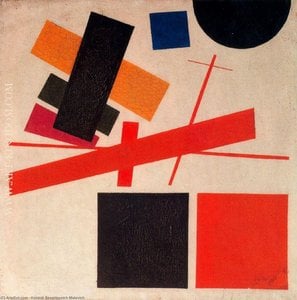
Malevich’s revolutionary breakthrough arrived in 1915 with *Black Square*, arguably the foundational work of Suprematism—a movement he established as a response to the prevailing artistic trends of his time. Rejecting representational art altogether, Malevich sought to express “the supremacy of pure feeling” through basic geometric forms—primarily squares and rectangles—arranged on a monochrome canvas. This audacious decision signaled a decisive break from tradition and embodied Malevich’s conviction that art should transcend mere imitation of nature, accessing instead the realm of spiritual truth. He famously declared: "I have overcome the lining of the colored sky."
## Technique & Materials
Executed in oil paint on canvas, *Black Square* exemplifies Malevich's meticulous attention to detail and his mastery of geometric rendering—a technique honed through years of experimentation with various artistic mediums. The artist employed a subtle layering process, applying thin washes of pigment onto the canvas surface to achieve an ethereal luminosity that belied its austere appearance. Careful brushstrokes contribute to textural nuances, grounding the abstract forms in a tangible reality while simultaneously conveying a sense of dynamism and visual intrigue. Malevich’s unwavering commitment to simplicity—reducing painting to its elemental components—served as a guiding principle throughout his artistic career.
## Historical Context: The Russian Revolution & Artistic Transformation
Malevich's artistic vision was inextricably linked to the tumultuous socio-political landscape of Russia during the early 20th century—specifically, the outbreak of the Bolshevik Revolution in 1917. Witnessing firsthand the upheaval and violence that engulfed the nation fueled his desire to create an art form capable of articulating the profound transformations occurring within Russian society. He believed Suprematism could serve as a vehicle for expressing the spiritual aspirations of the revolutionary era—a belief solidified by his association with Vladimir Lenin and Leon Trotsky, who championed avant-garde artistic experimentation as a means of advancing socialist ideals. Malevich’s uncompromising stance on artistic freedom resonated deeply with fellow artists and intellectuals who sought to redefine the role of art in shaping cultural consciousness.
## Symbolism & Emotional Resonance
Despite its apparent lack of recognizable imagery—a deliberate rejection of representational conventions—*Black Square* is laden with symbolic significance. The black square itself represents emptiness, negation, and the annihilation of traditional artistic hierarchies—a visual metaphor for Malevich’s desire to dismantle established aesthetic norms and liberate art from the shackles of illusionistic representation. Simultaneously, it embodies the concept of “zero”—the primordial state from which all creation emerges—reflecting Malevich's conviction that Suprematism offered a pathway toward accessing a deeper level of consciousness. The artwork invites contemplation on themes of spirituality, transcendence, and the fundamental nature of artistic expression—themes that continue to inspire artists and viewers alike.
## Impact & Legacy
Kazimir Malevich’s Suprematism profoundly influenced subsequent generations of artists—establishing itself as a cornerstone of abstract art history and shaping movements like Minimalism and Conceptual Art. His pioneering exploration of geometric abstraction challenged conventional notions of visual perception and artistic representation, paving the way for radical innovations in artistic practice. Malevich's unwavering belief in the transformative power of pure form—a conviction that underpinned his entire artistic philosophy—remains a testament to his enduring legacy as one of the most visionary artists of the 20th century. His work continues to provoke debate and inspire creativity, ensuring that Kazimir Malevich’s contribution to art history will endure for centuries to come.



 Vista previa
 Encargar reproducción pintada a mano
 Compartir
 Compartir
 Ver detalles
 Guía
Guía

 Descargar
 Ver artículos similares
 Radiografía
 Presentación de diapositivas
 Estadísticas

 Leer más






































 La opción de vidrio solo está disponible en tamaños inferiores a 110 cm.




![Circulo Negro [1913]](/media/artworks/images-thumb/62/67/6267e452b0c8476772a6511e19ce1616.jpg)


