Vista previa Vista previa en RA Encargar reproducción pintada a mano Ver versión en imagen digital Compartir
Ver detalles Guía Añadir a favoritos Descargar Ver artículos similares Radiografía Presentación de diapositivas Estadísticas

Untitled

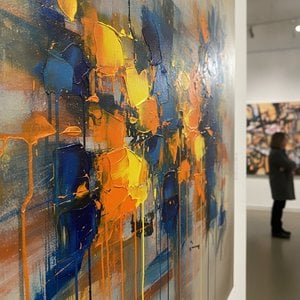
Experience the vibrant energy of Karel Appel's COBRA masterpiece; this abstract burst of color captures raw instinct from 1960—discover your own artistic freedom.

Descubre Karel Appel, fundador de CoBrA. Explora su arte audaz y expresivo, lleno de color y un espíritu poético único en la pintura moderna.

La obra de arte que se muestra en esta página está protegida por las leyes de propiedad intelectual, lo que significa que no podemos crear ni vender legalmente una reproducción idéntica. Esta protección se hace cumplir en virtud de acuerdos internacionales como el Convenio de Berna y por las leyes nacionales, incluidas aquellas establecidas por el Ley de derechos de autor de los EE. UU. - Título 17.

Este método cumple plenamente con las normativas de derechos de autor, ya que no implica la copia ni la duplicación de la obra protegida. En su lugar, se trata de una reinterpretación creativa: una nueva pintura influenciada por la original, pero que no es idéntica a ella.

Giclée / Impresión de arte

Impresiones giclée o en lienzo de calidad de museo con producción rápida y opciones de acabado flexibles. ( Encargar reproducción pintada a mano Ver versión en imagen digital)

Corner sample of the P118B picture frame: moulded polystyrene, 5 cm wide and 3 cm thick
P118B €10
Corner sample of the P118H picture frame: moulded polystyrene, 5 cm wide and 3 cm thick
P118H €10
Corner sample of the P118W picture frame: moulded polystyrene, 5 cm wide and 3 cm thick
P118W €10
Corner sample of the P438Z picture frame: moulded polystyrene, 5.5 cm wide and 3.5 cm thick
P438Z €10
Corner sample of the P508JH picture frame: moulded polystyrene, 7 cm wide and 3.5 cm thick
P508JH €12
Corner sample of the P508YH picture frame: moulded polystyrene, 7 cm wide and 3.5 cm thick
P508YH €12
Corner sample of the P805H picture frame: moulded polystyrene, 5 cm wide and 3.5 cm thick
P805H €10
Corner sample of the P805Z picture frame: moulded polystyrene, 5 cm wide and 3.5 cm thick
P805Z €10
Corner sample of the P919BZ picture frame: moulded polystyrene, 7 cm wide and 3.5 cm thick
P919BZ €10
Corner sample of the P919G picture frame: moulded polystyrene, 7 cm wide and 3.5 cm thick
P919G €10
Corner sample of the P919XJ picture frame: moulded polystyrene, 7 cm wide and 3.5 cm thick
P919XJ €10
Corner sample of the P959ZH picture frame: moulded polystyrene, 5 cm wide and 3 cm thick
P959ZH €10
Corner sample of the P968JZ picture frame: moulded polystyrene, 6 cm wide and 4 cm thick
P968JZ €12
Corner sample of the W106C picture frame: solid wood, 5 cm wide and 3 cm thick
W106C €8
Corner sample of the W218G picture frame: solid wood, 5 cm wide and 3 cm thick
W218G €10
Corner sample of the W218JH picture frame: solid wood, 5 cm wide and 3 cm thick
W218JH €8
Corner sample of the W218Y picture frame: solid wood, 5 cm wide and 3 cm thick
W218Y €10
Corner sample of the W307PJ picture frame: solid wood, 6 cm wide and 3 cm thick
W307PJ €10
Corner sample of the W316G picture frame: solid wood, 6 cm wide and 3 cm thick
W316G €10
Corner sample of the W316PJ picture frame: solid wood, 6 cm wide and 3 cm thick
W316PJ €8
Corner sample of the W316Y picture frame: solid wood, 6 cm wide and 3 cm thick
W316Y €10
Corner sample of the W398PJ picture frame: solid wood, 5 cm wide and 3 cm thick
W398PJ €8
Corner sample of the W4111J picture frame: solid wood, 6.5 cm wide and 3.5 cm thick
W4111J €10
Corner sample of the W500HY picture frame: solid wood, 7 cm wide and 5 cm thick
W500HY €15
Corner sample of the W500JH picture frame: solid wood, 7 cm wide and 5 cm thick
W500JH €15
Corner sample of the W692G picture frame: solid wood, 8 cm wide and 4 cm thick
W692G €12
Corner sample of the W849H picture frame: solid wood, 5 cm wide and 3 cm thick
W849H €8
Corner sample of the W940BG picture frame: solid wood, 7.5 cm wide and 4.5 cm thick
W940BG €15
Corner sample of the W953PJ picture frame: solid wood, 6 cm wide and 3.5 cm thick
W953PJ €8

Estándar
personalizado
CM
INCH

Elija entre nuestros tamaños predefinidos que respetan las proporciones originales de la obra.

ancho
altura

Puede introducir sus propias dimensiones para adaptarse a un marco o espacio específico. Si el tamaño seleccionado no coincide con las proporciones de la imagen original, recortaremos la obra de arte o extenderemos la imagen con un borde con efecto espejo o de color sólido. Se enviará una maqueta digital para su aprobación antes de que comience la producción.
Tenga en cuenta que la vista previa en pantalla no refleja el recorte o la extensión real. Solo la maqueta mostrará con precisión la composición final.
Aunque existen tamaños personalizados, recomendamos seleccionar una dimensión de la lista predefinida para preservar las proporciones originales.

Envío a todo el mundo () en 2 semanas en lugar de las 4/5 semanas estándar. (11 octubre)

Envío exprés gratuito a todo el mundo
Lienzo de lino de alta calidad
Seguro de envío completo
Garantía de reembolso de impuestos aduaneros
Garantía de fidelidad cromática exacta
Política de devolución de 100 días (solo por defectos)
Garantía de devolución del 100% del dinero
Oferta por volumen

Precio total

€ 59

Untitled

Giclée / Impresión de arte

Tamaño de la reproducción

-

Precio total

€ 59

Datos clave

  • Artistic style: Abstract Expressionism
  • Movement: COBRA
  • Artist: Karel Appel
  • Title: Untitled
  • Year: 1960
  • Subject or theme: Organic shapes
  • Medium: Screenprint

Cuestionario de arte

Cada pregunta tiene una única respuesta correcta.

Pregunta 1:
What avant-garde movement is Karel Appel strongly associated with for this artwork?
Pregunta 2:
Which element of the artwork's composition is described as eschewing traditional perspective?
Pregunta 3:
According to the description, what emotion is often symbolized by the color yellow in Appel's work?
Pregunta 4:
What type of forms populate the artwork, described as rounded and organic, reminiscent of natural elements?
Pregunta 5:
What medium is the artwork most likely to be, given the visible layering and texture?

A Symphony of Spontaneity: The Primal Energy of Karel Appel

In the landscape of post-war European modernism, few voices resonate with as much raw, unbridled vitality as that of Karel Appel. His 1960 work, Untitled, serves as a breathtaking manifesto of the COBRA movement, an avant-garde collective that sought to strip away the suffocating layers of academic tradition in favor of something far more primal. To encounter this piece is to witness a deliberate rebellion; it is not merely a composition of pigment on paper, but an explosion of instinctual expression. The artwork captures a moment where the artist’s hand moves with the freedom of a child, yet carries the profound weight of a man navigating a world recovering from the shadows of conflict. Through its vibrant palette and gestural urgency, the work invites the viewer into a realm where emotion dictates form, and where the boundaries between the creator and the canvas dissolve into pure, rhythmic motion.

The visual language of this masterpiece is defined by its biomorphic forms—organic, rounded shapes that seem to pulse with an internal life force. There is no rigid geometry here, nor any attempt at traditional perspective; instead, Appel utilizes an asymmetrical arrangement where colors and shapes overlap in a dance of beautiful chaos. The palette is nothing short of celebratory, dominated by sun-drenched yellows, deep oceanic blues, and fiery reds, all anchored by bold strokes of black and punctuated by flashes of orange and white. These colors are not merely decorative choices but are deeply symbolic; the yellow radiates an infectious optimism, while the blue offers a moment of contemplative stillness amidst the surrounding energy. This interplay of hues creates a complex textural landscape, where the visible layering of the printmaking process suggests a tactile depth that draws the eye into a continuous, wandering exploration.

Historical Resonance and Interior Inspiration

To understand the soul of this work, one must look to the historical heartbeat of the COBRA movement. Born from a desire to break free from the constraints of Surrealism and Cubism, Appel and his contemporaries looked toward the "primitive"—finding profound inspiration in African masks, tribal art, and the uninhibably honest drawings of children. This 1960 print embodies that search for authenticity, rejecting meticulous representation in favor of intuition and gesture. The technique, likely a screenprint or lithograph, allows for a fascinating tension between the flatness of the medium and the perceived movement of the brushstrokes. Each layer of ink contributes to a sense of immediacy, as if the artist’s energetic movements were captured in mid-motion, frozen forever in a state of becoming.

For the discerning collector or interior designer, this artwork offers more than just visual interest; it provides a transformative emotional atmosphere. Its lack of a singular focal point allows it to integrate seamlessly into sophisticated modern environments, acting as a dynamic anchor in a room. In a minimalist setting, its bold colors can provide a much-needed burst of life and character, while in a more eclectic space, it serves as a testament to the enduring power of the avant-garde. Owning a high-quality reproduction of this piece is an invitation to live alongside a fragment of art history—a piece that celebrates the joy of existence, the beauty of imperfection, and the eternal, restless spirit of human creativity.

Preguntas y respuestas

¿Cómo equilibra la luz y la sombra "Untitled"?

"Untitled" tiene un brillo general de bright y su luminancia es Bright Balance.

¿Cuál es la fecha de creación de "Untitled" de Karel Appel?

"Untitled" de Karel Appel fue creada en 1960.

¿Qué edad tenía Karel Appel cuando se creó "Untitled"?

Karel Appel tenía 39 años cuando creó "Untitled" en 1960. La edad se calcula a partir del año de nacimiento del artista, 1921.

¿Cómo se relacionan los colores de "Untitled" de Karel Appel con su emoción?

En "Untitled", los colores de Neutrals acompañan a un sentimiento Joyful.

¿Qué origen nacional sustenta el COBRA Expressionism de "Untitled"?

"Untitled" fue creada por Karel Appel, nacido en Países Bajos, dentro del movimiento COBRA Expressionism. El origen del artista vincula la obra al COBRA Expressionism tal como lo practicaban los artistas de Países Bajos.

¿Qué artista y qué estilo están detrás de "Untitled"?

Karel Appel creó "Untitled" dentro del movimiento COBRA Expressionism.

¿Quién creó "Untitled"?

El artista detrás de "Untitled" es Karel Appel. La obra está catalogada bajo el nombre de Karel Appel.


Biografía del artista

Primeros Años y Educación

  • Nacido: 25 de abril de 1921, Ámsterdam, Países Bajos
  • Fallecido: 3 de mayo de 2006, Zúrich, Suiza
  • Padres: Jan Appel (barbero), Johanna Chevalier (descendiente de hugonotes franceses)
  • Apodo temprano: 'Kik'
  • Primera pintura a los catorce años: una naturaleza muerta de una cesta de frutas.
  • Recibió un juego de pinturas y un caballete como regalo de cumpleaños número quince de su tío Karel Chevalier, quien también proporcionó las primeras lecciones de arte.
  • Estudió en la Rijksakademie van Beeldende Kunsten en Ámsterdam (1940-1943) durante la ocupación alemana. Conoció a sus compañeros artistas Corneille y Constant durante este tiempo, formando amistades duraderas.
  • Dejó su hogar debido a la oposición de sus padres a sus aspiraciones artísticas y para evadir la captura por parte de la policía alemana para posible trabajo forzado.

El Movimiento CoBrA y Desarrollo Artístico

  • Primera exposición en Groningen (1946).
  • Participación significativa en la exposición del Stedelijk Museum Amsterdam en 1949, lo que generó controversia y debate público.
  • Influencias: Pablo Picasso, Henri Matisse, Jean Dubuffet.
  • Comenzó a esculpir en 1947 utilizando materiales encontrados (técnica de ensamblaje), pintándolos con colores vibrantes como blanco, rojo, amarillo, azul y negro.
  • Se unió al Experimentele Groep con Anton Rooskens, Theo Wolvecamp y Jan Nieuwenhuys; más tarde se unió Hugo Claus.

  • Co-fundador de CoBrA (Copenhague, Bruselas, Ámsterdam) en 1948 junto a Corneille, Constant, Jan Nieuwenhuys y Christian Dotremont.
  • El estilo artístico de CoBrA enfatizaba la espontaneidad, las imágenes infantiles y un rechazo de las convenciones artísticas tradicionales. Inspirado por la mitología danesa y nórdica.
  • Creó el controvertido fresco "Niños que Cuestionan" (1949) para el Ayuntamiento de Ámsterdam, que luego fue cubierto debido a la indignación pública.

Reconocimiento Internacional y Carrera Posterior

  • Se mudó a París en 1950 después de enfrentar reacciones negativas al CoBrA en los Países Bajos.
  • Desarrolló una reputación internacional a través de viajes a México, EE. UU., Yugoslavia y Brasil.
  • Vivió y trabajó en la ciudad de Nueva York y Florencia.
  • Primera exposición en galería estadounidense en la Martha Jackson Gallery (1954).
  • La pintura "Niño y Bestia II" (1951) fue destacada en la influyente exposición del Museo de Arte Moderno “La Nueva Década” (1955).
  • Conocido por su trabajo de murales.
  • Experimentó un resurgimiento de popularidad en los Países Bajos después de 1990, con importantes exposiciones en Ámsterdam y Bruselas organizadas por Rudy Fuchs.
  • Su obra fue destacada en el Museo CoBrA en Amstelveen.

Legado y Reconocimiento

  • Estableció la Fundación Karel Appel para preservar sus obras de arte y promover la conciencia pública de su obra.
  • Experimentó una pérdida temporal de obras de arte en 2002, que fueron recuperadas en 2012.
  • La Fundación Karel Appel sirve como su patrimonio e imagen oficial.
  • Representante estadounidense de derechos de autor para la fundación es The Artists Rights Society.
  • La obra de Appel continúa siendo exhibida internacionalmente y sigue siendo una contribución significativa al arte europeo de posguerra, particularmente dentro del movimiento CoBrA.
Karel Appel

Karel Appel

1921 - 2006 , Países Bajos

Datos clave

  • Artistas Que Influyeron:
    • Pablo Picasso
    • Henri Matisse
    • Jean Dubuffet
  • Fecha De Fallecimiento: 3 de mayo de 2006
  • Fecha De Nacimiento: 25 de abril de 1921
  • Influenciado A:
    • CoBrA
    • Arte expresionista
  • Lugar De Nacimiento: Ámsterdam, Países Bajos
  • Movimiento Artístico: CoBrA, Expresionismo abstracto
  • Nacionalidad: Neerlandés
  • Nombre Completo: Christiaan Karel Appel
  • Obras Notables:
    • Niño y Bestia II (1951)
    • ¿Cuestionan los niños?