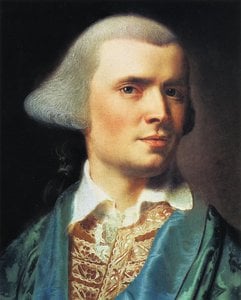
A Portrait of Refined Dignity: John, 2nd Viscount Dudley and Ward by John Singleton Copley
John Singleton Copley’s “John, 2nd Viscount Dudley and Ward,” painted in 1803, is more than a simple portrait; it's a meticulously crafted window into the burgeoning Neo-Classical aesthetic of early 19th-century England. Executed with remarkable precision on canvas, this work captures not just the physical appearance of its subject but also an underlying sense of order and moral composure – hallmarks of Copley’s distinctive style. Measuring 142 x 118 cm, the painting immediately draws the eye to the imposing figure of John Dudley and Ward, a gentleman rendered with a deliberate formality that speaks volumes about the societal expectations of the era.
The Artist's Hand: Copley’s Neo-Classical Vision
Copley, born in Boston in 1738, was a pivotal figure bridging the artistic traditions of Britain and America. His work reflects a conscious effort to emulate the classical ideals championed by artists like Raphael and Poussin, yet infused with a distinctly American sensibility. Notice the careful arrangement of the subject’s attire – the rich red coat adorned with gold trim, a symbol of status and authority, is presented with an almost sculptural quality. The black wig, a fashionable accessory for gentlemen at the time, adds to the formality, while the subtle use of light and shadow creates a sense of depth and volume, enhancing the realism of the portrait.
Symbolism in Detail: Apples, Plants, and Observation
Beyond the formal portraiture lies a wealth of symbolic detail. The three apples scattered throughout the composition are particularly noteworthy. In classical art, apples frequently represent knowledge, temptation, or even immortality – themes that resonate with the sitter’s position within society. The potted plants flanking the figure further contribute to the scene's visual richness and suggest an appreciation for nature and cultivated beauty. The subject’s gaze, directed slightly off-camera, invites the viewer into the painting, creating a sense of shared observation and subtly suggesting a contemplative mood.
Historical Context and Legacy
"John, 2nd Viscount Dudley and Ward" stands as a testament to Copley’s skill and his place within the broader artistic landscape. Created during a period of significant social and political change in Britain, the painting reflects the values of the elite – order, decorum, and an appreciation for classical ideals. Copley's influence extended far beyond Boston; his portraits are held in prestigious collections across Europe and America, including the Museum of Fine Arts in Boston and the Art Institute of Chicago. This piece exemplifies Copley’s ability to capture not just a likeness but also the spirit of an age, solidifying his legacy as one of the most important portrait painters of his time.



 Vista previa
 Encargar reproducción pintada a mano
 Compartir
 Compartir
 Ver detalles
 Guía
Guía

 Descargar
 Ver artículos similares
 Radiografía
 Presentación de diapositivas
 Estadísticas


 Leer más






































 La opción de vidrio solo está disponible en tamaños inferiores a 110 cm.