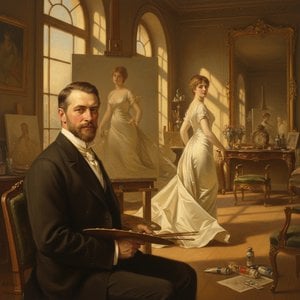
Óleo sobre lienzo pintado a mano en el tamaño y marco de su elección, realizado por encargo por nuestros artistas. ( Cambiar a formato impreso
Ver versión en imagen digital)
Elija entre nuestros tamaños predefinidos que respetan las proporciones originales de la obra.
Puede ingresar sus propias dimensiones para adaptarse a un marco o espacio específico. Si el tamaño seleccionado no coincide con las proporciones de la imagen original, recortaremos la obra o extenderemos la pintura con elementos adicionales pintados a mano. Se le enviará una maqueta digital para su aprobación antes de comenzar la producción.
Tenga en cuenta que la vista previa en pantalla no refleja el recorte o la extensión reales. Solo la maqueta mostrará con precisión la composición final.
Si bien existen tamaños personalizados, recomendamos seleccionar una dimensión de la lista predefinida para preservar las proporciones originales.
Envío a todo el mundo () en 3-4 semanas en lugar de las 5 semanas estándar. (19 septiembre). Sin comprometer la calidad.
Gondolier
Tamaño de la reproducción
In the heart of 1905, amidst the shimmering canals and sun-drenched facades of Venice, John Singer Sargent captured a moment that transcends the boundaries of mere portraiture. His masterpiece, Gondolier, is far more than a depiction of a working man; it is an evocative window into the soul of the Belle Épone. As the viewer encounters this oil on canvas, they are immediately met by the steady, contemplative gaze of a man whose very presence seems to anchor the fluid, ever-changing atmosphere of the Venetian lagoon. There is a profound stillness in his expression, a quiet dignity that suggests a lifetime of navigating both the physical currents of the city and the deeper, unseen tides of human thought.
Sargent, an artist renowned for his ability to capture the opulence of high society, pivots here toward a more grounded, intimate realism. While his contemporaries often sought the idealized, Sargent found beauty in the authentic. The subject, dressed in a dark, heavy coat and hat, stands as a sentinel of tradition against the backdrop of a city in transition. The subtle textures of his attire—the weight of the fabric and the meticulous rendering of his facial hair—demonstrate a technical virtuosity that honors the grit and grace of the Venetian working class.
What truly elevates Gondolier is Sargent’s masterful command over light, a hallmark of his unique stylistic synthesis. While the foundation of the work is rooted in the precision of Realism, there is an undeniable pulse of Impressionism flowing through the brushstrokes. The artist employs a diffused luminescence that washes over the subject, creating a soft, atmospheric glow that mirrors the humid, salt-kissed air of Italy. This light does not merely illuminate; it breathes life into the scene, casting delicate shadows that lend a three-dimensional depth to the man’s features.
Observe how the technique shifts when capturing the periphery of the subject. In the reflections upon the water and the distant architectural elements, Sargent utilizes more spontaneous, fluid strokes. This creates a captivating tension between the solid, unmoving presence of the gondolier and the shimmering, ephemeral nature of his environment. For the collector or interior designer, this duality offers a remarkable visual rhythm, making the piece equally suited for a quiet study where introspection is encouraged, or a grand salon where it can serve as a focal point of sophisticated movement.
To possess a reproduction of Gondolier is to invite the historical romance of the early 20th century into a modern space. The painting serves as a bridge between eras, embodying the technical brilliance of the Gilded Age and the emotional depth of a man lost in thought. It is a piece that demands attention not through loudness, but through its quiet, commanding intensity. Its palette of deep tones and luminous highlights provides a versatile anchor for diverse interior aesthetics, from classical European elegance to contemporary minimalist luxury.
For those seeking to curate an environment filled with narrative and soul, this work offers unparalleled inspiration. It is a testament to Sargent’s ability to find the extraordinary within the ordinary, reminding us that even in a single, frozen moment of a laborer's day, there lies a universe of light, history, and human emotion. Whether as a tribute to the artistry of John Singer Sargent or as a centerpiece for a curated collection, Gondolier remains an eternal icon of the Venetian spirit.
John Singer Sargent (1856-1925) fue un artista expatriado estadounidense considerado el “pintor de retratos líder” de su generación, para la sociedad de la clase alta eduardiana. Su obra encarna una mezcla única de brillantez técnica, influencias impresionistas e insight psicológico.
Nacido el 12 de enero de 1856 en Florencia, Italia, de padres estadounidenses Fitzwilliam y Mary Newbold Sargent, John Singer Sargent experimentó una infancia nómada. Sus padres eran expatriados que se mudaban con frecuencia entre Francia, Alemania, Italia y Suiza. Este estilo de vida fomentó una amplia conciencia cultural, pero significó una educación menos convencional. En lugar de escolarización formal, la educación temprana de Sargent se centró en visitar museos e iglesias por toda Europa.
En 1874, Sargent comenzó a estudiar con el artista francés de retratos Carolus-Duran en París. Esta mentoría resultó fundamental. Duran enfatizó la pintura directa – una técnica de aplicación de pintura sin bocetos preliminares – que afinó la notable destreza técnica de Sargent y su capacidad para capturar rasgos con asombrosa rapidez y precisión.
La producción artística de Sargent se puede dividir ampliamente en dos categorías: retratos encargados e estudios informales. Su retrato formal, a menudo representando a las ricas y prominentes figuras de su tiempo, se adhería a la tradición del “estilo grandioso” – enfatizando la elegancia, el estatus y la profundidad psicológica.
Sin embargo, Sargent también persiguió un estilo más personal en sus paisajes y estudios al aire libre. Estas obras demuestran una clara afinidad con el Impresionismo, caracterizado por pinceladas sueltas, paletas de colores vibrantes y un énfasis en capturar momentos fugaces de luz y atmósfera.
Sargent fue influenciado por una diversa gama de artistas y movimientos:
Inicialmente, Sargent enfrentó críticas por su enfoque poco convencional del retrato y su disposición a desafiar las normas artísticas tradicionales. Sin embargo, a principios del siglo XX, se había establecido como uno de los principales artistas de su tiempo.
En la década de 1980, hubo una reevaluación significativa de la obra de Sargent, particularmente sus desnudos masculinos previamente desatendidos. Esta redescubrimiento reveló un artista más complejo y matizado de lo que se había entendido anteriormente. Hoy en día, John Singer Sargent es celebrado por su virtuosismo técnico, su capacidad para capturar el espíritu de su época y su contribución perdurable al arte estadounidense.
Sus pinturas ofrecen una ventana fascinante a la lujos y las dinámicas sociales de la era eduardiana, mientras que también reflejan su propia visión artística personal. Su obra continúa inspirando a artistas y cautivando a audiencias en todo el mundo.
1856 - 1925 , Italia