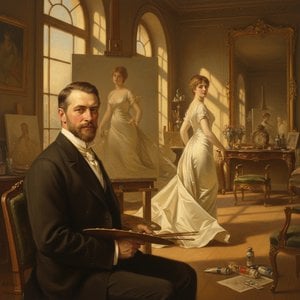
John Singer Sargent: Una Vida en el Arte
John Singer Sargent (1856-1925) fue un artista expatriado estadounidense considerado el “pintor de retratos líder” de su generación, para la sociedad de la clase alta eduardiana. Su obra encarna una mezcla única de brillantez técnica, influencias impresionistas e insight psicológico.
Vida Temprana y Formación
Nacido el 12 de enero de 1856 en Florencia, Italia, de padres estadounidenses Fitzwilliam y Mary Newbold Sargent, John Singer Sargent experimentó una infancia nómada. Sus padres eran expatriados que se mudaban con frecuencia entre Francia, Alemania, Italia y Suiza. Este estilo de vida fomentó una amplia conciencia cultural, pero significó una educación menos convencional. En lugar de escolarización formal, la educación temprana de Sargent se centró en visitar museos e iglesias por toda Europa.
En 1874, Sargent comenzó a estudiar con el artista francés de retratos Carolus-Duran en París. Esta mentoría resultó fundamental. Duran enfatizó la pintura directa – una técnica de aplicación de pintura sin bocetos preliminares – que afinó la notable destreza técnica de Sargent y su capacidad para capturar rasgos con asombrosa rapidez y precisión.
Carrera Artística y Estilo
La producción artística de Sargent se puede dividir ampliamente en dos categorías: retratos encargados e estudios informales. Su retrato formal, a menudo representando a las ricas y prominentes figuras de su tiempo, se adhería a la tradición del “estilo grandioso” – enfatizando la elegancia, el estatus y la profundidad psicológica.
Sin embargo, Sargent también persiguió un estilo más personal en sus paisajes y estudios al aire libre. Estas obras demuestran una clara afinidad con el Impresionismo, caracterizado por pinceladas sueltas, paletas de colores vibrantes y un énfasis en capturar momentos fugaces de luz y atmósfera.
Obras Maestras y Logros
- Madame X (1884): Quizás la obra más famosa de Sargent, este retrato causó controversia por su audaz representación de la socialite Virginie Amélie Avegno Gautreau.
- El Jaleo (1882): Una escena dinámica y colorida que captura una danza flamenca española, mostrando el dominio de Sargent del movimiento y la luz.
- Carnación, Lily, Lily, Rose (1886): Un cuadro sereno e evocador que representa a dos jóvenes chicas encendiendo faroles en un jardín inglés.
- Una Mesa de Cena por la Noche (1882-83): Una composición innovadora que captura la atmósfera íntima de una cena utilizando luz artificial.
Influencias
Sargent fue influenciado por una diversa gama de artistas y movimientos:
- Carolus-Duran: Su maestro, quien le inculcó una técnica de pintura directa.
- Diego Velázquez: Sargent admiró el magistral uso de luz y pincelada de Velázquez.
- Impresionismo: La énfasis de los impresionistas en capturar momentos fugaces y efectos atmosféricos impactó profundamente en sus pinturas de paisajes.
Significado Histórico y Legado
Inicialmente, Sargent enfrentó críticas por su enfoque poco convencional del retrato y su disposición a desafiar las normas artísticas tradicionales. Sin embargo, a principios del siglo XX, se había establecido como uno de los principales artistas de su tiempo.
En la década de 1980, hubo una reevaluación significativa de la obra de Sargent, particularmente sus desnudos masculinos previamente desatendidos. Esta redescubrimiento reveló un artista más complejo y matizado de lo que se había entendido anteriormente. Hoy en día, John Singer Sargent es celebrado por su virtuosismo técnico, su capacidad para capturar el espíritu de su época y su contribución perdurable al arte estadounidense.
Sus pinturas ofrecen una ventana fascinante a la lujos y las dinámicas sociales de la era eduardiana, mientras que también reflejan su propia visión artística personal. Su obra continúa inspirando a artistas y cautivando a audiencias en todo el mundo.



 Ver en contexto
 Comprar pintura hecha a mano
 Enviar
 Compartir
 Detalles

 Descargar
 Similares
 Radiografía
 Presentación de diapositivas
 Estadísticas

 Ver más






































 La opción de vidrio solo está disponible en tamaños inferiores a 110 cm.