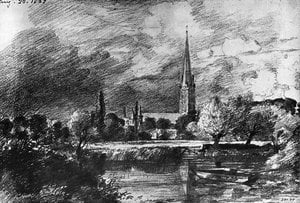
A Window into Romantic England
John Constable, a name synonymous with the English landscape tradition, stands as one of the most influential painters of his era. Born in 1776 in East Bergholt, Suffolk, he wasn’t merely capturing scenery; he was channeling the spirit of Romanticism itself onto canvas—a movement that prioritized emotion and imagination over rational thought. His formative years spent observing the rhythms of rural life, particularly the verdant Vale of Stour owned by his father, profoundly shaped his artistic vision. This early immersion in nature instilled a deep appreciation for its subtleties and an unwavering commitment to portraying it with unprecedented honesty and immediacy.
- Early Influences: Constable’s artistic journey began under the tutelage of George Beaumont, who introduced him to the works of Claude Lorrain—a master of idealized landscapes—and crucially, William Blake. These artists served as beacons of inspiration, demonstrating how art could convey profound emotional resonance.
- The Romantic Spirit Embodied: Constable’s approach differed markedly from prevailing artistic conventions. Rejecting academic formalism, he championed *plein air* painting—working outdoors directly before the subject—a technique that allowed him to capture fleeting atmospheric effects and imbue his canvases with palpable vitality.
The Dramatic Ascent of Highgate Hill
“View from Highgate Hill,” painted circa 1820, exemplifies Constable’s Romantic ideals perfectly. This monumental landscape depicts the breathtaking panorama afforded by Highgate Hill overlooking London—a scene that encapsulates the movement's fascination with sublime grandeur and its exploration of humanity’s relationship with the natural world. The painting isn’t simply a topographical record; it’s an emotional response to the vista, rendered with masterful brushstrokes and luminous color palettes.
- Composition & Light: Constable skillfully employs diagonal lines to draw the eye upwards towards the turbulent sky—a swirling expanse of clouds punctuated by shafts of sunlight that illuminate patches of meadow and distant buildings. This dramatic interplay of light and shadow creates a sense of depth and movement, mirroring the dynamism inherent in Romantic thought.
- Symbolism & Atmosphere: The sheep grazing on the hillside serve as emblems of pastoral innocence—a recurring motif in Constable’s oeuvre—while simultaneously symbolizing the enduring presence of rural life amidst urban expansion. More broadly, the painting conveys a feeling of awe and contemplation, inviting viewers to immerse themselves in the grandeur of nature.
A Legacy of Impressionistic Vision
Constable's influence extended far beyond his own lifetime, foreshadowing developments in Impressionism decades later. His willingness to prioritize subjective experience over objective representation—his insistence on capturing the “truth” of a moment—challenged established artistic dogma and paved the way for artists like Monet and Renoir to explore new expressive possibilities. "View from Highgate Hill" remains an enduring testament to Constable’s genius as a landscape artist and his unwavering devotion to conveying the emotional power of the natural world. It is a painting that continues to inspire admiration and contemplation, securing its place among the masterpieces of Romantic art history.
Experience the Beauty of “View from Highgate Hill”
At
WahooArt.com, we are proud to offer high-quality reproductions of this masterpiece, allowing you to bring the magic of Constable’s vision into your home or office. Our handmade oil paintings are meticulously crafted by skilled artisans who use only the finest materials and techniques to ensure that each piece is a true work of art. Visit
WahooArt.com today and browse our extensive selection of handmade oil paintings reproductions. With our commitment to quality and customer satisfaction, we guarantee that you will be delighted with your purchase.
Preguntas y respuestas
¿Qué colores predominan en "Vista desde Highgate Hill" de John Constable?
La identidad cromática de "Vista desde Highgate Hill" de John Constable: una paleta Tonos tierra, dominada por el Morado ciruela (#bfb7bf).
¿Qué color destaca más en "Vista desde Highgate Hill"?
El Morado ciruela (#bfb7bf) es el color predominante de "Vista desde Highgate Hill" de John Constable.
¿Dónde puedo encontrar estadísticas sobre "Vista desde Highgate Hill" de John Constable?
Existe una página de Estadísticas para "Vista desde Highgate Hill". En ella se registran las visitas mensuales de la obra y de otras obras del artista, con desgloses por país e idioma.



 Vista previa
 Encargar reproducción pintada a mano
 Compartir
 Compartir
 Ver detalles
 Guía
Guía

 Descargar
 Ver artículos similares
 Radiografía
 Presentación de diapositivas
 Estadísticas
 Leer más






































 La opción de vidrio solo está disponible en tamaños inferiores a 110 cm.