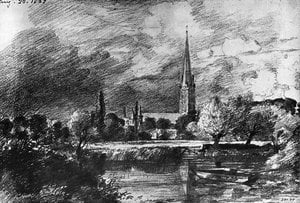
John Constable's 'Tree Trunks': A Symphony of Light and Landscape
John Constable’s ‘Tree Trunks’, painted in 1824, stands as an emblem of Romanticism—a movement that fundamentally reshaped the artistic landscape of Britain and beyond. More than just a depiction of trees; it’s a profound meditation on nature's sublime beauty and the artist’s intimate connection to his surroundings. Constable wasn’t merely observing; he was feeling, translating the subtle nuances of light and atmosphere onto canvas with unparalleled sensitivity—a characteristic that distinguishes him from earlier Neoclassical painters who prioritized idealized forms over emotional resonance.
The painting captures a close-up view of tree trunks and branches bathed in dappled sunlight filtering through the foliage above. This seemingly simple composition belies a complex interplay of observation and artistic interpretation. Constable meticulously rendered the textures of bark, capturing the rough surface and subtle variations in color with remarkable precision—a technique that anticipates Impressionism’s focus on capturing fleeting moments of visual experience.
Romanticism Embodied: Emotion and Observation
Constable's approach to landscape painting aligns perfectly with the core tenets of Romanticism. Unlike his predecessors who sought to impose rational order onto nature, Constable embraced its spontaneity and unpredictability. He believed that art should evoke emotion—that it should transport the viewer into the artist’s world—and ‘Tree Trunks’ succeeds admirably in achieving this goal. The painting isn't merely aesthetically pleasing; it communicates a palpable sense of tranquility and wonder.
The scene unfolds near Dedham Vale, Constable’s beloved home and studio, where he spent countless hours studying the rhythms of rural life. This personal connection to the landscape informs every aspect of the artwork—from the careful positioning of the tree trunks to the subtle gradations of color in the foliage. As Constable himself wrote, “I should paint my own places best,” reflecting a conviction that true artistic expression arises from immersing oneself in the natural world.
A Masterpiece of Light and Texture
The brilliance of ‘Tree Trunks’ lies primarily in Constable's masterful manipulation of light—a technique he honed throughout his career. He skillfully employed atmospheric perspective, blurring distant objects to create a sense of depth and distance while emphasizing the luminous quality of the sunlight illuminating the tree trunks. The artist’s brushstrokes are loose and expressive, conveying movement and dynamism without sacrificing detail.
- Artist: John Constable
- Year Painted: 1824
- Style: Romanticism
- Medium: Oil on Canvas
- Location: Tate Britain, London
WahooArt's Reproduction: Authenticity and Beauty
At
WahooArt, we recognize the enduring appeal of Constable’s vision—his ability to capture the essence of nature’s grandeur with breathtaking artistry. Our skilled artisans meticulously recreate each detail of ‘Tree Trunks’, ensuring an authentic representation of the original masterpiece. Experience the emotional impact and beauty of Romanticism with our
John Constable: A Cottage in a Cornfield reproduction or explore other exceptional works by
John Constable: Hadleigh Castle on our website:
Immerse yourself in the world of Romanticism and let the beauty and emotion of
John Constable’s art touch your soul.
For more information on
John Constable and his works, visit our website or explore the
artist's page. Discover how
handmade oil painting reproductions can enhance your home or office with the beauty of art.
Explore Constable’s legacy at Tate Britain: https://www.tate.org.uk/explore/artists/john-constable/
Preguntas y respuestas
¿Se encuentra "Troncos de árboles" de John Constable entre las obras más codiciadas del Este cuadro ejemplifica los ideales del Romanticis?
"Troncos de árboles" figura con un nivel de Icónico entre las obras del Este cuadro ejemplifica los ideales del Romanticis en el catálogo.
¿Existe una ficha informativa sobre "Troncos de árboles" de John Constable para estudiantes?
La guía de "Troncos de árboles" es la página Guía de la obra: una ficha imprimible que muestra la pieza con su pie de foto, línea de crédito y tabla de identidad (artista, fechas, técnica, tamaño original, colección).
¿Dónde puedo comprar una lámina de "Troncos de árboles" de John Constable?
Para obtener una impresión de "Troncos de árboles" de John Constable, simplemente pídala en esta página: una impresión de bellas artes sobre lienzo de algodón o papel de lienzo de archivo.
¿Puedo pedir una reproducción al óleo de "Troncos de árboles"?
Puede solicitar una reproducción pintada a mano de "Troncos de árboles" de John Constable directamente en esta página: una reproducción al óleo pintada a mano sobre lienzo de lino, realizada bajo pedido.
¿Qué paleta y qué sentimiento combinan "Troncos de árboles"?
"Troncos de árboles" de John Constable combina una paleta de Tonos oscuros con un tono Romántico.
¿Quién creó "Troncos de árboles"?
"Troncos de árboles" fue creada por John Constable. La información en esta página describe la obra original de John Constable.
¿De qué tamaño se recomienda "Troncos de árboles" para un Salón principal?
La combinación recomendada para "Troncos de árboles" de John Constable: una impresión de Grande en un/a Salón principal.



 Vista previa
 Encargar reproducción pintada a mano
 Compartir
 Compartir
 Ver detalles
 Guía
Guía

 Descargar
 Ver artículos similares
 Radiografía
 Presentación de diapositivas
 Estadísticas
 Leer más






































 La opción de vidrio solo está disponible en tamaños inferiores a 110 cm.