Ver en contexto Vista previa en RA Comprar pintura hecha a mano Cambiar a imagen digital Enviar
Detalles Guía Añadir a favoritos Descargar Similares Radiografía Presentación de diapositivas Preguntas y respuestas Descargar presentación Estadísticas

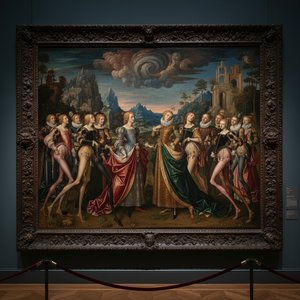
JUPITER ET DANAE

Experience Mannerist drama with Wtewael's Jupiter and Danaë, a masterpiece of divine encounter; discover this rich narrative art today.

Joachim Anthonisz Wtewael (1566-1638) fue un pintor manierista holandés conocido por sus figuras pulidas, escenas mitológicas y religiosas, y su estilo único que resistió el naturalismo. ¡Explora su cautivadora obra!

Giclée / Impresión de arte

Impresiones giclée o en lienzo de calidad de museo con producción rápida y opciones de acabado flexibles. ( Comprar pintura hecha a mano Cambiar a imagen digital)

Corner sample of the P118B picture frame: poliestireno moldeado, 5 cm wide and 3 cm thick
P118B €10
Corner sample of the P118H picture frame: poliestireno moldeado, 5 cm wide and 3 cm thick
P118H €10
Corner sample of the P118W picture frame: poliestireno moldeado, 5 cm wide and 3 cm thick
P118W €10
Corner sample of the P438Z picture frame: poliestireno moldeado, 5.5 cm wide and 3.5 cm thick
P438Z €10
Corner sample of the P508JH picture frame: poliestireno moldeado, 7 cm wide and 3.5 cm thick
P508JH €12
Corner sample of the P508YH picture frame: poliestireno moldeado, 7 cm wide and 3.5 cm thick
P508YH €12
Corner sample of the P805H picture frame: poliestireno moldeado, 5 cm wide and 3.5 cm thick
P805H €10
Corner sample of the P805Z picture frame: poliestireno moldeado, 5 cm wide and 3.5 cm thick
P805Z €10
Corner sample of the P919BZ picture frame: poliestireno moldeado, 7 cm wide and 3.5 cm thick
P919BZ €10
Corner sample of the P919G picture frame: poliestireno moldeado, 7 cm wide and 3.5 cm thick
P919G €10
Corner sample of the P919XJ picture frame: poliestireno moldeado, 7 cm wide and 3.5 cm thick
P919XJ €10
Corner sample of the P959ZH picture frame: poliestireno moldeado, 5 cm wide and 3 cm thick
P959ZH €10
Corner sample of the P968JZ picture frame: poliestireno moldeado, 6 cm wide and 4 cm thick
P968JZ €12
Corner sample of the W106C picture frame: madera maciza, 5 cm wide and 3 cm thick
W106C €8
Corner sample of the W218G picture frame: madera maciza, 5 cm wide and 3 cm thick
W218G €10
Corner sample of the W218JH picture frame: madera maciza, 5 cm wide and 3 cm thick
W218JH €8
Corner sample of the W218Y picture frame: madera maciza, 5 cm wide and 3 cm thick
W218Y €10
Corner sample of the W307PJ picture frame: madera maciza, 6 cm wide and 3 cm thick
W307PJ €10
Corner sample of the W316G picture frame: madera maciza, 6 cm wide and 3 cm thick
W316G €10
Corner sample of the W316PJ picture frame: madera maciza, 6 cm wide and 3 cm thick
W316PJ €8
Corner sample of the W316Y picture frame: madera maciza, 6 cm wide and 3 cm thick
W316Y €10
Corner sample of the W398PJ picture frame: madera maciza, 5 cm wide and 3 cm thick
W398PJ €8
Corner sample of the W4111J picture frame: madera maciza, 6.5 cm wide and 3.5 cm thick
W4111J €10
Corner sample of the W500HY picture frame: madera maciza, 7 cm wide and 5 cm thick
W500HY €15
Corner sample of the W500JH picture frame: madera maciza, 7 cm wide and 5 cm thick
W500JH €15
Corner sample of the W692G picture frame: madera maciza, 8 cm wide and 4 cm thick
W692G €12
Corner sample of the W849H picture frame: madera maciza, 5 cm wide and 3 cm thick
W849H €8
Corner sample of the W940BG picture frame: madera maciza, 7.5 cm wide and 4.5 cm thick
W940BG €15
Corner sample of the W953PJ picture frame: madera maciza, 6 cm wide and 3.5 cm thick
W953PJ €8

Tamaño estándar
a medida
CM
INCH

Elija entre nuestros tamaños predefinidos que respetan las proporciones originales de la obra.

ancho
altura

Introduzca el ancho y el alto que necesite para adaptarse a su marco o pared. Una impresión solo puede recortarse, nunca hacerse más grande que la imagen original, por lo que un tamaño con una forma distinta perderá parte de la obra. Le enviaremos una maqueta digital para su aprobación antes de realizar cualquier impresión. La imagen que se muestra en esta página no refleja el recorte real; solo la maqueta lo hace.

Envío a todo el mundo () en 2 semanas en lugar de las 4/5 semanas estándar. (8 noviembre)

Envío exprés gratuito a todo el mundo
Lienzo de lino de alta calidad
Seguro de envío total
Garantía de reembolso de aranceles aduaneros
Garantía de fidelidad cromática exacta
Política de devolución de 100 días (solo por defectos)
Garantía de devolución del 100% del dinero
Descuento por cantidad

Precio total

€ 62

JUPITER ET DANAE

Giclée / Impresión de arte

Dimensiones de la reproducción

-

Precio total final

€ 62

Datos clave

  • Subject or theme: Mythology; Divine intervention
  • Title: Jupiter et Danaë
  • Influences: Italian Renaissance
  • Location: Louvre RF 1979-23
  • Artistic style: Elegant; Detailed

Test de conocimientos artísticos

Cada pregunta tiene una única respuesta correcta.

Pregunta 1:
What artistic movement is Joachim Wtewael’s ‘Jupiter and Danaë’ primarily associated with?
Pregunta 2:
The painting depicts a mythological narrative featuring Jupiter and Danaë. What is the central theme of this story?
Pregunta 3:
What technique did Wtewael employ to achieve a rich, layered texture in ‘Jupiter and Danaë’?
Pregunta 4:
The composition of the artwork emphasizes Jupiter's descent from the heavens. How does this visual element contribute to the overall dramatic effect?
Pregunta 5:
‘Jupiter and Danaë’ draws inspiration from Renaissance art. Which artistic style is it most similar to?

Jupiter and Danaë - A Masterpiece of Mannerism

Joachim Anthonisz Wtewael’s “Jupiter and Danaë” stands as an exceptional example of Northern Mannerist painting, captivating viewers with its dramatic composition and meticulous execution. Created around 1598-1600, this monumental canvas resides in the Louvre Museum's collection (RF 1979-23), offering a glimpse into the artistic sensibilities of the late Renaissance period. The artwork depicts Zeus’s clandestine encounter with Danaë, daughter of King Acrisius of Argos, as foretold by Cronus—Zeus impregnates Danaë with golden rain, securing his lineage and ensuring the birth of Perseus, destined to slay Medusa and liberate Greece from tyranny.
  • Composition & Perspective: The painting’s vertical orientation immediately draws attention upwards towards Jupiter's imposing presence. Diagonal lines created by Zeus’s body emphasize movement and dynamism, mirroring the turbulent skies above. Despite a flattened perspective—characteristic of Mannerist style—Wtewael skillfully employs overlapping forms and subtle tonal variations to convey depth and create a sense of spatial illusion.
  • Color Palette & Lighting: Wtewael utilizes a rich color palette dominated by warm hues – reds, golds, and browns – juxtaposed against cooler blues and whites. Dramatic lighting illuminates Jupiter and Danaë’s figures, highlighting their expressions and emphasizing the central narrative. Shadows deepen the atmosphere, fostering an emotional intensity that transcends mere visual representation.
  • Technique & Texture: Executed in oil paint on canvas, Wtewael's technique demonstrates mastery of layering and blending—a hallmark of Mannerism. Visible brushstrokes contribute to a textured surface, capturing the materiality of skin, fabric, and clouds with remarkable accuracy. The artist’s meticulous attention to detail elevates the artwork beyond mere depiction, transforming it into an immersive experience for the viewer.
  • Symbolism & Emotion: Beyond its narrative content, “Jupiter and Danaë” embodies profound symbolic themes—divine intervention, fate, and heroism. Zeus's regal posture conveys authority and divine power, while Danaë’s apprehensive gaze reflects vulnerability and fear. The overall emotional impact is one of awe and wonder, capturing the sublime beauty of mythological grandeur.
  • Influence & Style: Wtewael’s work draws heavily from Italian Renaissance art, particularly the influence of artists like Michelangelo Buonarroti and Raphael Sanzio. However, he distinguishes himself through his unwavering adherence to Mannerist principles—elongated figures, exaggerated poses, and complex compositions—creating a uniquely expressive style that continues to inspire admiration today.

The painting’s enduring appeal lies in its ability to convey not only a compelling story but also an emotional resonance that speaks to universal human experiences. “Jupiter and Danaë” remains a testament to Wtewael's artistic genius—a masterpiece of Mannerism that secures its place as one of the most celebrated artworks of the sixteenth century.

Preguntas y respuestas

¿Permite los derechos de autor de "JUPITER ET DANAE" de Joachim Anthonisz Wtewael realizar reproducciones?

"JUPITER ET DANAE" de Joachim Anthonisz Wtewael, conservada en Museo del Louvre, es en el dominio público: sus derechos de autor han expirado. Este estado determina si se pueden realizar reproducciones de la imagen.

¿Dónde y para qué uso se recomienda "JUPITER ET DANAE"?

Se recomienda el uso de (Accent) y su ubicación en (Living Room) para "JUPITER ET DANAE" de Joachim Anthonisz Wtewael.

¿Cómo puedo descubrir obras de arte similares a "JUPITER ET DANAE" de Joachim Anthonisz Wtewael?

Puedes encontrar obras similares a "JUPITER ET DANAE" de Joachim Anthonisz Wtewael en la página de Obras similares de esta obra.


Biografía del artista

El pulido perdurable de un maestro manierista

Joachim Anthonisz Wtewael, un nombre pronunciado con reverencia entre los conocedores de la Edad de Oro holandesa, sigue siendo una figura cautivadora cuya obra desafía cualquier categorización sencilla. Nacido en 1566 y fallecido en 1638, su vida fue tan polifacética como sus lienzos. Si bien su genio artístico brilló con intensidad, es igualmente notable que también fue un exitoso comerciante de lino y un activo concejal de Utrecht. Esta existencia dual —el artesano meticuloso junto al pilar de la sociedad civil— sugiere a un hombre cuya vida exigía tanto perspicacia mundana como un profundo enfoque creativo. El estilo distintivo de Wtewacio, sin embargo, poseía una consistencia notable; permaneció en gran medida inalterado por las sweeping corrientes naturalistas que estaban remodelando el arte en toda Europa durante su vida.

Un viaje a través del estilo y la influencia

La formación temprana de Wtewael lo arraigó profundamente en el sofisticado vocabulario del manierismo de Haarlem de finales del siglo XVI. Su vida profesional inicial lo vio trabajando como vidriero y grabador en el taller de su padre, un aprendizaje que sin duda perfeccionó su mano para el detalle intrincado. Un período crucial llegó cuando emprendió viajes por Italia y Francia a partir de 1586. Estas estancias fueron fundamentales, exponiéndolo a las ricas corrientes artísticas de la Segunda Escuela de Fontainebleau. Sin embargo, a pesar de estas influencias, Wtewael poseía una brújula interna única. Su obra se caracteriza por figuras magistralmente dibujadas, que poseen un pulido casi de porcelana, a menudo dispuestas en poses que se sienten maravillosamente caprichosas y dramáticamente cargadas.

Profundidad temática: el mito se encuentra con la devoción

El conjunto de su obra superviviente —que comprende alrededor de cien pinturas, junto con numerosos dibujos y diseños de vitrales— revela una fascinante dualidad temática. Se sentía igualmente cómodo representando profundas narrativas religiosas que celebrando el exuberante drama de la mitología clásica. Consideremos obras como la Adoración de los Pastores yuxtapuesta con Venus y Marte sorprendidos por Vulcano. Estas piezas muestran su notable capacidad para entrelazar temas sagrados convencionales con el saber pagano, impregnando a menudo ambos reinos con un palpable, y a veces fuerte, trasfondo erótico que atrae al espectador hacia su abrazo narrativo. Su atención al detalle es asombrosa; en obras como Perseo y Andrómeda, albergada notablemente en el museo Mauritshuis en Utrecht, se puede rastrear su habilidad inigualable.

Significado histórico y legado

Lo que hace que la contribución de Wtewael sea tan significativa es precisamente esa resistencia al cambio. Mientras el naturalismo atraía a los artistas hacia un mayor realismo, Wtewael se mantuvo firme en una estética pulida e idealizada, creando un cuerpo de trabajo que se siente tanto históricamente situado como eternamente vibrante. Sus pinturas de gabinete, ejecutadas sobre planchas de cobre, son particularmente distintivas y numerosas, ofreciendo vislumbres íntimos de su proceso artístico. Aunque la última década de su vida lo vio retirarse de la pintura —un período posiblemente marcado por el dolor personal tras el fallecimiento de su esposa—, el impacto de su visión perdura. Le regaló a la historia del arte un estilo que permanece siendo, a la vez, altamente refinado y maravillosamente impredecible.

Joachim Anthonisz Wtewael

Joachim Anthonisz Wtewael

1566 - 1638 , Países Bajos

Datos clave

  • Artistic Movement Or Style: Manierismo
  • Artists Who Influenced This Artist: ['Segunda escuela de Fontainebleau']
  • Date Of Birth: 1566
  • Date Of Death: 1638
  • Full Name: Joachim Anthonisz Wtewael
  • Nationality: Neerlandés
  • Notable Artworks:
    • Adoración de los pastores
    • Venus y Marte sorprendidos por Vulcano
Explore obras de arte organizadas por temas, estilos y características.