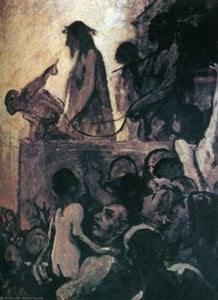
Una Vida de Arte y Activismo
Honoré-Victorin Daumier, un grabador, caricaturista, pintor y escultor francés, dejó una huella imborrable en la escena artística del siglo XIX. Nacido en Marsella el 26 de febrero de 1808 y fallecido en París el 10 de febrero de 1879, la vida de Daumier fue un testimonio de su inquebrantable dedicación a capturar la esencia de la sociedad francesa.
Primeros Años e Influencias
La primera infancia de Daumier se vio marcada por las aspiraciones poéticas de su padre, lo que llevó a la familia a mudarse a París en 1814. Esta exposición a la vibrante escena artística de la ciudad influyó en su inclinación hacia el arte. Comenzó su aprendizaje con Alexandre Lenoir y luego ingresó a la Académie Suisse.
Trayectoria Artística
La prolífica carrera de Daumier abarcó múltiples medios, incluyendo la litografía, la pintura y la escultura. Su trabajo temprano se caracterizó por contribuciones anónimas a editoriales, emulando el estilo de Charlet y mostrando un ferviente entusiasmo por la leyenda napoleónica. Tras la revolución de 1830, su arte se volvió más abiertamente político.
- Le Charivari, un periódico cómico lanzado por Charles Philipon, proporcionó una plataforma para el trabajo satírico de Daumier, apuntando a la burguesía y la incompetencia del gobierno.
- Sus caricaturas de figuras políticas y sátiras sobre el comportamiento social le valieron tanto elogios como controversias, incluyendo un encarcelamiento de seis meses en 1832.
Obras Destacadas y Legado
- Rue Transnonain, 15 de abril de 1834: Una conmovedora litografía que representa la masacre en la rue Transnoin, parte de los disturbios de abril de 1834 en París.
- Les Gens de Justice: Una satíra mordaz sobre la profesión legal, que muestra la maestría de Daumier en la caricatura.
El impacto de Daumier en la historia del arte El compromiso inquebrantable de Daumier con capturar la verdad de la sociedad francesa ha influenciado a generaciones de artistas. Su trabajo se puede encontrar en varios museos y colecciones, incluyendo los que se presentan en
WahooArt, que ofrece una visión general completa de su producción artística.
- Explore las litografías y pinturas de Daumier en WahooArt.
- Descubra más sobre los movimientos artísticos franceses, incluyendo el realismo, en Wikipedia.
Conclusión
La vida de Daumier fue un testimonio de su inquebrantable dedicación a capturar la esencia de la sociedad francesa. A través de su arte, continúa inspirando y provocando, ofreciendo una ventana única al siglo XIX francés.
- El Musée d'Orsay en París exhibe algunas de las esculturas de arcilla sin cocer restauradas de Daumier.
- Aprenda más sobre la vida y obra de Daumier en WahooArt.



 Vista previa
 Encargar reproducción pintada a mano
 Compartir
 Compartir
 Ver detalles
 Guía
Guía

 Descargar
 Ver artículos similares
 Radiografía
 Presentación de diapositivas
 Estadísticas


 Leer más






































 La opción de vidrio solo está disponible en tamaños inferiores a 110 cm.