


 Óleo sobre lienzoArte de paredNorthern Renaissance
 65.0 x 53.0 cm
Óleo sobre lienzo pintado a mano en el tamaño y marco de su elección, realizado por encargo por nuestros artistas. ( Comprar impresión Comprar imagen)





























Elija entre nuestros tamaños predefinidos que respetan las proporciones originales de la obra.

Puede ingresar sus propias dimensiones para adaptarse a un marco o espacio específico. Si el tamaño seleccionado no coincide con las proporciones de la imagen original, recortaremos la obra o extenderemos la pintura con elementos adicionales pintados a mano. Se le enviará una maqueta digital para su aprobación antes de comenzar la producción.
Tenga en cuenta que la vista previa en pantalla no refleja el recorte o la extensión reales. Solo la maqueta mostrará con precisión la composición final.
Si bien existen tamaños personalizados, recomendamos seleccionar una dimensión de la lista predefinida para preservar las proporciones originales.
Envío a todo el mundo () en 3-4 semanas en lugar de las 5 semanas estándar. (6 septiembre). Sin comprometer la calidad.


The Conjuror
Dimensiones de la reproducción
Hieronymus Bosch remains one of art history's most perplexing figures, an artist whose unsettling visions continue to captivate audiences centuries after his death in 1516. Born around 1450 in ’s-Hertogenbosch, Brabant—a region grappling with religious anxieties and burgeoning societal change—Bosch’s oeuvre defies easy categorization, presenting a landscape of grotesque figures, fantastical creatures, and meticulously rendered details that simultaneously repel and intrigue.
“The Conjurer,” painted circa 1502, exemplifies Bosch's distinctive style. Executed in oil on wood, the painting depicts a man dressed in scarlet robes standing beside a table laden with symbolic objects: a tennis racket, a bowl containing fruit, a wine glass, and two clocks—one positioned prominently near the upper left corner, the other lower right.
The symbolism embedded within “The Conjurer” is multilayered and profoundly disturbing. The tennis racket represents manipulation and deceit—a tool wielded by the conjurer to control his audience. The fruit symbolizes temptation and decay, mirroring Bosch’s preoccupation with themes of mortality and corruption. Crucially, the clocks serve as potent reminders of time's relentless passage and the inevitability of judgment.
More than just a visual spectacle, “The Conjurer” operates on an emotional level, provoking feelings of unease and apprehension. Bosch’s masterful use of color—particularly scarlet—intensifies the painting’s unsettling atmosphere, drawing viewers into a realm where rationality yields to irrationality and beauty is subsumed by grotesquery. It's a work that compels contemplation, prompting us to confront uncomfortable truths about human nature and the perils of spiritual complacency.
Ultimately, Bosch’s “The Conjurer” transcends its historical context, resonating with viewers across generations due to its enduring exploration of fundamental anxieties concerning faith, morality, and the human condition. It stands as a cornerstone of Northern Renaissance art—a chilling reminder that beauty can coexist with terror and that true understanding requires venturing beyond the confines of conventional perception.


1450 - 1516 , Países Bajos
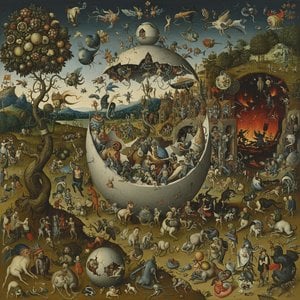
Descubre las 25 obras maestras de Hieronymus Bosch, el enigmático pintor medieval. Explora 'El Jardín de las Delicias' y su simbolismo único. Reproducciones de arte de alta calidad para tu hogar en WahooArt.com.

Explore the captivating world of Hieronymus Bosch! Delve into the symbolism, religious context, and artistic innovation of this Netherlandish master with WahooArt's expert analysis. Discover his iconic paintings & lasting influence.

Descubre el fascinante mundo del Realismo Mágico. Explora sus orígenes, características clave y a los grandes autores que definieron este movimiento literario y artístico. Análisis profundo y experto.

Descubre las 25 obras maestras del Museo del Prado: Velázquez, Goya, El Greco y más. Explora la historia, técnica y belleza de cada cuadro español. Encuentra reproducciones de arte exclusivas e inspira tu hogar con WahooArt.com.
Descubre los 10 imprescindibles del Primitivo Flamenco: Jan van Eyck, Robert Campin y más. Explora la historia, simbolismo y técnica de estas obras maestras renacentistas tempranas. Encuentra reproducciones de arte de museo en WahooArt.com.

 Ver en contexto
 Enviar
 Compartir
 Detalles

 Descargar
 Similares
 Radiografía
 Presentación de diapositivas
 Ver más







 La opción de vidrio solo está disponible en tamaños inferiores a 110 cm.


