


 Ink On PaperExpressionism
 1922Modern
 26.0 x 34.0 cm
 Arnold Schönberg Center
Óleo sobre lienzo pintado a mano en el tamaño y marco de su elección, realizado por encargo por nuestros artistas. ( Comprar impresión Comprar imagen)





























Elija entre nuestros tamaños predefinidos que respetan las proporciones originales de la obra.

Puede ingresar sus propias dimensiones para adaptarse a un marco o espacio específico. Si el tamaño seleccionado no coincide con las proporciones de la imagen original, recortaremos la obra o extenderemos la pintura con elementos adicionales pintados a mano. Se le enviará una maqueta digital para su aprobación antes de comenzar la producción.
Tenga en cuenta que la vista previa en pantalla no refleja el recorte o la extensión reales. Solo la maqueta mostrará con precisión la composición final.
Si bien existen tamaños personalizados, recomendamos seleccionar una dimensión de la lista predefinida para preservar las proporciones originales.
Envío a todo el mundo () en 3-4 semanas en lugar de las 5 semanas estándar. (6 septiembre). Sin comprometer la calidad.


Erhebt euch, Freunde, op. 2/4
Dimensiones de la reproducción
In the delicate, aged fibers of the musical score Erhebt euch, Freunde, op. 2/4, one finds more than mere notation; one encounters a profound dialogue between two titans of twentieth-century modernism. Created in the winter of 1922, this piece serves as a poignant intersection where the lyrical text of Klabund meets the burgeoning musical language of Hanns Eisler. The visual presentation of the score—rendered on paper that has mellowed into a warm, nostalgic tan—evokes the atmosphere of a lost era of European intellectualism. As the eye wanders across the dense, vertical arrangement of black ink, it encounters a rhythmic landscape of clefs, rests, and notes that pulse with the quiet intensity of a composer finding his voice amidst the political and social tremors of post-war Germany.
The aesthetic of this work is defined by its structural elegance and the raw, tactile quality of its medium. The composition is dominated by the meticulous geometry of the musical staff, where every horizontal line acts as a stage for the circular dance of notes. There is a striking contrast between the stark, black precision of the engraving and the organic, weathered texture of the parchment. This interplay creates a sense of depth that belies its two-dimensional nature, inviting the viewer to feel the weight of history held within each measure. The lighting, soft and diffused as if captured in a quiet study, highlights the slight wrinkles and imperfections of the aged paper, lending the piece an authentic, archival soul that resonates with those who appreciate the beauty of antiquity.
To understand this work is to understand the tension between tradition and revolution. During this period, the musical world was grappling with the radical shifts introduced by figures like Arnold Schönberg, whom Eisler famously defended as a true master rather than a mere destroyer of convention. The score itself embodies this duality; while it utilizes the established language of musical notation, the very existence of such a piece in 1922 speaks to a period of intense creative reconfiguration. The symbols on the page are not merely instructions for performance but are artifacts of a movement seeking to create a new material for music—one that could achieve the unity of the classics while embracing the complexities of the modern psyche.
For the discerning collector or interior designer, Erhebt euch, Freunde offers a sophisticated focal point that transcends simple decoration. It brings an air of academic prestige and contemplative calm to any space, whether it be a private library, a contemporary studio, or a refined living area. The piece does not demand attention through loud colors or aggressive forms; instead, it commands respect through its subtle complexity and historical gravity. As a high-quality reproduction, it serves as a window into the heart of the twentieth century, offering an emotional connection to the era of profound musical evolution and providing a timeless element of intellectual elegance to any curated environment.


1898 - 1962 , Alemania
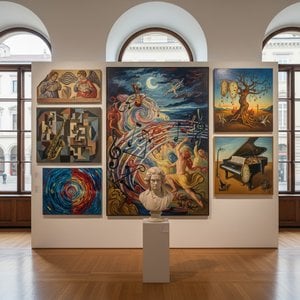
Explore the fascinating history of music's visual representation in art! From ancient symbolism to modern abstraction, discover how artists have captured sound and emotion on canvas. Expert insights & stunning examples.

Explore the captivating world of Mikalojus Konstantinas Čiurlionis, a pioneer of abstract art. Discover his unique blend of music and painting, spiritual themes, and lasting influence on Lithuanian culture. Learn more at WahooArt.
Descubre las 25 obras maestras de la Bienal de Venecia. Explora la historia, artistas y técnicas detrás de iconos del arte renacentista, moderno y contemporáneo. Encuentra reproducciones de alta calidad e inspira tu hogar con WahooArt.com.

 Ver en contexto
 Enviar
 Compartir
 Detalles

 Descargar
 Similares
 Radiografía
 Presentación de diapositivas
 Ver más







 La opción de vidrio solo está disponible en tamaños inferiores a 110 cm.


