The Roman Villa: A Dreamscape of Disquiet
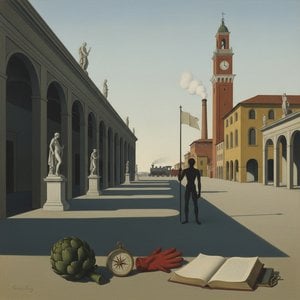
Giorgio de Chirico’s “The Roman Villa” stands as a cornerstone of Metaphysical Art, emerging from the crucible of post-war European thought and capturing a singular vision of architectural space infused with unsettling stillness. Painted in 1928, this enigmatic canvas transcends mere representation; it delves into the subconscious mind, mirroring the anxieties and intellectual explorations prevalent during its time.
Stylistically, “The Roman Villa” firmly establishes itself within Neo-baroque aesthetics—a deliberate harkening back to classical grandeur juxtaposed with a disconcerting modernity. De Chirico meticulously renders a crumbling villa bathed in diffused sunlight, creating an atmosphere of profound melancholy and isolation. The architectural details are rendered with painstaking precision, yet they lack warmth or vibrancy, emphasizing the emptiness at the heart of the scene.
Technique-wise, de Chirico employs a masterful blend of oil paint on canvas, utilizing layering and glazing to achieve remarkable tonal depth and luminosity. His brushstrokes are deliberate and controlled, conveying both solidity and fragility simultaneously. The artist’s meticulous attention to texture contributes significantly to the painting's unsettling realism—a deceptive surface concealing an inner world brimming with psychological complexity.
The historical context surrounding “The Roman Villa” is inextricably linked to the philosophical currents of Nietzsche, Schopenhauer, and Weininger. These thinkers questioned traditional morality and championed pessimism, mirroring de Chirico’s preoccupation with existential dread and the irrational forces shaping human consciousness. The villa itself serves as a symbolic representation of memory—a decaying edifice haunted by echoes of vanished grandeur—reflecting the artist's contemplation on time, loss, and the inescapable grip of fate.
Beyond its formal qualities, “The Roman Villa” possesses an undeniable emotional impact. It evokes feelings of unease, disorientation, and profound solitude. The pervasive stillness is punctuated by two clocks – a deliberate motif echoing Nietzsche’s concept of eternal recurrence—further amplifying the sense of temporal compression and highlighting the futility of striving against the inevitable march of time. This artwork invites viewers to confront uncomfortable truths about human existence and to contemplate the beauty inherent in decay.
As a reproduction, “The Roman Villa” allows art enthusiasts to experience this seminal piece firsthand. WahooArt offers exceptional quality prints that faithfully capture the painting’s luminous palette and textural nuances, bringing De Chirico's dreamlike vision into any interior space.



 Vista previa
 Cambiar a formato impreso
 Compartir
 Compartir
 Ver detalles
 Guía
Guía

 Descargar
 Ver artículos similares
 Radiografía
 Presentación de diapositivas
 Estadísticas
 Leer más






































 La opción de vidrio solo está disponible en tamaños inferiores a 110 cm.