Asesoría de arte gratuita

x
Encargar reproducción Encargar reproducciónComprar imagen en alta resolución Comprar imagen en alta resolución EnviarEnviar
DetallesDetalles Añadir a favoritos Añadir a favoritos DescargarDescargar SimilaresSimilares Rayos XRayos X Presentación de diapositivasPresentación de diapositivas

Vesuvius

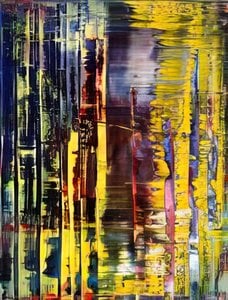
Gerhard Richter’s ‘Vesuvius,’ a mesmerizing Capitalist Realism painting from 1976, evokes memory and landscape through layered color washes over a grayscale photograph of the Italian volcano. Explore this iconic artwork and its profound reflections on human experience.

Explore el arte innovador de Gerhard Richter (nac. en 1932), un destacado artista alemán conocido por sus pinturas abstractas y fotorealistas, 'Realismo Capitalista' y grandes gráficos de color. Descubre sus registros de subastas e influencia en el arte contemporáneo.

Giclée / Impresión de arte

Impresión giclée o en lienzo de calidad de museo con producción rápida y opciones de acabado flexibles.

P118B $10
P118H $10
P118W $10
P438Z $10
P508JH $12
P508YH $12
P805H $10
P805Z $10
P919BZ $10
P919G $10
P919XJ $10
P959ZH $10
P968JZ $12
W106C $8
W218G $10
W218JH $8
W218Y $10
W307PJ $10
W316G $10
W316PJ $8
W316Y $10
W398PJ $8
W4111J $10
W500HY $15
W500JH $15
W692G $12
W849H $8
W940BG $15
W953PJ $8

Standard
custom
CM
INCH

Elija entre nuestros tamaños predefinidos que respetan las proporciones originales de la obra.

ancho
altura

Puede introducir sus propias dimensiones para adaptarse a un marco o espacio específico. Si el tamaño seleccionado no coincide con las proporciones de la imagen original, recortaremos la obra de arte o extenderemos la imagen con un borde con efecto espejo o de color sólido. Se enviará una maqueta digital para su aprobación antes de que comience la producción.
Tenga en cuenta que la vista previa en pantalla no refleja el recorte o la extensión real. Solo la maqueta mostrará con precisión la composición final.
Aunque existen tamaños personalizados, recomendamos seleccionar una dimensión de la lista predefinida para preservar las proporciones originales.

Entrega mundial () en 2 semanas en lugar de las 4/5 semanas estándar. (3 julio)

why_choose_icon
Envío exprés gratuito a todo el mundo
why_choose_icon
Lienzo de lino de alta calidad
why_choose_icon
Seguro de envío total
why_choose_icon
Garantía de reembolso de impuestos aduaneros
why_choose_icon
Garantía de fidelidad de color
why_choose_icon
Política de devolución de 60 días (solo por defectos)
why_choose_icon
Garantía de devolución del 100% del dinero
why_choose_icon
Descuento por pedido múltiple

Precio total

-

reproduction

Vesuvius

Giclée / Impresión de arte

Tamaño de la reproducción

-

Precio total final

-

Datos clave

  • Year: 1976
  • Title: Vesuvius
  • Dimensions: 73 x 105 cm
  • Subject or theme: Volcanic Landscape
  • Influences: Landscape Painting
  • Notable elements or techniques: Photorealistic layering
  • Medium: Oil on canvas

Test de arte

Solo hay una respuesta correcta para cada pregunta.

Pregunta 1:
What artistic movement is Gerhard Richter most associated with?
Pregunta 2:
The image depicts a landscape featuring what prominent natural element?
Pregunta 3:
What is the airplane in the painting meant to symbolize?
Pregunta 4:
Gerhard Richter's early life was significantly impacted by:
Pregunta 5:
Richter’s artistic style is characterized by a blending of realism and abstraction. Which technique exemplifies this approach?

Descripción de la obra

Vesuvius – A Meditation on Landscape and Memory

Gerhard Richter’s “Vesuvius,” painted in 1976, isn't merely a depiction of the Italian volcano; it’s an exploration of how memory shapes perception. Richter, deeply influenced by his formative years under Nazi Germany—a period characterized by displacement and uncertainty—employs his signature technique of layering semi-transparent squares of color onto a photographic print to achieve a mesmerizing effect.

  • Style: Richter’s approach aligns with ‘Capitalist Realism,’ a movement he spearheaded that deliberately eschews traditional artistic conventions. Instead, it prioritizes the reproduction of photographs as an autonomous art form, questioning notions of originality and authorship.
  • Technique: The artist meticulously applies thin washes of color—often muted reds, yellows, and blues—over a grayscale image of Vesuvius. This layering process creates a hazy atmosphere, blurring the boundaries between reality and illusion. It’s as if Richter is attempting to capture not just what he sees but also how it feels – the lingering impressions of experience.
  • Historical Context: Created in the wake of the Vietnam War and amidst growing anxieties about environmental degradation, “Vesuvius” speaks to a broader cultural preoccupation with confronting the destructive forces of nature alongside acknowledging the fragility of human existence. Richter’s deliberate obfuscation mirrors the difficulty of grasping complex events and emotions fully.

The Photographic Source – A Dialogue Between Image and Reality

Richter's fascination with photography stems from a profound belief that it possesses an inherent honesty—a quality he seeks to preserve while simultaneously transforming it into something new. He argues that photographs capture moments in time with unparalleled accuracy, yet they are inherently incomplete representations of experience. By reworking these images through color washes, Richter acknowledges this limitation but elevates them beyond mere documentation.

“The photograph,” Richter famously stated, “is not a copy; it’s an interpretation.”

Color as Emotion – Capturing Atmosphere and Suggestion

The subtle hues employed in “Vesuvius” aren't intended to convey literal representations of the volcano itself. Rather, they serve as conduits for emotion—a reflection of Richter’s own contemplative gaze upon the landscape. The colors evoke a sense of melancholy and quiet contemplation, mirroring the artist’s preoccupation with memory and loss.

Symbolism Beyond Representation

While “Vesuvius” presents a visually striking panorama, its significance transcends mere visual pleasure. The volcano symbolizes both destructive power and regenerative potential—themes that resonate deeply within Richter's artistic worldview. He uses color to subtly suggest these ideas, inviting viewers to engage in an imaginative dialogue with the artwork.

Obras similares


Biografía del artista

**vida temprana y educación**

Gerhard Richter, un reconocido artista visual alemán, nació el 9 de febrero de 1932, en el hospital de Dresdede-Neustadt, Dresdede, Sajonia. Creció en Reichenau, Baja Silesia (ahora Bogatynia, Polonia), y Waltersdorf (Zittauer Gebirge), en la campiña superior de Lusacia. El padre de Richter, Horst Richter, era estudiante de matemáticas y física en la Technische Hochschule de Dresdede.

**Carrera artística**

Richter comenzó su viaje artístico como aprendiz de pintor de carteles y más tarde estudió en la Academia de Bellas Artes de Dresdede. Su obra temprana fue influenciada por los estilos de Picasso y Jean Arp, lo que se evidencia en sus pinturas abstractas y fotorealistas. En 1957, Richter trabajó como aprendiz maestro en la academia, realizando encargos para el entonces estado de Alemania Oriental.

**Obras notables y logros**

* Abstraktes Bild (2012) fijó un récord de precio en subasta para una pintura de un artista vivo por $34 millones (£21 millones). * Domplatz, Mailand (Plaza del Catedral, Milán) (1968) se vendió por $37.1 millones (£24.4 millones) en Nueva York. * Abstraktes Bild (2015) se vendió por $44.52 millones (£30.4 millones) en la subasta de arte contemporáneo de Sotheby's.

**Estilo artístico y movimiento**

La obra de Richter se caracteriza por su eclecticismo, combinando estilos abstractos y fotorealistas. Junto con Sigmar Polke, introdujo el término Kapitalistischer Realismus (Realismo Capitalista), un antiestilo de arte que se apropia del lenguaje pictórico publicitario.

**Vida personal**

Richter se casó con Marianne Eufinger en 1957 y tuvo una hija. Más tarde se casó con Isa Genzken en 1982 y Sabine Moritz en 1995, con quien tuvo dos hijos y una hija. **Nota:** Este artículo se basa en la información proporcionada y puede no ser una biografía completa. Para obtener información más detallada, visite las fuentes vinculadas.
Gerhard Richter

Gerhard Richter

1932 - , Alemania

Datos clave

  • Artistas Que Influyeron:
    • Pablo Picasso
    • Jean Arp
  • Fecha De Nacimiento: 9 de febrero de 1932
  • Lugar De Nacimiento: Dresde, Alemania
  • Movimiento Artístico:
    • Expresionismo abstracto
    • Fotorealismo
  • Nacionalidad: Alemán
  • Nombre Completo: Gerhard Richter
  • Obras Notables:
    • Abstraktes Bild (2012)
    • Domplatz, Milán (1968)
    • Nubes
    • Firenze
    • Imagen Abstracta
    • S. con Niño
Explore obras de arte organizadas por temas, estilos y características.