Asesoría de arte gratuita

x
Encargar reproducción Encargar reproducciónComprar imagen en alta resolución Comprar imagen en alta resolución EnviarEnviar
DetailsDetails Añadir a favoritos Añadir a favoritos DescargarDescargar SimilaresSimilares X-RayX-Ray Presentación de diapositivasPresentación de diapositivas

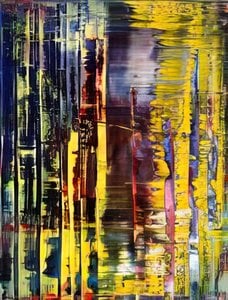
Skull

Gerhard Richter's 'Skull' (1983) is a haunting monochrome study of bone, reflecting themes of mortality and memory through subtle brushstrokes. Explore this iconic work’s layered abstraction and Richter’s signature style.

Explore el arte innovador de Gerhard Richter (nac. en 1932), un destacado artista alemán conocido por sus pinturas abstractas y fotorealistas, 'Realismo Capitalista' y grandes gráficos de color. Descubre sus registros de subastas e influencia en el arte contemporáneo.

Giclée / Impresión de arte

Impresión giclée o en lienzo de calidad de museo con producción rápida y opciones de acabado flexibles.

P118B $10
P118H $10
P118W $10
P438Z $10
P508JH $12
P508YH $12
P805H $10
P805Z $10
P919BZ $10
P919G $10
P919XJ $10
P959ZH $10
P968JZ $12
W106C $8
W218G $10
W218JH $8
W218Y $10
W307PJ $10
W316G $10
W316PJ $8
W316Y $10
W398PJ $8
W4111J $10
W500HY $15
W500JH $15
W692G $12
W849H $8
W940BG $15
W953PJ $8

Standard
custom
CM
INCH

Elija entre nuestros tamaños predefinidos que respetan las proporciones originales de la obra.

ancho
altura

Puede introducir sus propias dimensiones para adaptarse a un marco o espacio específico. Si el tamaño seleccionado no coincide con las proporciones de la imagen original, recortaremos la obra de arte o extenderemos la imagen con un borde con efecto espejo o de color sólido. Se enviará una maqueta digital para su aprobación antes de que comience la producción.
Tenga en cuenta que la vista previa en pantalla no refleja el recorte o la extensión real. Solo la maqueta mostrará con precisión la composición final.
Aunque existen tamaños personalizados, recomendamos seleccionar una dimensión de la lista predefinida para preservar las proporciones originales.

Entrega mundial () en 2 semanas en lugar de las 4/5 semanas estándar. (2 julio)

why_choose_icon
Envío exprés gratuito a todo el mundo
why_choose_icon
Lienzo de lino de alta calidad
why_choose_icon
Seguro de envío total
why_choose_icon
Garantía de reembolso de impuestos aduaneros
why_choose_icon
Garantía de fidelidad de color
why_choose_icon
Política de devolución de 60 días (solo por defectos)
why_choose_icon
Garantía de devolución del 100% del dinero
why_choose_icon
Descuento por pedido múltiple

Precio total

-

reproduction

Skull

Giclée / Impresión de arte

Tamaño de la reproducción

-

Precio total final

-

Datos clave

  • Medium: Oil on canvas
  • Artistic style: Photorealism
  • Dimensions: 80 x 65 cm
  • Influences: Dürer sketches
  • Year: 1983
  • Notable elements: Bone/ceramic texture

Test de arte

Solo hay una respuesta correcta para cada pregunta.

Pregunta 1:
What is the primary material depicted in Gerhard Richter’s ‘Skull’?
Pregunta 2:
The photograph of the skull appears to be taken in what type of setting?
Pregunta 3:
Gerhard Richter is primarily known for his work in which of the following styles?
Pregunta 4:
Considering Richter’s broader body of work, what is a recurring theme often explored in his paintings?
Pregunta 5:
In ‘Skull’, what technique does Richter employ to create a slightly blurred effect?

Descripción de la obra

The Stark Beauty of Absence: An Exploration of Richter's 'Skull'

Gerhard Richter’s 1983 painting, “Skull,” isn’t a celebration of death, but rather an intensely contemplative meditation on the fragility of existence and the enduring power of memory. Rendered in oil on canvas with a deceptively simple palette – primarily stark white against muted grays and blues – the work immediately commands attention not through dramatic gesture or vibrant color, but through its profound stillness and unsettling intimacy. The skull itself, presented in close-up, possesses an almost unnerving realism; it’s not idealized or romanticized, but a tangible representation of mortality, stripped bare of any embellishment. Richter's masterful control of texture – achieved through subtle brushstrokes and the layering of paint – creates a surface that is both smooth and subtly tactile, inviting the viewer to reach out and touch (though, of course, it’s impossible). This deliberate ambiguity, this refusal to offer easy answers, is characteristic of much of Richter's oeuvre and contributes significantly to the painting’s enduring power.

The genesis of “Skull” lies within a period of profound personal and historical upheaval for Richter. Born in Dresden in 1932, his childhood was shaped by the escalating tensions of Nazi Germany and the subsequent devastation of World War II. This experience instilled within him a deep-seated sense of uncertainty and a questioning spirit – qualities that would become central to his artistic practice. The skull itself can be interpreted as a visual echo of this trauma; it’s a symbol of loss, displacement, and the inescapable awareness of our own mortality. Richter's decision to photograph the skull before painting it suggests an initial attempt to capture its essence directly, but ultimately, he transforms the image through his artistic process, imbuing it with layers of meaning that extend far beyond mere representation.

The Process of Deconstruction: Technique and Style

Richter’s technique in “Skull” is a fascinating blend of realism and abstraction. He began by projecting a photograph of a human skull onto the canvas, meticulously tracing its outline with graphite. This foundational layer provides a sense of grounding and establishes the image's initial form. However, Richter then proceeded to paint over these lines, not with a single, decisive stroke, but with multiple layers of oil paint – often incorporating subtle variations in color and texture. This layering process is crucial to understanding Richter’s artistic approach; it’s a deliberate act of deconstruction, where the original image is gradually obscured and transformed into something new. The resulting surface is not perfectly smooth or uniform; instead, it exhibits a delicate interplay of textures – areas of subtle glossiness juxtaposed with matte patches, creating a sense of depth and complexity.

The muted color palette—primarily whites, grays, and blues—further contributes to the painting’s somber mood. Richter avoids bright or saturated colors, opting instead for tones that are both understated and evocative. The subtle shifts in hue create a sense of atmospheric perspective, drawing the viewer's eye into the heart of the image. Notably, Richter often employed this technique of overpainting photographs – a practice he termed “photo-paintings” – to explore the relationship between representation and reality. He wasn’t simply replicating images; he was actively engaging with them, transforming them through his own artistic vision.

Symbolism and Emotional Resonance

Beyond its technical merits, "Skull" is rich in symbolic meaning. The skull, of course, is a universal symbol of mortality, but Richter’s painting transcends the purely literal. It speaks to the ephemeral nature of life, the inevitability of death, and the enduring power of memory. The stark simplicity of the image – the skull presented against a blurred background – creates a sense of isolation and vulnerability. The lack of context forces the viewer to confront the subject directly, without any mediating elements. This directness is both unsettling and profoundly moving.

Furthermore, Richter’s deliberate blurring of the background suggests a desire to detach the skull from its original context – perhaps even from time itself. It becomes an archetypal image, stripped of specific historical or personal associations, and presented as a timeless meditation on human existence. The subtle brushstrokes and layered textures contribute to this sense of ambiguity, creating a surface that is both familiar and strangely alien.

A Timeless Masterpiece: Reproduction and Interpretation

WahooArt offers meticulously crafted hand-painted reproductions of Gerhard Richter’s “Skull,” allowing art lovers to experience the painting's profound beauty and complexity in their own homes. Our skilled artists carefully replicate Richter’s nuanced technique, capturing the subtle variations in texture and color that define this iconic work. Each reproduction is created using archival-quality materials, ensuring its longevity and preserving the integrity of the original image. Whether you are a seasoned art collector or simply seeking to add a touch of contemplative beauty to your interior space, a WahooArt reproduction of “Skull” offers a unique opportunity to engage with one of Richter’s most compelling and enduring works.

Obras similares


Biografía del artista

**vida temprana y educación**

Gerhard Richter, un reconocido artista visual alemán, nació el 9 de febrero de 1932, en el hospital de Dresdede-Neustadt, Dresdede, Sajonia. Creció en Reichenau, Baja Silesia (ahora Bogatynia, Polonia), y Waltersdorf (Zittauer Gebirge), en la campiña superior de Lusacia. El padre de Richter, Horst Richter, era estudiante de matemáticas y física en la Technische Hochschule de Dresdede.

**Carrera artística**

Richter comenzó su viaje artístico como aprendiz de pintor de carteles y más tarde estudió en la Academia de Bellas Artes de Dresdede. Su obra temprana fue influenciada por los estilos de Picasso y Jean Arp, lo que se evidencia en sus pinturas abstractas y fotorealistas. En 1957, Richter trabajó como aprendiz maestro en la academia, realizando encargos para el entonces estado de Alemania Oriental.

**Obras notables y logros**

* Abstraktes Bild (2012) fijó un récord de precio en subasta para una pintura de un artista vivo por $34 millones (£21 millones). * Domplatz, Mailand (Plaza del Catedral, Milán) (1968) se vendió por $37.1 millones (£24.4 millones) en Nueva York. * Abstraktes Bild (2015) se vendió por $44.52 millones (£30.4 millones) en la subasta de arte contemporáneo de Sotheby's.

**Estilo artístico y movimiento**

La obra de Richter se caracteriza por su eclecticismo, combinando estilos abstractos y fotorealistas. Junto con Sigmar Polke, introdujo el término Kapitalistischer Realismus (Realismo Capitalista), un antiestilo de arte que se apropia del lenguaje pictórico publicitario.

**Vida personal**

Richter se casó con Marianne Eufinger en 1957 y tuvo una hija. Más tarde se casó con Isa Genzken en 1982 y Sabine Moritz en 1995, con quien tuvo dos hijos y una hija. **Nota:** Este artículo se basa en la información proporcionada y puede no ser una biografía completa. Para obtener información más detallada, visite las fuentes vinculadas.
Gerhard Richter

Gerhard Richter

1932 - , Alemania

Datos clave

  • Artistas Que Influyeron:
    • Pablo Picasso
    • Jean Arp
  • Fecha De Nacimiento: 9 de febrero de 1932
  • Lugar De Nacimiento: Dresde, Alemania
  • Movimiento Artístico:
    • Expresionismo abstracto
    • Fotorealismo
  • Nacionalidad: Alemán
  • Nombre Completo: Gerhard Richter
  • Obras Notables:
    • Abstraktes Bild (2012)
    • Domplatz, Milán (1968)
    • Nubes
    • Firenze
    • Imagen Abstracta
    • S. con Niño
Explore obras de arte organizadas por temas, estilos y características.