Vista previa Vista previa en RA Encargar reproducción pintada a mano Ver versión en imagen digital Compartir
Ver detalles Guía Añadir a favoritos Descargar Ver artículos similares Radiografía Presentación de diapositivas Estadísticas

TheConcert

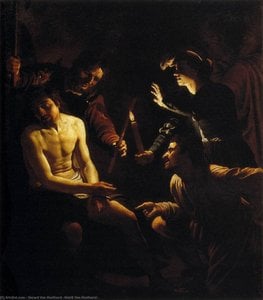
The Concert by Gerrit van Honthorst - National Gallery of Art Gerrit van Honthorst (1592–1656) has long been considered one of the greatest painters of the Dutch Golden Age. After training in Utrecht, he traveled to Italy around 1615, where he embraced the radical stylistic and thematic ideas of Caravaggio. The dramatic use of tenebrism, a technique employing stark contrasts between light and dark

Descubre a Gerard van Honthorst (1590-1656), maestro del Siglo de Oro Neerlandés y figura clave del caravaggismo en Utrecht. Retratos, escenas bíblicas e influencia barroca.

Giclée / Impresión de arte

Impresiones giclée o en lienzo de calidad de museo con producción rápida y opciones de acabado flexibles. ( Encargar reproducción pintada a mano Ver versión en imagen digital)

P118B $10
P118H $10
P118W $10
P438Z $10
P508JH $12
P508YH $12
P805H $10
P805Z $10
P919BZ $10
P919G $10
P919XJ $10
P959ZH $10
P968JZ $12
W106C $8
W218G $10
W218JH $8
W218Y $10
W307PJ $10
W316G $10
W316PJ $8
W316Y $10
W398PJ $8
W4111J $10
W500HY $15
W500JH $15
W692G $12
W849H $8
W940BG $15
W953PJ $8

Estándar
personalizado
CM
INCH

Elija entre nuestros tamaños predefinidos que respetan las proporciones originales de la obra.

ancho
altura

Puede introducir sus propias dimensiones para adaptarse a un marco o espacio específico. Si el tamaño seleccionado no coincide con las proporciones de la imagen original, recortaremos la obra de arte o extenderemos la imagen con un borde con efecto espejo o de color sólido. Se enviará una maqueta digital para su aprobación antes de que comience la producción.
Tenga en cuenta que la vista previa en pantalla no refleja el recorte o la extensión real. Solo la maqueta mostrará con precisión la composición final.
Aunque existen tamaños personalizados, recomendamos seleccionar una dimensión de la lista predefinida para preservar las proporciones originales.

Envío a todo el mundo () en 2 semanas en lugar de las 4/5 semanas estándar. (23 septiembre)

why_choose_icon
Envío exprés gratuito a todo el mundo
why_choose_icon
Lienzo de lino de alta calidad
why_choose_icon
Seguro de envío completo
why_choose_icon
Garantía de reembolso de impuestos aduaneros
why_choose_icon
Garantía de fidelidad cromática exacta
why_choose_icon
Política de devolución de 100 días (solo por defectos)
why_choose_icon
Garantía de devolución del 100% del dinero
why_choose_icon
Oferta por volumen

Precio total

$ 68

reproduction

TheConcert

Giclée / Impresión de arte

Tamaño de la reproducción

-

Precio total

$ 68

Datos clave

  • Location: Prince Willem V Collection
  • Year: 1632
  • Title: The Concert
  • Medium: Oil on canvas
  • Artist: Gerrit van Honthorst
  • Subject or theme: Musical Performance
  • Dimensions: 48 x 37 cm

Cuestionario de arte

Cada pregunta tiene una única respuesta correcta.

Pregunta 1:
What artistic technique is prominently featured in Gerrit van Honthorst's "The Concert," characterized by dramatic contrasts between light and dark?
Pregunta 2:
Who profoundly influenced Gerrit van Honthorst's style, inspiring him to adopt tenebrism and explore dramatic narratives?
Pregunta 3:
In what city did Gerrit van Honthorst initially receive his artistic training, establishing a foundational understanding of draftsmanship and composition?
Pregunta 4:
What was the primary reason for Gerrit van Honthorst's transformative journey to Rome around 1615, shaping his artistic vision and earning him the nickname “Gherardo delle Notti”?
Pregunta 5:
What musical instrument is prominently displayed in "The Concert," symbolizing artistic performance and cultural sophistication?

A Symphony of Shadow and Light

In the quiet, amber-hued depths of the Dutch Golden Age, few works capture the visceral tension between intimacy and drama as profoundly as Gerard van Honthorst’s “The Concert.” This masterpiece serves as a breathtaking window into a world where music is not merely heard, but felt through the very texture of light. As one of the most celebrated practitioners of the Utrecht Caravaggisti style, Honthorst earned the evocative moniker “Gherardo delle Notti”—Gerard of the Nights—a title that perfectly encapsulates his ability to conjure life from the impenetrable darkness. In this particular scene, the artist invites us into a dimly lit chamber, where the soft glow of unseen candlelight dances across scarlet drapery and illuminates a gathering of musicians caught in a moment of profound musical engagement.

The composition is a masterclass in tenebrism, a technique borrowed from the revolutionary Caravaggio. By juxtaposing intense, concentrated light against deep, swallowing shadows, Honthorost creates a sense of three-dimensional weight that pulls the viewer directly into the room. The eye is immediately drawn to the central figures: a woman seated gracefully on a bench, her hands poised with a violin, accompanied by companions whose faces emerge from the gloom like memories surfacing from sleep. There is a palpable sense of movement and rhythm in the way the light catches the curve of an instrument or the fold of a sleeve, transforming a static portrait into a living, breathing performance.

The Soul of the Dutch Golden Age

Beyond its technical brilliance, “The Concert” is steeped in the historical anxieties and cultural richness of the 17th-century Netherlands. Unlike the idealized, polished portraits common in other eras, Honthorst embraced a gritty, tactile realism. He eschewed perfection in favor of truth, capturing the textures of fabric, the sheen of wood, and the subtle expressions of human emotion. This dedication to realism allowed him to mirror the complexities of his era—a time of great prosperity but also profound uncertainty. The presence of the scarlet curtains adds a layer of theatrical grandeur, suggesting that this musical gathering is both a private sanctuary and a staged spectacle of high culture.

For the discerning collector or interior designer, this painting offers more than just aesthetic beauty; it provides an emotional anchor for a space. The interplay of warm tones and deep shadows makes it an ideal centerpiece for rooms designed to evoke intimacy, sophistication, and contemplation. Whether placed in a contemporary gallery setting or a classic study, the artwork commands attention through its silent narrative. It is a piece that does not merely decorate a wall but transforms an environment, inviting guests to linger in the glow of its historical mystery and to find their own rhythm within its beautifully orchestrated shadows.


Biografía del artista

Primeros años y formación

Gerrit van Honthorst, un destacado pintor del Siglo de Oro neerlandés, nació el 4 de noviembre de 1590 en Utrecht, Países Bajos. Era hijo de un pintor decorativo y inicialmente se formó bajo la tutela de su padre. Posteriormente, continuó su educación artística con Abraham Bloemaert.

Carrera e influencias

La carrera temprana de Van Honthorst incluyó una visita a Roma, donde fue fuertemente influenciado por el estilo de Caravaggio. Esta influencia es evidente en sus obras posteriores, particularmente en su uso de escenas iluminadas artificialmente, lo que le valió el apodo de "Gherardo delle Notti" o "Gerard de las noches". Tras su regreso a los Países Bajos, Van Honthorst se convirtió en un retratista líder.

Patronazgo y encargos notables

El trabajo de Van Honthorst tuvo una gran demanda, con notables patronos que incluyen a Vincenzo Giustiniani, quien lo encargó para pintar "Cristo ante el sumo sacerdote", ahora alojado en la National Gallery de Londres. También trabajó para Cosimo II de' Medici, Gran Duque de Toscana, y fue un favorito entre la República Neerlandesa y en el extranjero.

Legado y vida posterior

En 1620, Van Honthorst regresó a Utrecht, donde construyó una considerable reputación. Para 1623, el año de su matrimonio, se había convertido en presidente del gremio de San Lucas en Utrecht. Su éxito llevó a recomendaciones por parte de Sir Dudley Carleton para el Conde de Arundel y Lord Dorchester.

Obras clave y colaboraciones

  • "La toma de Cristo", una obra colaborativa inicialmente atribuida a Van Honthorst, ahora reconocida como obra de otro artista.
  • "Cristo ante el sumo sacerdote", encargado por Vincenzo Giustiniani, muestra la habilidad de Van Honthorst para capturar escenas iluminadas artificialmente.
  • Colaboraciones con otros artistas, como Peter Paul Rubens, demuestran su influencia en el estilo barroco flamenco.

Movimiento artístico y estilo

Van Honthorst formó parte del movimiento de los utrecht caravaggisti, caracterizado por su uso de una iluminación dramática y una profundidad emocional intensa. Su obra refleja la influencia del barroco italiano, al mismo tiempo que contribuye al desarrollo del Siglo de Oro neerlandés.
Gerard van Honthorst

Gerard van Honthorst

1590 - 1656 , Países Bajos

Datos clave

  • Artistas Influenciados:
    • Rembrandt van Rijn
    • Georges de la Tour
  • Artistas Que Influyeron:
    • Caravaggio
    • Abraham Bloemaert
  • Fecha De Nacimiento: 4 de noviembre de 1590
  • Lugar De Nacimiento: Utrecht, Países Bajos
  • Movimiento Artístico: Caravaggismo Utrechtano
  • Nacionalidad: Neerlandés
  • Nombre Completo: Gerard van Honthorst
  • Obras Notables:
    • Cristo ante el sumo sacerdote
    • La toma de Cristo
    • Escenas nocturnas iluminadas
Explore obras de arte organizadas por temas, estilos y características.