Ver en contextoVer en contexto Vista previa en RAVista previa en RA Comprar pintura hecha a mano Comprar pintura hecha a manoCambiar a imagen digital Cambiar a imagen digital EnviarEnviar
DetallesDetalles Añadir a favoritos Añadir a favoritos DescargarDescargar SimilaresSimilares RadiografíaRadiografía Presentación de diapositivasPresentación de diapositivas EstadísticasEstadísticas

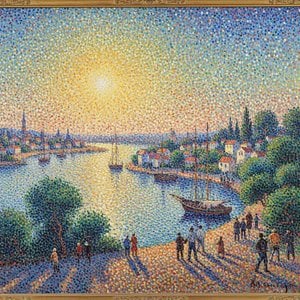
untitled (4615)

Witness Georges Seurat's revolutionary Pointillism in 'Bathers at Asnières'! This iconic Neo-Impressionist masterpiece, meticulously crafted with tiny dots of color, captures a Parisian afternoon with unparalleled precision and light. A must-see for art lovers!

Explora a Georges Seurat (1859-1891), pionero del Puntillismo y Neoimpresionismo. Descubre 'Un domingo en la Gran Játita' y su revolucionaria teoría del color que captura la vida moderna. ¡Compra reproducciones pintadas a mano!

Giclée / Impresión de arte

Impresiones giclée o en lienzo de calidad de museo con producción rápida y opciones de acabado flexibles. (Comprar pintura hecha a mano Comprar pintura hecha a manoCambiar a imagen digital Cambiar a imagen digital)

P118B $10
P118H $10
P118W $10
P438Z $10
P508JH $12
P508YH $12
P805H $10
P805Z $10
P919BZ $10
P919G $10
P919XJ $10
P959ZH $10
P968JZ $12
W106C $8
W218G $10
W218JH $8
W218Y $10
W307PJ $10
W316G $10
W316PJ $8
W316Y $10
W398PJ $8
W4111J $10
W500HY $15
W500JH $15
W692G $12
W849H $8
W940BG $15
W953PJ $8

Estándar
a medida
CM
INCH

Elija entre nuestros tamaños predefinidos que respetan las proporciones originales de la obra.

ancho
altura

Puede introducir sus propias dimensiones para adaptarse a un marco o espacio específico. Si el tamaño seleccionado no coincide con las proporciones de la imagen original, recortaremos la obra de arte o extenderemos la imagen con un borde con efecto espejo o de color sólido. Se enviará una maqueta digital para su aprobación antes de que comience la producción.
Tenga en cuenta que la vista previa en pantalla no refleja el recorte o la extensión real. Solo la maqueta mostrará con precisión la composición final.
Aunque existen tamaños personalizados, recomendamos seleccionar una dimensión de la lista predefinida para preservar las proporciones originales.

Envío a todo el mundo () en 2 semanas en lugar de las 4/5 semanas estándar. (9 septiembre)

why_choose_icon
Envío exprés gratuito a todo el mundo
why_choose_icon
Lienzo de lino de alta calidad
why_choose_icon
Seguro de envío total
why_choose_icon
Garantía de reembolso de impuestos aduaneros
why_choose_icon
Garantía de fidelidad cromática exacta
why_choose_icon
Política de devolución de 100 días (solo por defectos)
why_choose_icon
Garantía de devolución del 100% del dinero
why_choose_icon
Descuento por cantidad

Precio total

$ 68

reproduction

untitled (4615)

Giclée / Impresión de arte

Dimensiones de la reproducción

-

Precio total final

$ 68

Datos clave

  • Artist: Georges Seurat
  • Subject or theme: Modern life, leisure
  • Medium: Oil on canvas
  • Influences:
    • Impressionism
    • Delacroix
  • Artistic style: Neo-Impressionism
  • Notable elements or techniques: Pointillism
  • Year: 1884–1886

Test de arte

Cada pregunta tiene una única respuesta correcta.

Pregunta 1:
What artistic technique is most prominently displayed in the painting "untitled (4615)"?
Pregunta 2:
The description mentions the painting utilizes a ‘post-impressionist style’. What does this generally indicate about its approach?
Pregunta 3:
According to the description, what is a key characteristic of the painting’s visual effect?
Pregunta 4:
Georges Seurat is best known for his pioneering work in which artistic movement?
Pregunta 5:
The description highlights the meticulous detail of the painting. What does this suggest about Seurat’s artistic process?

Georges Seurat’s *A Sunday Afternoon on the Island of La Grande Jatte* – A Symphony of Light and Modernity

Georges Pierre Seurat's *A Sunday Afternoon on the Island of La Grande Jatte*, completed between 1884 and 1886, stands as a monumental achievement not just within Impressionism, but as a foundational work of modern art. More than simply a depiction of a Parisian leisure scene, it’s a meticulously constructed meditation on time, modernity, and the evolving relationship between humanity and its environment – a theme that continues to resonate powerfully today. The painting's scale alone—a colossal 17 feet by 25 feet—immediately commands attention, drawing the viewer into a world of carefully orchestrated observation and scientific precision.

  • The Technique: Pointillism Seurat’s revolutionary technique, known as Pointillism or Divisionism, is the very heart of this masterpiece. Rather than blending colors directly on the canvas, he applied tiny dots of pure color – meticulously calculated to create optical mixtures when viewed from a distance. This method, inspired by scientific theories of optics and championed by Seurat himself, aimed to capture the fleeting effects of light and atmosphere with unprecedented accuracy.
  • Color Theory The painting’s palette is remarkably restrained, dominated by blues, greens, ochres, and browns – colors that evoke the hazy summer afternoon and the industrial landscape surrounding La Grande Jatte. Seurat's understanding of color theory was exceptional; he used complementary colors strategically to heighten visual impact and create a sense of shimmering light.
  • Composition The composition is carefully balanced, with figures arranged in shallow depth planes, creating an illusion of space that’s both realistic and stylized. The diagonal lines of the boats and the receding shoreline draw the viewer's eye into the scene, while the central grouping of figures anchors the composition.

A Reflection on Modern Life

Painted during a period of rapid industrialization and social change in Paris, *A Sunday Afternoon* offers a complex commentary on the burgeoning modern world. The island itself was a popular leisure spot for Parisians escaping the city’s bustle, but Seurat presents a scene that feels strangely detached from everyday life. The figures are posed awkwardly, seemingly unaware of each other, and their activities – boating, sunbathing, picnicking – feel almost ritualistic. This detachment reflects the growing alienation and anonymity experienced by individuals in an increasingly urbanized society.

Symbolism: Some scholars interpret the painting as a critique of bourgeois leisure, suggesting that the figures’ detached behavior represents a superficial enjoyment of wealth and status. The industrial backdrop – the factory chimneys and the boats powered by steam – subtly underscores the impact of technology on human life. The painting's stillness is also significant; it captures a moment frozen in time, reflecting the anxieties surrounding the relentless march of progress.

Historical Context & Seurat’s Vision

Seurat was deeply influenced by scientific advancements of the late 19th century, particularly those related to optics and color theory. He studied the work of Eugène Delacroix, but rejected his expressive brushwork in favor of a more objective approach. His ambition was not simply to paint what he saw, but to capture the *impression* of light and atmosphere with scientific rigor. This pursuit led him to develop Pointillism as a revolutionary technique that would transform the course of modern art.

Neo-Impressionism: Seurat’s work is considered a cornerstone of Neo-Impressionism, an artistic movement that emerged in response to Impressionism. While Impressionists focused on capturing fleeting moments of light and color, Neo-Impressionists, led by Seurat and Paul Signac, employed scientific principles to create works with a more structured and systematic approach. *A Sunday Afternoon* is arguably the most significant example of this movement.

Emotional Impact & Legacy

Despite its intellectual rigor, *A Sunday Afternoon on the Island of La Grande Jatte* possesses a profound emotional impact. The painting’s scale, combined with Seurat's masterful use of color and light, creates a sense of immersive beauty that draws the viewer into the scene. It is a work that invites contemplation – about time, modernity, human connection, and the enduring power of art to capture the essence of our experience.


Biografía del artista

Georges Seurat: Un Pionero del Neoimpresionismo

Vida Temprana y Educación

  • Nacido: 2 de diciembre de 1859, en París, Francia.
  • La familia de Seurat se mudó al Boulevard de Magenta poco después de su nacimiento.
  • Su padre, Antoine Chrysostome Seurat, fue un exfuncionario legal que se hizo rico a través de la especulación inmobiliaria.
  • Comenzó su formación artística en la École Municipale de Sculpture et Dessin, cerca de su hogar, bajo el escultor Justin Lequien.
  • En 1878, se matriculó en la prestigiosa École des Beaux-Arts, estudiando bajo Henri Lehmann.

Desarrollo Artístico e Influencias

  • La personalidad artística de Seurat fue una mezcla única de sensibilidad y abstracción lógica. Combinó una delicada sensibilidad con la precisión matemática.
  • Influencias: Si bien las influencias específicas son debatidas, estudió las teorías del color de científicos como Michel Eugène Chevreul y Ogden Rood.
  • Inicialmente experimentó con técnicas de dibujo tradicionales antes de desarrollar su estilo distintivo.
  • Sus primeras obras muestran interés en la pintura académica pero gradualmente se movieron hacia un enfoque más innovador.

Chromoluminarismo y Puntillismo

  • Seurat ideó las técnicas de chromoluminarismo (la ciencia del color) y puntillismo, aplicando pequeños puntos distintos de color puro a un lienzo.
  • Usó lápiz Conté para dibujos detallados en papel con superficie rugosa como parte de su proceso.
  • Objetivo del Puntillismo: La idea era que la vista del espectador fusionaría ópticamente estos colores, creando un efecto vibrante y luminoso.

Logros Importantes y Obras Notables

  • Un Domingo Tarde en la Isla de la Grande Jatte (1884-1886): Su obra más famosa, que marca el comienzo del Neoimpresionismo. Ejemplifica su técnica puntillista y su enfoque meticuloso.
  • Alfalfa, Saint-Denis (1886-1887): Demuestra su aplicación de la teoría del color a un paisaje rural.
  • Paisaje en Saint-Ouen (1882-1883): Un ejemplo temprano que muestra su estilo en evolución e interés por la luz y la atmósfera.
  • La Torre Eiffel (1889): Una representación del icónico monumento parisino, representada utilizando técnicas puntillistas.
  • Bañistas en Asnières (1884): Otra obra significativa que explora el ocio y la vida moderna con su estilo distintivo.

Significado Histórico y Legado

  • El trabajo de Seurat influyó profundamente en el desarrollo del arte moderno, particularmente a través de su énfasis en la expresión subjetiva y la exploración de nuevas técnicas.
  • Allanó el Camino: Allanó el camino para movimientos como el Fauvismo, el Cubismo y el Expresionismo Abstracto.
  • Su enfoque científico del arte desafió las convenciones artísticas tradicionales.
  • A pesar de su corta vida (murió a los 31 años), Seurat dejó una marca indeleble en la historia del arte, inspirando a generaciones de artistas con su visión innovadora.
Georges Pierre Seurat

Georges Pierre Seurat

1859 - 1891 , Francia

Datos clave

  • Artistas Influenciados:
    • Fauvismo
    • Cubismo
    • Expresionismo Abstracto
  • Artistas Que Influyeron:
    • Michel Eugène Chevreul
    • Ogden Rood
  • Fecha De Nacimiento: 2 de diciembre de 1859
  • Lugar De Nacimiento: París, Francia
  • Movimiento Artístico: Neoimpresionismo
  • Nacionalidad: Francés
  • Nombre Completo: Georges Pierre Seurat
  • Obras Notables:
    • Un domingo en la Grande Jatte
    • Bañistas en Asnières
    • La Torre Eiffel
Explore obras de arte organizadas por temas, estilos y características.