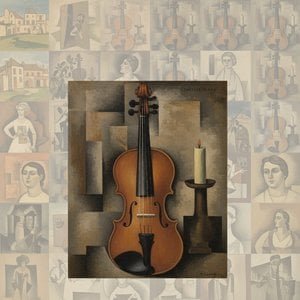
Georges Braque’s Fragmented Vision: An Exploration of “Untitled (9129)”
This compelling artwork, designated simply as "Untitled (9129)," offers a captivating glimpse into the mind of Georges Braque, one of the pivotal figures in the genesis of Cubism. The piece, characterized by its layered composition and earthy palette, immediately draws the viewer into a world of fragmented forms and ambiguous narratives – a hallmark of Braque’s groundbreaking approach to representation. The photograph reveals a densely populated scene, dominated by a centrally positioned guitar, suggesting themes of musicality, perhaps even melancholy or introspection. A seated figure adds an element of human presence, though their posture and expression remain deliberately obscured, inviting the viewer to project their own emotions and interpretations onto the canvas.
The Roots of Cubism in Technique and Material
Braque’s artistic journey was profoundly shaped by his early training as a house painter and decorator. This practical experience instilled within him an acute awareness of form, structure, and the properties of materials – skills that would later become central to his revolutionary approach to painting. “Untitled (9129)” exemplifies this influence; the collage-like construction, utilizing seemingly disparate elements, echoes the meticulous layering and textural exploration found in decorative arts. The predominantly brown tones, reminiscent of aged wood or worn leather, contribute to a sense of groundedness and solidity, while simultaneously hinting at decay or transformation – themes frequently explored by Braque during his early Cubist period. The artist’s deliberate use of shape and form, breaking down objects into geometric components, anticipates the core tenets of Cubism, pioneered in collaboration with Pablo Picasso.
Symbolic Layers and the Ambiguity of Form
While seemingly abstract, “Untitled (9129)” is rich in potential symbolic meaning. The guitar, a recurring motif in Braque’s work, can be interpreted as representing musical expression, memory, or even the passage of time. The presence of multiple figures – some clearly defined, others partially obscured – adds to the painting's complexity and invites speculation about relationships, identities, and the nature of perception. Braque intentionally avoided providing a literal narrative, instead prioritizing the exploration of form and space over representational accuracy. This deliberate ambiguity aligns with the broader Cubist project of challenging traditional notions of perspective and illusion.
Historical Context and Lasting Impact
Created during Braque’s pivotal years in the early 20th century (1882-1963), “Untitled (9129)” stands as a testament to his crucial role in shaping modern art. The painting reflects the intellectual ferment of Paris at the time, where artists were grappling with new ideas about space, perception, and representation. Braque’s collaboration with Picasso on works like *Les Demoiselles d'Avignon* fundamentally altered the course of Western art, paving the way for subsequent movements such as Futurism and Constructivism. This piece, a testament to his innovative spirit, continues to resonate today, offering a compelling example of early Cubist experimentation and demonstrating Braque’s profound impact on the development of 20th-century artistic expression.
Preguntas y respuestas
¿Está "untitled (9129)" disponible como una impresión de bellas artes?
"untitled (9129)" está disponible como una impresión de bellas artes sobre lienzo de algodón o papel de lienzo de archivo. Los pedidos se realizan en su página Impresión de bellas artes, en el tamaño de su elección.
¿Cómo se combinan el contraste y la armonía en "untitled (9129)"?
El análisis cromático de "untitled (9129)" de Georges Braque registra un Statement contraste y una Unified Palette armonía.
¿Cómo se combinan el medio y el movimiento en "untitled (9129)"?
En "untitled (9129)", la técnica de Acrylic On Canvas se encuentra con el movimiento Cubist Abstraction.



 Vista previa
 Encargar reproducción pintada a mano
 Compartir
 Compartir
 Ver detalles
 Guía
Guía

 Descargar
 Ver artículos similares
 Radiografía
 Presentación de diapositivas
 Estadísticas

 Leer más






































 La opción de vidrio solo está disponible en tamaños inferiores a 110 cm.