x
Ver en contextoVer en contexto Vista previa en RAVista previa en RA Comprar impresión Comprar impresiónComprar imagen Comprar imagen EnviarEnviar
DetallesDetalles Añadir a favoritos Añadir a favoritos DescargarDescargar SimilaresSimilares RadiografíaRadiografía Presentación de diapositivasPresentación de diapositivas

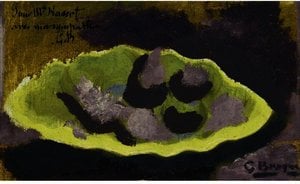
The Green Apples

Georges Braque’s masterful Cubist still life captures the essence of form and texture—green apples arranged in a dynamic circle alongside a lemon—reflecting the groundbreaking artistic innovations of the early 20th century. Explore this iconic piece and bring its timeless beauty into your home.

Explore la vida y el arte de Georges Braque (1882-1963), una figura clave en la pintura del siglo XX. Pionero del Cubismo junto a Picasso, conocido por el Fauvismo, el collage y formas geométricas innovadoras. Descubre su legado en WahooArt!

Reproducción al óleo hecha a mano

Óleo sobre lienzo pintado a mano en el tamaño y marco de su elección, realizado por encargo por nuestros artistas. (Comprar impresión Comprar impresiónComprar imagen Comprar imagen)

P118B $10
P118H $10
P118W $10
P438Z $10
P508JH $12
P508YH $12
P805H $10
P805Z $10
P919BZ $10
P919G $10
P919XJ $10
P959ZH $10
P968JZ $12
W106C $8
W218G $10
W218JH $8
W218Y $10
W307PJ $10
W316G $10
W316PJ $8
W316Y $10
W398PJ $8
W4111J $10
W500HY $15
W500JH $15
W692G $12
W849H $8
W940BG $15
W953PJ $8

Estándar
a medida
CM
INCH

Elija entre nuestros tamaños predefinidos que respetan las proporciones originales de la obra.

ancho
altura

Puede ingresar sus propias dimensiones para adaptarse a un marco o espacio específico. Si el tamaño seleccionado no coincide con las proporciones de la imagen original, recortaremos la obra o extenderemos la pintura con elementos adicionales pintados a mano. Se le enviará una maqueta digital para su aprobación antes de comenzar la producción.
Tenga en cuenta que la vista previa en pantalla no refleja el recorte o la extensión reales. Solo la maqueta mostrará con precisión la composición final.
Si bien existen tamaños personalizados, recomendamos seleccionar una dimensión de la lista predefinida para preservar las proporciones originales.

Ejemplos de lo que se puede personalizar: Reemplace el rostro con una foto del cliente; Agregue una mascota (por ejemplo, cambie un gato por un perro); Incluya un mensaje oculto en el fondo; Cambie el paisaje o los elementos del fondo.
Tras realizar el pedido, el equipo de WahooArt.com enviará un correo electrónico al cliente para solicitar instrucciones y proporcionarle una vista previa del boceto.

Envío a todo el mundo () en 3-4 semanas en lugar de las 5 semanas estándar. (4 septiembre). Sin comprometer la calidad.

why_choose_icon
Envío exprés gratuito a todo el mundo
why_choose_icon
Lienzo de lino de alta calidad
why_choose_icon
Seguro de envío total
why_choose_icon
Garantía de reembolso de impuestos aduaneros
why_choose_icon
Garantía de fidelidad cromática exacta
why_choose_icon
Política de devolución de 60 días (solo por defectos)
why_choose_icon
Garantía de devolución del 100% del dinero
why_choose_icon
Descuento por cantidad

Precio total

$ 272

reproduction

The Green Apples

Técnica de reproducción

Dimensiones de la reproducción

-

Precio total final

$ 272

Datos clave

  • Artistic style: Analytical Cubism
  • Artist: Georges Braque
  • Location: Private Collection
  • Medium: Oil on canvas
  • Notable elements or techniques: Geometric abstraction
  • Movement: Cubism

Test de arte

Cada pregunta tiene una única respuesta correcta.

Pregunta 1:
Georges Braque is best known for his contribution to which artistic movement?
Pregunta 2:
The painting depicts a still life featuring what prominent objects?
Pregunta 3:
What artistic technique is primarily employed in 'The Green Apples' to create a sense of fractured perspective?
Pregunta 4:
The painting's muted color palette contributes to what overall mood or atmosphere?

A Quiet Revolution in Form: Decoding Braque’s The Green Apples

In the quietude of Georges Braque’s 1912 masterpiece, The Green Apples, one finds far more than a simple arrangement of fruit upon a table. At first glance, the viewer is met with a deceptively humble tableau: a collection of verdant apples resting on a plate, accompanied by a bowl and a subtle hint of a lemon. Yet, to look closer is to enter the very heart of the Cubist revolution. This work serves as a profound exploration of visual perception, where the boundaries between object and space begin to dissolve. Braque does not merely present a still life; he invites us into a meditative study of how light, mass, and geometry intersect to create a new reality.

The technique employed here is a masterclass in the analytical approach that defined Braque’s pivotal period. Moving away from the vibrant, emotive outbursts of his Fauvist beginnings, Braque adopts a muted, sophisticated palette dominated by earthy greens, deep browns, and soft ochres. This deliberate restraint prioritizes tonal harmony over mere spectacle, allowing the viewer to focus on the structural rhythm of the composition. Through the use of fragmentation and multiple simultaneous viewpoints, the artist deconstructs the traditional illusion of depth. The apples are not merely painted; they are reconstructed through geometric abstraction, challenging the eye to piece together a fragmented world that exists beyond a single, static perspective.

Historical Resonance and Symbolic Depth

To understand The Green Apples, one must consider the turbulent era from which it emerged. Painted during the height of the Cubist movement alongside his legendary collaborator Pablo Picasso, this work reflects a broader intellectual shift in early 20th-century Europe. As the world faced the complexities of rapid industrialization and the looming shadows of global conflict, artists like Braque sought to dismantle conventional notions of perspective. The painting acts as a blueprint for modern vision, stripping away the superficiality of representation to find the structural truth beneath. It is an era where the mirror of art was shattered, and Braque was one of the primary architects of its reconstruction.

Beyond its formal brilliance, the composition is rich with subtle symbolic resonance. The circular arrangement of the apples serves as a recurring motif for Braque, suggesting themes of wholeness, continuity, and the cyclical nature of time. This sense of stability is punctuated by the sharp, acidic brightness of the lemon on the left, a small but vital disruption that prevents the tonal balance from becoming too static. Even the partially obscured chair in the background provides an anchor of domesticity, grounding the abstract experimentation in a recognizable, human space. For the collector or designer, this piece offers a sophisticated balance of intellectual rigor and domestic warmth.

An Essential Addition to the Modern Interior

For those seeking to curate a space defined by elegance and contemplation, The Green Apples offers an unparalleled emotional impact. It evokes a mood of quiet meditation—a sanctuary of thought in an increasingly loud world. The painting’s ability to command attention through subtlety rather than volume makes it an ideal centerpiece for high-end interiors, whether placed in a minimalist gallery setting or a richly textured study. Its muted tones and organic forms harmonize effortlessly with contemporary decor, providing a sense of historical depth and artistic prestige.

Owning a high-quality reproduction of this work is more than an aesthetic choice; it is an invitation to engage with the very foundations of modern art. It allows the presence of Braque’s revolutionary spirit to inhabit a room, offering daily inspiration through its complex interplay of light and form. Whether you are an art historian captivated by its Cubist lineage or an interior designer looking for a piece that embodies timeless sophistication, The Green Apples remains a profound testament to the power of seeing the world anew.


Biografía del artista

**vida temprana y formación**

georges braque, un destacado pintor francés, collageador, dibujante, grabador y escultor, nació el 13 de mayo de 1882 en Argelo, Val-d'Oise. Creció en Le Havre y inicialmente se formó para ser pintor de casas y decorador, como su padre y abuelo. Sin embargo, las inclinaciones artísticas de Braque lo llevaron a estudiar pintura en la École des Beaux-Arts en Le Havre de 1897 a 1899.

**evolución artística y fauvismo**

En 1902, después de completar su aprendizaje con un decorador en París, Braque asistió a la Academia Humbert hasta 1904. Este período marcó su introducción al fauvismo, un estilo caracterizado por colores vibrantes y respuestas emocionales. Influenciado por las obras de henri matisse y andré derain, Braque adoptó un enfoque fauvista, como se ve en su pintura the patience (fauvismo, óleo sobre lienzo).

**contribución al cubismo**

La colaboración de Braque con pablo picasso desde 1908 hasta 1912 llevó al desarrollo del cubismo. Sus obras cubistas analíticas, como georges braque: the patience y pablo picasso: clarinet(cubismo analítico, óleo sobre lienzo), se consideran hitos en la historia del arte.

**legado y obras notables**

* Houses at l'Estaque: un testimonio del uso innovador de la geometría y la perspectiva simultánea de Braque. * The Patience(fauvismo, óleo sobre lienzo): demuestra el estilo fauvista de Braque. * Clarinet(cubismo analítico, óleo sobre lienzo): una obra cubista colaborativa con Picasso.

**museos y colecciones**

* Musée d'Orsay: presenta una extensa colección de arte impresionista y postimpresionista, incluyendo obras de Braque. * Musée de l'Orangerie: exhibe una amplia gama de obras de arte, incluyendo las de Braque y otros artistas notables. **Georges Braque's estilo innovador y su colaboración con Pablo Picasso continúan inspirando a artistas y entusiastas del arte.**
Georges Braque

Georges Braque

1882 - 1963 , Francia

Datos clave

  • Artistas Influenciados Por Este Artista: ['Pablo Picasso']
  • Artistas Que Influyeron:
    • Henri Matisse
    • André Derain
    • Paul Cézanne
  • Fecha De Muerte: 31 de agosto de 1963
  • Fecha De Nacimiento: 13 de mayo de 1882
  • Lugar De Nacimiento: Argenteuil, Francia
  • Movimiento Artístico: Cubismo, Fauvismo
  • Nacionalidad: Francés
  • Nombre Completo: Georges Braque
  • Obras Notables:
    • Casas en L'Estaque
    • La paciencia (Fauvismo)
    • Violin y Paleta
    • Mandola
Explore obras de arte organizadas por temas, estilos y características.