


x

 Comprar impresión Comprar imagen en alta resolución
 Enviar
 Details
 Añadir a favoritos
 Descargar
 Similares
 X-Ray
X-Ray
 Presentación de diapositivas
Óleo sobre lienzo pintado a mano en el tamaño y marco de su elección, realizado por encargo por nuestros artistas.





























Elija entre nuestros tamaños predefinidos que respetan las proporciones originales de la obra.

Puede ingresar sus propias dimensiones para adaptarse a un marco o espacio específico. Si el tamaño seleccionado no coincide con las proporciones de la imagen original, recortaremos la obra o extenderemos la pintura con elementos adicionales pintados a mano. Se le enviará una maqueta digital para su aprobación antes de comenzar la producción.
Tenga en cuenta que la vista previa en pantalla no refleja el recorte o la extensión reales. Solo la maqueta mostrará con precisión la composición final.
Si bien existen tamaños personalizados, recomendamos seleccionar una dimensión de la lista predefinida para preservar las proporciones originales.
Entrega mundial () en 3-4 semanas en lugar de las 5 semanas estándar. (1 julio). Sin compromisos con la calidad.


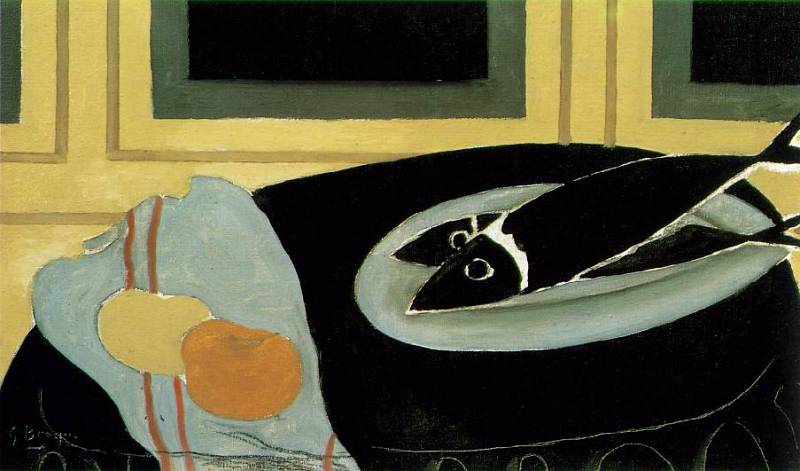
Black fish
Tamaño de la reproducción
Georges Braque's "Black Fish," painted in 1942 during the tumultuous years of World War II, is far more than a simple depiction of a fish and two apples. It’s a profound meditation on form, perception, and the quietude amidst chaos – a hallmark of the artist’s evolving Cubist style. The painting immediately draws the eye to the dominant black fish, rendered with an almost sculptural solidity that occupies a significant portion of the canvas. Its body isn't realistically modeled; instead, it’s fragmented into geometric planes, echoing the principles Braque developed alongside Pablo Picasso during their groundbreaking explorations of Cubism. This deliberate flattening of space challenges traditional notions of representation, inviting the viewer to actively engage with the image and reconstruct its form in their mind.
The record player, positioned centrally, acts as a grounding element within this fractured landscape. Its mechanical components – dials, knobs, and a rotating platter – introduce an unexpected layer of industrial detail into what might otherwise be considered a purely abstract composition. This juxtaposition of organic (the fish) and inorganic (the machine) is characteristic of Braque’s approach, suggesting a broader commentary on the relationship between nature and technology, a theme that resonated deeply during the mid-20th century.
Created in the aftermath of the First World War, “Black Fish” reflects the anxieties and uncertainties of the era. The devastation of conflict prompted artists to question established artistic conventions and seek new ways to represent reality. Braque’s Cubism, born from his collaboration with Picasso, offered a radical departure from traditional perspective and representation. Rather than aiming for an illusionistic portrayal of depth, Cubist painters like Braque dissected objects into their constituent geometric forms, presenting multiple viewpoints simultaneously on a single plane. This technique wasn't merely stylistic; it was a philosophical response to the fragmented nature of modern experience.
The painting’s monochromatic palette – primarily shades of gray and black – further contributes to its mood of introspection and restraint. This limited color range, reminiscent of Cézanne’s influence, emphasizes the interplay of light and shadow and allows Braque to focus on the essential shapes and structures within the composition. The apples, rendered with a similar geometric precision, add a touch of domesticity and perhaps even a subtle commentary on consumer culture – a recurring theme in Braque's work.
While “Black Fish” resists easy interpretation, certain symbolic readings are possible. The black fish itself could represent resilience, adaptability, or even the subconscious—a dark, enigmatic force navigating an unfamiliar world. Its placement above the record player might suggest a yearning for order and stability amidst the chaos of modern life, or perhaps a critique of the increasingly dominant role of technology in shaping human experience. The apples, traditionally associated with knowledge and temptation, could symbolize the complexities of choice and the pursuit of meaning.
Despite its formal rigor, “Black Fish” possesses an undeniable emotional depth. The painting’s quiet intensity invites contemplation and encourages viewers to consider their own perceptions of reality. It's a testament to Braque’s ability to distill complex ideas into a deceptively simple composition—a hallmark of his enduring artistic legacy.
WahooArt is proud to offer meticulously crafted, hand-painted reproductions of Georges Braque's "Black Fish." Our expert art reproductionists utilize the highest quality archival materials and techniques to faithfully recreate the painting’s nuanced details, textures, and color palette. Whether you are a seasoned collector or simply seeking a stunning piece of art for your home or office, our reproduction provides an authentic representation of this iconic work.
Available in a range of sizes to suit your needs, each WahooArt reproduction is individually inspected and guaranteed to meet the highest standards of quality. Explore our selection today and bring the contemplative power of “Black Fish” into your world.


1882 - 1963 , Francia
Explore the revolutionary world of Cubist Still Life with WahooArt. Discover Picasso & Braque's groundbreaking techniques, its philosophical roots, and lasting impact on modern art. Expert insights for collectors.

Explore the rich history of still life painting & the symbolism of fruit across art movements. Discover masterpieces from Caravaggio to Cézanne with WahooArt – expert guidance & museum-quality reproductions.

Explora los fundamentos estéticos y filosóficos del Expresionismo Cubista. Análisis profundo de Picasso, Braque y su impacto en el arte moderno. Guía experta para coleccionistas.
Descubre los 10 lienzos cubistas que revolucionaron el arte moderno. Explora las obras maestras de Picasso, Braque y Gris en WahooArt.com. Reproducciones de alta calidad para tu hogar.

Explore the captivating world of Severin Roesen, a major American still life painter influenced by Dutch masters. Discover his lush compositions and the symbolism within his art – a window into 19th-century America.


Manténgase al día con las últimas noticias de arte, ofertas exclusivas e ideas de decoración.
Cuéntanos sobre tu proyecto y nuestros expertos en arte te ofrecerán 3 sugerencias de obras personalizadas.
Permítenos seleccionar 3 opciones solo para ti – ¡Gratis!
 Compartir









 Leer más información
 La opción de vidrio solo está disponible en tamaños inferiores a 110 cm.


