Vista previa Vista previa en RA Encargar reproducción pintada a mano Ver versión en imagen digital Compartir
Ver detalles Guía Añadir a favoritos Descargar Ver artículos similares Radiografía Presentación de diapositivas Estadísticas

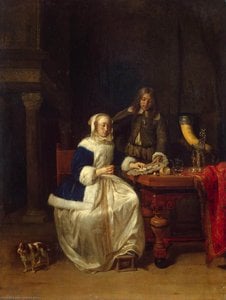
La Riboteuse

Descubre 'La Riboteuse' de Gabriel Metsu, una obra maestra del Siglo de Oro holandés que captura la dignidad y serenidad de una mujer mayor. Un retrato íntimo lleno de detalles y luz.

Descubre a Gabriël Metsu (1629-1667), pintor del Siglo de Oro Holandés, conocido por escenas de género, retratos e interiores. ¡Explora su legado!

Giclée / Impresión de arte

Impresiones giclée o en lienzo de calidad de museo con producción rápida y opciones de acabado flexibles. ( Encargar reproducción pintada a mano Ver versión en imagen digital)

Corner sample of the P118B picture frame: poliestireno moldeado, 5 cm wide and 3 cm thick
P118B €10
Corner sample of the P118H picture frame: poliestireno moldeado, 5 cm wide and 3 cm thick
P118H €10
Corner sample of the P118W picture frame: poliestireno moldeado, 5 cm wide and 3 cm thick
P118W €10
Corner sample of the P438Z picture frame: poliestireno moldeado, 5.5 cm wide and 3.5 cm thick
P438Z €10
Corner sample of the P508JH picture frame: poliestireno moldeado, 7 cm wide and 3.5 cm thick
P508JH €12
Corner sample of the P508YH picture frame: poliestireno moldeado, 7 cm wide and 3.5 cm thick
P508YH €12
Corner sample of the P805H picture frame: poliestireno moldeado, 5 cm wide and 3.5 cm thick
P805H €10
Corner sample of the P805Z picture frame: poliestireno moldeado, 5 cm wide and 3.5 cm thick
P805Z €10
Corner sample of the P919BZ picture frame: poliestireno moldeado, 7 cm wide and 3.5 cm thick
P919BZ €10
Corner sample of the P919G picture frame: poliestireno moldeado, 7 cm wide and 3.5 cm thick
P919G €10
Corner sample of the P919XJ picture frame: poliestireno moldeado, 7 cm wide and 3.5 cm thick
P919XJ €10
Corner sample of the P959ZH picture frame: poliestireno moldeado, 5 cm wide and 3 cm thick
P959ZH €10
Corner sample of the P968JZ picture frame: poliestireno moldeado, 6 cm wide and 4 cm thick
P968JZ €12
Corner sample of the W106C picture frame: madera maciza, 5 cm wide and 3 cm thick
W106C €8
Corner sample of the W218G picture frame: madera maciza, 5 cm wide and 3 cm thick
W218G €10
Corner sample of the W218JH picture frame: madera maciza, 5 cm wide and 3 cm thick
W218JH €8
Corner sample of the W218Y picture frame: madera maciza, 5 cm wide and 3 cm thick
W218Y €10
Corner sample of the W307PJ picture frame: madera maciza, 6 cm wide and 3 cm thick
W307PJ €10
Corner sample of the W316G picture frame: madera maciza, 6 cm wide and 3 cm thick
W316G €10
Corner sample of the W316PJ picture frame: madera maciza, 6 cm wide and 3 cm thick
W316PJ €8
Corner sample of the W316Y picture frame: madera maciza, 6 cm wide and 3 cm thick
W316Y €10
Corner sample of the W398PJ picture frame: madera maciza, 5 cm wide and 3 cm thick
W398PJ €8
Corner sample of the W4111J picture frame: madera maciza, 6.5 cm wide and 3.5 cm thick
W4111J €10
Corner sample of the W500HY picture frame: madera maciza, 7 cm wide and 5 cm thick
W500HY €15
Corner sample of the W500JH picture frame: madera maciza, 7 cm wide and 5 cm thick
W500JH €15
Corner sample of the W692G picture frame: madera maciza, 8 cm wide and 4 cm thick
W692G €12
Corner sample of the W849H picture frame: madera maciza, 5 cm wide and 3 cm thick
W849H €8
Corner sample of the W940BG picture frame: madera maciza, 7.5 cm wide and 4.5 cm thick
W940BG €15
Corner sample of the W953PJ picture frame: madera maciza, 6 cm wide and 3.5 cm thick
W953PJ €8

Estándar
personalizado
CM
INCH

Elija entre nuestros tamaños predefinidos que respetan las proporciones originales de la obra.

ancho
altura

Introduzca el ancho y el alto que necesite para adaptarse a su marco o pared. Una impresión solo puede recortarse, nunca hacerse más grande que la imagen original, por lo que un tamaño con una forma distinta perderá parte de la obra. Le enviaremos una maqueta digital para su aprobación antes de realizar cualquier impresión. La imagen que se muestra en esta página no refleja el recorte real; solo la maqueta lo hace.

Envío a todo el mundo () en 2 semanas en lugar de las 4/5 semanas estándar. (23 octubre)

Envío exprés gratuito a todo el mundo
Lienzo de lino de alta calidad
Seguro de envío completo
Garantía de reembolso de impuestos aduaneros
Garantía de fidelidad cromática exacta
Política de devolución de 100 días (solo por defectos)
Garantía de devolución del 100% del dinero
Oferta por volumen

Precio total

€ 60

La Riboteuse

Giclée / Impresión de arte

Tamaño de la reproducción

-

Precio total

€ 60

Datos clave

  • Influencias:
    • Tiziano
    • Veronese
  • Movimiento: Pintura holandesa
  • Dimensiones: Desconocidas
  • Medio: Óleo sobre lienzo

Cuestionario de arte

Cada pregunta tiene una única respuesta correcta.

Pregunta 1:
¿Cuál es el estilo artístico predominante en "La Riboteuse"?
Pregunta 2:
¿Qué técnica pictórica se utiliza prominentemente en la obra para crear volumen y dramatismo?
Pregunta 3:
¿Qué simbolismo pueden representar las jarras en la pintura?
Pregunta 4:
Gabriel Metsu es conocido por su estilo...
Pregunta 5:
¿Qué característica del retrato refleja la realidad de la vida cotidiana en el siglo XVII?

La Riboteuse de Gabriel Metsu: Un Reflejo de la Dignidad Cotidiana

“La Riboteuse” (The Washerwoman) by Gabriel Metsu, painted around 1665, is more than just a portrait; it’s a poignant window into the heart of 17th-century Dutch life. This intimate scene, rendered with an almost unsettling realism, captures a moment of quiet contemplation within a domestic setting – a world both familiar and subtly imbued with symbolic weight. Metsu, a remarkably eclectic artist whose career spanned diverse genres, here masterfully employs the techniques characteristic of the Dutch Golden Age to create an image that resonates deeply with viewers centuries later.

The painting immediately draws us in through its masterful use of light and shadow, a hallmark of chiaroscuro. A single, unseen source illuminates the woman’s face and hands, highlighting the intricate details of her worn clothing and the delicate wrinkles etched by time. These shadows, deep and velvety, create a sense of depth and volume, lending an almost sculptural quality to the figure. The muted earth tones – browns, ochres, creams, and subtle hints of red – dominate the palette, reflecting the practicality and simplicity of everyday life in Holland at that period. The artist’s meticulous attention to texture is equally remarkable; you can practically feel the roughness of the fabric, the smoothness of her skin, and the cool solidity of the jugs resting on the table.

El Contexto Histórico y la Eclecticidad de Metsu

To understand “La Riboteuse,” it’s crucial to consider Gabriel Metsu's place within the broader artistic landscape of the Dutch Golden Age. This era, marked by unprecedented prosperity and a burgeoning merchant class, witnessed an explosion of artistic creativity. Artists like Metsu were tasked with documenting the realities of daily life – not in grand historical narratives, but in intimate portraits of ordinary people. Metsu’s career was defined by his refusal to adhere strictly to any single style; he seamlessly blended elements from history painting, still life, portraiture, and genre scenes, earning him a reputation for remarkable versatility. This eclectic approach is vividly displayed here, combining the meticulous detail of a portrait with the symbolic richness often found in still lifes.

Born into a family connected to tapestry production – his father was a painter originally from Hainault – Metsu’s early exposure to diverse artistic traditions undoubtedly shaped his unique style. Leiden, where he spent much of his life, served as a vibrant hub for artistic exchange and innovation during this period. His relatively short but intensely productive career (1629-1667) produced only around 133 works, making each one exceptionally valuable and offering a rare glimpse into the mind of an artist grappling with form, light, and human experience.

Simbolismo y la Dignidad de una Mujer Común

Beyond its technical brilliance, “La Riboteuse” is rich in subtle symbolism. The jugs on the table are not merely decorative elements; they represent domestic labor, the essential work of women in 17th-century Holland. They speak to the rhythms of daily life and the quiet dignity of those who sustained the household. The woman’s expression – a mixture of thoughtfulness and perhaps a touch of melancholy – invites us to contemplate her story, her struggles, and her resilience. She is not idealized or romanticized; she is simply presented as an ordinary woman, worthy of our attention and respect.

Metsu's ability to capture such profound emotion with such understated grace is what elevates “La Riboteuse” beyond a mere depiction of a washerwoman. It’s a testament to his artistic skill and his deep understanding of the human condition. The painting serves as a powerful reminder that beauty can be found in the most unexpected places – in the everyday lives of ordinary people, rendered with exquisite detail and imbued with a quiet dignity.

Reproducciones de Alta Calidad para tu Espacio

WahooArt offers meticulously crafted reproductions of Gabriel Metsu’s “La Riboteuse,” allowing you to bring this remarkable artwork into your home or office. Our hand-painted reproductions faithfully capture the original's nuances, from the subtle variations in color and texture to the evocative lighting and emotional depth. Whether you are an art collector, a design enthusiast, or simply someone seeking a piece of history to enrich your surroundings, our reproductions provide an authentic and stunning representation of this iconic Dutch masterpiece. Explore our collection today and discover the timeless beauty of “La Riboteuse.”

Preguntas y respuestas

¿Qué atmósfera aportaría una reproducción de "La Riboteuse" de Gabriel Metsu a una habitación?

"La Riboteuse" de Gabriel Metsu tiene una atmósfera Calma y se recomienda para un/a Salón principal. El estado de ánimo es lo que la obra aporta al espacio que la rodea.

¿Permaneció "La Riboteuse" en el país de origen de su artista?

No; la obra se encuentra en el extranjero. "La Riboteuse" se encuentra en Francia, mientras que Gabriel Metsu nació en Países Bajos.

¿Con qué otros nombres se conoce a Gabriel Metsu?

Otros nombres registrados para Gabriel Metsu, creador de "La Riboteuse", incluyen Gabriël Metsu.


Biografía del artista

Una Vida de Exploración Artística: Gabriël Metsu

  • Nacimiento: Leiden, Países Bajos (1629)
  • Fallecimiento: 1667

Primeros Años e Influencias

Gabriël Metsu vivió una vida marcada por la exploración artística y la innovación. Nacido en 1629, era hijo de Jacques Metsu, un fabricante de tapices y pintor originario de Hainault. Este trasfondo diverso probablemente influyó en su temprano interés en diversas técnicas artísticas. La mudanza familiar a Leiden lo expuso a numerosas influencias culturales.

Carrera Artística: Un Estilo Ecléctico

La carrera de Metsu se caracterizó por una adhesión a ningún estilo o técnica única, ganándose el título de "un artista altamente ecléctico". Su obra abarcó pinturas históricas, bodegones, retratos y obras de género. Notablemente, solo 14 de sus 133 obras conocidas están fechadas, lo que deja mucho por descubrir sobre su proceso creativo.

  • Primeras Influencias: La influencia de Rembrandt van Rijn en la obra temprana de Metsu es evidente en su uso de la luz y el color.
  • Período de Ámsterdam (a partir de 1655): Su traslado a Ámsterdam marcó un cambio hacia interiores domésticos y escenas de género, con mayor énfasis en el detalle y el realismo.
  • Formación y Mentoría: Formó a Michiel van Musscher y Joost van Geel, lo que refleja su compromiso con la comunidad artística.

Obras Notables y Desarrollo Artístico

Las pinturas de Metsu a menudo presentaban mujeres jóvenes, escenas de mercado y ancianos, basándose en los emblemas populares de la época. Su estilo evolucionó a lo largo de su carrera, demostrando un dominio de diversas técnicas.

  • El Niño Enfermo (c. 1664): Esta obra refleja la admiración de Metsu por el meticuloso detalle y el uso de la luz de Johannes Vermeer.
  • Retrato de la Familia Hinlopen: Una obra maestra que combina la pintura de género con el retrato, mostrando su capacidad para capturar tanto el carácter individual como la vida doméstica.
  • El Hijo Pródigo (c. 1640): Demuestra una influencia barroca con su composición dramática y ricos detalles.
  • Temas Recurrentes: Metsu representó frecuentemente escenas de la vida cotidiana, a menudo imbuídas de significado simbólico.

Significado Histórico y Legado

El legado de Gabriël Metsu reside en su versatilidad y contribución a la Edad de Oro holandesa. Su estilo ecléctico, aunque a veces enigmático, influyó en generaciones posteriores de artistas. Hoy en día, sus obras se conservan en prestigiosos museos de todo el mundo.

  • Pintor de la Edad de Oro Holandesa: Es reconocido como una figura significativa dentro del vibrante panorama artístico del siglo XVII neerlandés.
  • Colecciones de Museos: Sus pinturas se pueden encontrar en varios museos, incluido el Rijksmuseum de Ámsterdam.
  • Apreciación Continua: El arte de Metsu continúa fascinando e inspirando a los espectadores con su realismo, detalle y sutiles narrativas.
Gabriel Metsu

Gabriel Metsu

1629 - 1667 , Países Bajos

Datos clave

  • Artistas Que Influyeron: ['Rembrandt van Rijn']
  • Fecha De Fallecimiento: 1667
  • Fecha De Nacimiento: 1629
  • Lugar De Nacimiento: Leiden, Países Bajos
  • Movimiento Artístico: Edad de Oro Holandesa
  • Nacionalidad: Holandés
  • Nombre Completo: Gabriël Metsu
  • Obras Notables:
    • El niño enfermo
    • Retrato de la familia Hinlopen
    • Vendedora de aves de corral
    • La escritora sorprendida
    • El hijo pródigo
Explore obras de arte organizadas por temas, estilos y características.