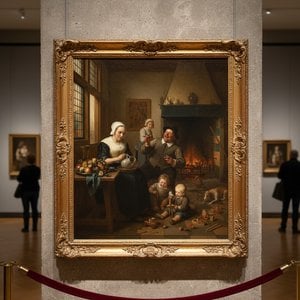
An Intimate Encounter in the Dutch Golden Age
In the quiet, shadowed corners of seventeenth-century Leiden, there existed a world defined by both extreme refinement and raw human impulse. Frans van Mieris the Elder, a master of the fijnschilder technique, captures this duality with breathtaking precision in his 1658 masterpiece, Brothel Scene. The painting invites the viewer into a private, almost voyeuristic moment, where a man kneels before a seated woman, their bodies positioned in a way that suggests a whispered confidence or a shared secret. This is not merely a depiction of a setting; it is a window into the psychological tension of an era caught between moral piety and the allure of earthly pleasures.
The composition is a masterclass in narrative intimacy. As the eye wanders through the room, it encounters the domestic markers of a life lived in the shadows: a sturdy chair, the soft folds of a bed in the background, and even the presence of a dog, often used in Dutch art to symbolize fidelity or, in more provocative contexts, base instincts. The inclusion of two bottles—one positioned to the left and another toward the right—hints at the indulgence that often accompanied such clandestine meetings. Every element, from the ticking clock on the wall to the subtle play of light on fabric, serves to ground this fleeting interaction in a tangible, breathing reality.
The Mastery of the Fijnschilder Technique
To behold a work by Van Mieris is to witness the pinnacle of Dutch technical virtuosity. As a student of Gerrit Dou, Van Mieris inherited the mantle of the fijnschilders, or "fine painters," whose primary goal was the erasure of the brushstroke itself. In Brothel Scene, this meticulous approach creates a surface so smooth and detailed that it feels almost photographic to the modern eye. The texture of the woman's garments, the glint of light on glass, and the soft warmth of skin are rendered with such care that the viewer can almost feel the atmosphere of the room.
For the discerning collector or interior designer, this painting offers more than just visual beauty; it offers a profound sense of depth and texture. The way the light falls across the scene creates a chiaroscuro effect that lends a dramatic weight to the subject matter. This level of detail makes a high-quality reproduction an extraordinary centerpiece for any curated space, providing a focal point that rewards prolonged contemplation. Whether placed in a contemporary gallery setting or a classic study, the painting’s ability to command attention through subtle nuance is unparalleled.
A Timeless Allure for Modern Spaces
Beyond its historical significance, Brothel Scene resonates with a timeless emotional complexity. It explores themes of desire, secrecy, and the human condition that remain deeply relevant today. The painting does not shout; it whispers, drawing the observer into its quiet drama through a sophisticated use of color and composition. This understated power makes it an ideal choice for those looking to infuse their interiors with a sense of history, intellect, and soulful elegance.
Integrating such a piece into a home or professional design project allows for a dialogue between the past and the present. The rich, earthy tones and the dramatic interplay of light and shadow provide a sophisticated palette that complements both traditional and modern decor. Owning a reproduction of this caliber is an invitation to celebrate the enduring legacy of the Dutch Golden Age, bringing a piece of art history into the intimate sanctuary of one's own surroundings.



 Vista previa
 Cambiar a formato impreso
 Compartir
 Compartir
 Ver detalles

 Descargar
 Ver artículos similares
 Radiografía
 Presentación de diapositivas
 Estadísticas


 Leer más






































 La opción de vidrio solo está disponible en tamaños inferiores a 110 cm.