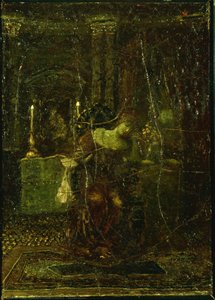
A Vision of Enchantment: Unveiling Frank Barrington Craig’s Goblin Market
In the realm of early twentieth-century British art, few works capture the ethereal tension between innocence and temptation as vividly as Frank Barrington Craig’s Goblin Market. Completed in 1911, this masterpiece serves as a breathtaking visual bridge between the lush, symbolic traditions of the Pre-Raphaelite movement and the refined academic realism of the Edwardian era. The painting transports the viewer into a shadowy, woodland sanctuary where the boundaries between our world and the supernatural dissolve. At its heart, we encounter a young woman caught in a moment of profound hesitation, surrounded by a troupe of mischievous goblins or fairies. The scene is thick with atmosphere, pulling the observer into a narrative that feels both like a whispered fairy tale and a dramatic stage performance.
The technical mastery displayed in this work is nothing short of extraordinary, making it a centerpiece worthy of any sophisticated collection. Craig, heavily influenced by his mentor Edwin Austin Abbey, employs a meticulous approach to texture and light. One can almost feel the dampness of the forest floor and the velvety skin of the forbidden fruits held within the goblins' baskets. Through the skillful use of chiaroscuro, Craig orchestrates a dramatic interplay of light and shadow; brilliant highlights dance upon the central figure, while deep, mysterious recesses in the foliage suggest the lurking unknown. This contrast does more than create depth—it heightens the psychological stakes of the encounter, casting a spell of suspense over the entire composition.
Symbolism and the Echoes of Victorian Lore
Beyond its surface beauty, Goblin Market is a profound exploration of literary and cultural motifs. The painting draws direct inspiration from the fantastical realms found in Shakespearean drama and, most notably, provides a visual interpretation of Christina Rossetti’s iconic narrative poem of the same name. Every element within the frame carries a weight of meaning: the basket serves as a symbol of sustenance and spiritual nourishment, while the woman’s gaze—a delicate blend of curiosity and apprehension—mirrors the universal human struggle with desire and moral choice. For the discerning collector or interior designer, this piece offers more than mere decoration; it provides a conversational focal point that invites deep contemplation of themes such as temptation, protection, and the allure of the unknown.
For those looking to infuse a space with a sense of wonder and historical gravity, a high-quality reproduction of this work offers an unparalleled opportunity. Whether placed in a sunlit library or a moody, contemporary study, the painting’s rich tonal palette and evocative subject matter command attention. It brings with it the spirit of a bygone era—a time when art sought to capture the magic hidden within the shadows of the natural world. To possess such a piece is to hold a fragment of Victorian enchantment, a timeless window into a forest where legends still breathe.



 Vista previa
 Cambiar a formato impreso
 Compartir
 Compartir
 Ver detalles
 Guía
Guía

 Descargar
 Ver artículos similares
 Radiografía
 Presentación de diapositivas
 Estadísticas


 Leer más