Vista previa Vista previa en RA Encargar reproducción pintada a mano Ver versión en imagen digital Compartir
Ver detalles Guía Añadir a favoritos Descargar Ver artículos similares Radiografía Presentación de diapositivas Estadísticas

Postcard

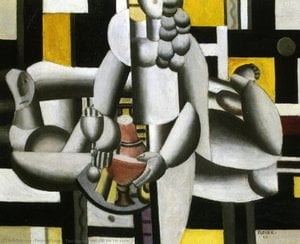
Explore Fernand Léger’s vibrant ‘Postcard,’ a captivating depiction of three women surrounded by birds and botanical elements—a bold fusion of abstraction and observation emblematic of the early 20th century's machine aesthetic. Discover this stunning reproduction and bring Léger’s artistic vision home.

Explore el arte de Fernand Léger (1881-1955), un pionero del Cubismo y 'Tubismo'. Descubre sus audaces pinturas figurativas que celebran la vida moderna, las máquinas y la forma humana. ¡Un precursor del Pop Art!

Giclée / Impresión de arte

Impresiones giclée o en lienzo de calidad de museo con producción rápida y opciones de acabado flexibles. ( Encargar reproducción pintada a mano Ver versión en imagen digital)

Corner sample of the P118B picture frame: poliestireno moldeado, 5 cm wide and 3 cm thick
P118B €10
Corner sample of the P118H picture frame: poliestireno moldeado, 5 cm wide and 3 cm thick
P118H €10
Corner sample of the P118W picture frame: poliestireno moldeado, 5 cm wide and 3 cm thick
P118W €10
Corner sample of the P438Z picture frame: poliestireno moldeado, 5.5 cm wide and 3.5 cm thick
P438Z €10
Corner sample of the P508JH picture frame: poliestireno moldeado, 7 cm wide and 3.5 cm thick
P508JH €12
Corner sample of the P508YH picture frame: poliestireno moldeado, 7 cm wide and 3.5 cm thick
P508YH €12
Corner sample of the P805H picture frame: poliestireno moldeado, 5 cm wide and 3.5 cm thick
P805H €10
Corner sample of the P805Z picture frame: poliestireno moldeado, 5 cm wide and 3.5 cm thick
P805Z €10
Corner sample of the P919BZ picture frame: poliestireno moldeado, 7 cm wide and 3.5 cm thick
P919BZ €10
Corner sample of the P919G picture frame: poliestireno moldeado, 7 cm wide and 3.5 cm thick
P919G €10
Corner sample of the P919XJ picture frame: poliestireno moldeado, 7 cm wide and 3.5 cm thick
P919XJ €10
Corner sample of the P959ZH picture frame: poliestireno moldeado, 5 cm wide and 3 cm thick
P959ZH €10
Corner sample of the P968JZ picture frame: poliestireno moldeado, 6 cm wide and 4 cm thick
P968JZ €12
Corner sample of the W106C picture frame: madera maciza, 5 cm wide and 3 cm thick
W106C €8
Corner sample of the W218G picture frame: madera maciza, 5 cm wide and 3 cm thick
W218G €10
Corner sample of the W218JH picture frame: madera maciza, 5 cm wide and 3 cm thick
W218JH €8
Corner sample of the W218Y picture frame: madera maciza, 5 cm wide and 3 cm thick
W218Y €10
Corner sample of the W307PJ picture frame: madera maciza, 6 cm wide and 3 cm thick
W307PJ €10
Corner sample of the W316G picture frame: madera maciza, 6 cm wide and 3 cm thick
W316G €10
Corner sample of the W316PJ picture frame: madera maciza, 6 cm wide and 3 cm thick
W316PJ €8
Corner sample of the W316Y picture frame: madera maciza, 6 cm wide and 3 cm thick
W316Y €10
Corner sample of the W398PJ picture frame: madera maciza, 5 cm wide and 3 cm thick
W398PJ €8
Corner sample of the W4111J picture frame: madera maciza, 6.5 cm wide and 3.5 cm thick
W4111J €10
Corner sample of the W500HY picture frame: madera maciza, 7 cm wide and 5 cm thick
W500HY €15
Corner sample of the W500JH picture frame: madera maciza, 7 cm wide and 5 cm thick
W500JH €15
Corner sample of the W692G picture frame: madera maciza, 8 cm wide and 4 cm thick
W692G €12
Corner sample of the W849H picture frame: madera maciza, 5 cm wide and 3 cm thick
W849H €8
Corner sample of the W940BG picture frame: madera maciza, 7.5 cm wide and 4.5 cm thick
W940BG €15
Corner sample of the W953PJ picture frame: madera maciza, 6 cm wide and 3.5 cm thick
W953PJ €8

Estándar
personalizado
CM
INCH

Elija entre nuestros tamaños predefinidos que respetan las proporciones originales de la obra.

ancho
altura

Introduzca el ancho y el alto que necesite para adaptarse a su marco o pared. Una impresión solo puede recortarse, nunca hacerse más grande que la imagen original, por lo que un tamaño con una forma distinta perderá parte de la obra. Le enviaremos una maqueta digital para su aprobación antes de realizar cualquier impresión. La imagen que se muestra en esta página no refleja el recorte real; solo la maqueta lo hace.

Envío a todo el mundo () en 2 semanas en lugar de las 4/5 semanas estándar. (16 octubre)

Envío exprés gratuito a todo el mundo
Lienzo de lino de alta calidad
Seguro de envío completo
Garantía de reembolso de impuestos aduaneros
Garantía de fidelidad cromática exacta
Política de devolución de 100 días (solo por defectos)
Garantía de devolución del 100% del dinero
Oferta por volumen

Precio total

€ 59

Postcard

Giclée / Impresión de arte

Tamaño de la reproducción

-

Precio total

€ 59

Datos clave

  • Location: Private Collection
  • Artist: Fernand Léger
  • Medium: Painting
  • Movement: Cubism
  • Subject or theme: Women; Birds; Clock; Plant

A Symphony of Form and Color: The Modernist Vision of Fernand Léger

In the vibrant tapestry of early twentieth-century modernism, few works capture the rhythmic pulse of the machine age as evocatively as Fernand Léger’s "Postcard." Painted during his most prolific creative era between 1925 and 1930, this masterpiece serves as a profound meditation on the intersection of human tradition and technological progress. At first glance, the viewer is greeted by three women, poised in a moment of quiet contemplation as they hold books to their chests. Yet, beneath this serene surface lies Léger’s signature Tubism—a style that celebrates the beauty of cylindrical forms and the geometric precision of an industrializing world. The painting does not merely depict a scene; it constructs a visual language where the organic and the mechanical dance in a delicate, colorful equilibrium.

The technique employed by Léger is nothing short of transformative. While his contemporaries often retreated into pure abstraction, Léger utilized a sophisticated blend of Cubist fragmentation and bold, saturated color palettes to create an illusionistic depth that defies simple representation. The figures are rendered with simplified, almost sculptural shapes, yet they possess a weight and presence that feels remarkably tangible. Through masterful tonal modulation, he breathes life into the canvas, allowing light to play across the geometric planes of the women’s garments and the surrounding environment. This approach creates a sense of movement and vitality, making the artwork feel less like a static image and more like a living, breathing fragment of a modern metropolis.

Symbolism and the Harmony of Contrasts

Beyond its striking aesthetic, "Postcard" is rich with symbolic layers that invite deep intellectual engagement. Léger masterfully weaves elements of nature into an otherwise mechanized composition to suggest a world where progress and biology coexist. The inclusion of two birds—one soaring near the top left and another nestled toward the bottom right—acts as a poignant metaphor for freedom and the boundless aspirations of the human spirit. These organic flourishes are balanced by the presence of a potted plant, which embodies resilience and the enduring strength of life amidst the steel and stone of urban existence. Even the prominent clock positioned at the upper center serves as a silent narrator, reminding us of the relentless march of time that shapes both our personal histories and the evolution of art itself.

For the discerning collector or interior designer, this artwork offers more than just visual splendor; it provides an emotional anchor. The juxtaposition of the women’s intellectual pursuits—symbolized by their books—against a backdrop of industrial geometry creates a narrative of intellectual grace within a fast-paced world. It is a piece that commands attention in any sophisticated space, offering a sense of structured calm and historical depth. Whether placed in a contemporary gallery setting or a classic study, "Postcard" inspires a sense of wonder, reminding us that even in an age of machines, the human soul remains the ultimate architect of beauty.

Preguntas y respuestas

¿Dónde puedo encontrar una guía de "Postcard"?

Una página de Guía está disponible para "Postcard" de Fernand Léger: una ficha imprimible sobre la obra, diseñada para estudiantes y uso en el aula.

¿En qué movimiento y en qué época se sitúa "Postcard" de Fernand Léger?

"Postcard" pertenece al movimiento Geometric Abstraction, y su creador trabajó en la época Edad Moderna.

¿Qué estado de ánimo expresa "Postcard" de Fernand Léger dentro de Geometric Abstraction?

La emoción Reflective de "Postcard" acompaña a su estilo Geometric Abstraction.


Biografía del artista

vida temprana y formación

fernand léger, un pintor, escultor y cineasta francés, nació el 4 de febrero de 1881 en Argentán, Orne, Baja Normandía. Su padre criaba ganado, y Léger inicialmente se formó como arquitecto de 1897 a 1899. Luego se mudó a París en 1900, ganándose la vida como dibujante arquitectónico.

desarrollo artístico

El trabajo temprano de Léger estuvo influenciado por el impresionismo, como se ve en le jardin de ma mère (mi madre's garden) (1905). Después de asistir a la escuela de artes decorativas y la academia Julian, comenzó a trabajar seriamente como pintor a los 25 años. Su estilo evolucionó hacia una forma personal del cubismo, que los críticos denominaron "tubismo" por su énfasis en las formas cilíndricas.

cubismo y el grupo puteaux

En 1910, Léger expuso en el salón de otoño junto a jean metzinger y henri le fauconnier. Se unió al grupo puteaux, también conocido como la sección dorada (la sección de oro), junto con otros artistas como francis picabia y marcel duchamp.

guerra y su influencia en el trabajo de léger

Las experiencias de Léger en la Primera Guerra Mundial impactaron significativamente su obra. Durante su tiempo en el frente, produjo dibujos de piezas de artillería, aviones y soldados compañeros. Su pintura soldier with a pipe (1916) refleja este período.

obra posterior y legado

La obra posterior de Léger, caracterizada por formas mecánicas y elegantes, lo vinculó a la tradición de la pintura figurativa francesa. Sus paisajes animados de 1921 mostraron figuras y animales en formas armoniosas y aerodinámicas. obras clave: museos que exhiben el trabajo de léger:
Fernand Léger

Fernand Léger

1881 - 1955 , Francia

Datos clave

  • Artistas Influenciados Por: ['Pop Art']
  • Artistas Que Influyeron:
    • Cézanne
    • Impresionismo
  • Fecha De Nacimiento: 4 de febrero de 1881
  • Lugar De Nacimiento: Argentan, Francia
  • Movimiento Artístico:
    • Cubismo
    • Tubismo
  • Nacionalidad: Francés
  • Nombre Completo: Fernand Léger
  • Obras Notables:
    • La Mujer Sentada
    • Elemento de Máquina
    • El Gran Desfile
    • Paisajes Animados
Explore obras de arte organizadas por temas, estilos y características.