Asesoría de arte gratuita

x
Encargar reproducción Encargar reproducciónComprar imagen en alta resolución Comprar imagen en alta resolución EnviarEnviar
DetallesDetalles Añadir a favoritos Añadir a favoritos DescargarDescargar SimilaresSimilares Rayos XRayos X Presentación de diapositivasPresentación de diapositivas

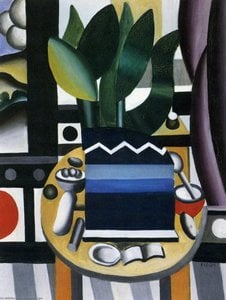
Flower lamp

Explore Fernand Léger’s ‘Flower Lamp’ (1951): A striking Cubist still life featuring a perfume bottle & flower in black & white. Linear hatching creates depth, celebrating modern beauty.

Explore el arte de Fernand Léger (1881-1955), un pionero del Cubismo y 'Tubismo'. Descubre sus audaces pinturas figurativas que celebran la vida moderna, las máquinas y la forma humana. ¡Un precursor del Pop Art!

Giclée / Impresión de arte

Impresión giclée o en lienzo de calidad de museo con producción rápida y opciones de acabado flexibles.

P118B $10
P118H $10
P118W $10
P438Z $10
P508JH $12
P508YH $12
P805H $10
P805Z $10
P919BZ $10
P919G $10
P919XJ $10
P959ZH $10
P968JZ $12
W106C $8
W218G $10
W218JH $8
W218Y $10
W307PJ $10
W316G $10
W316PJ $8
W316Y $10
W398PJ $8
W4111J $10
W500HY $15
W500JH $15
W692G $12
W849H $8
W940BG $15
W953PJ $8

Standard
custom
CM
INCH

Elija entre nuestros tamaños predefinidos que respetan las proporciones originales de la obra.

ancho
altura

Puede introducir sus propias dimensiones para adaptarse a un marco o espacio específico. Si el tamaño seleccionado no coincide con las proporciones de la imagen original, recortaremos la obra de arte o extenderemos la imagen con un borde con efecto espejo o de color sólido. Se enviará una maqueta digital para su aprobación antes de que comience la producción.
Tenga en cuenta que la vista previa en pantalla no refleja el recorte o la extensión real. Solo la maqueta mostrará con precisión la composición final.
Aunque existen tamaños personalizados, recomendamos seleccionar una dimensión de la lista predefinida para preservar las proporciones originales.

Entrega mundial () en 2 semanas en lugar de las 4/5 semanas estándar. (2 julio)

why_choose_icon
Envío exprés gratuito a todo el mundo
why_choose_icon
Lienzo de lino de alta calidad
why_choose_icon
Seguro de envío total
why_choose_icon
Garantía de reembolso de impuestos aduaneros
why_choose_icon
Garantía de fidelidad de color
why_choose_icon
Política de devolución de 60 días (solo por defectos)
why_choose_icon
Garantía de devolución del 100% del dinero
why_choose_icon
Descuento por pedido múltiple

Precio total

-

reproduction

Flower lamp

Giclée / Impresión de arte

Tamaño de la reproducción

-

Precio total final

-

Datos clave

  • subject: Still life
  • title: Flower lamp
  • notable elements: Perfume bottle, stylized flower, bold lines, asymmetrical composition
  • year: 1951
  • influences: Paul Cézanne
  • artist: Fernand Léger

Test de arte

Solo hay una respuesta correcta para cada pregunta.

Pregunta 1:
To what artistic movement is Fernand Léger's 'Flower Lamp' most closely associated?
Pregunta 2:
What is a prominent characteristic of the composition in 'Flower Lamp'?
Pregunta 3:
What materials were most likely used to create 'Flower Lamp'?
Pregunta 4:
The artwork depicts a combination of which two types of subjects?
Pregunta 5:
Fernand Léger's early work was initially influenced by which movement?

Descripción de la obra

A Cubist Still Life: Fernand Léger’s ‘Flower Lamp’ (1951)

  • Subject & Composition: ‘Flower Lamp’ presents a striking, almost architectural arrangement of everyday objects – a perfume bottle and a stylized flower – set against a flat, rectangular background. Léger eschews traditional perspective in favor of a fragmented, Cubist approach, presenting multiple viewpoints simultaneously. The composition is deliberately asymmetrical, yet balanced through the careful consideration of form and scale; the bottle’s solidity anchors the left side while the floral element provides visual counterweight on the right.
  • Style & Technique: Executed in stark black and white, this work exemplifies Léger's mature style – a powerful synthesis of Cubism and his own unique aesthetic often referred to as ‘Tubism.’ The artist employs bold, angular lines and simplified geometric shapes. Texture is skillfully created through meticulous linear hatching and cross-hatching, lending depth and volume despite the limited palette. This technique, likely achieved with pen or ink on paper, showcases Léger’s mastery of draftsmanship.

Léger & The Machine Age Aesthetic

  • Historical Context: Fernand Léger (1881-1955) was a pivotal figure in the development of modern art. Initially influenced by Impressionism and Cézanne, he quickly embraced Cubism, but diverged to create his own distinctive style. Emerging after World War I, Léger’s work reflects a fascination with the dynamism and mechanization of the industrial world. While ‘Flower Lamp’ doesn't explicitly depict machinery, it embodies this aesthetic through its simplified forms and emphasis on structure – echoing the precision and functionality of manufactured objects.
  • A Shift in Focus: Léger sought to create an “art of machines” that celebrated modern life. He believed art should be accessible and relevant to a broader audience, moving away from purely decorative or representational styles. This work, created in 1951, demonstrates his continued exploration of these themes even as artistic trends evolved.

Symbolism & Emotional Resonance

  • Juxtaposition and Meaning: The pairing of a perfume bottle – representing luxury, beauty, and perhaps femininity – with a stylized flower suggests a subtle interplay between the natural world and human artifice. Léger’s abstraction elevates these everyday objects to iconic status, prompting contemplation on themes of beauty, refinement, and the impact of modernity.
  • Emotional Impact: Despite its geometric rigor, ‘Flower Lamp’ possesses a quiet elegance and visual harmony. The stark contrast between black and white creates a sense of drama and sophistication. The work invites viewers to appreciate the inherent beauty in simplified forms and the power of abstract composition.

Biografía del artista

vida temprana y formación

fernand léger, un pintor, escultor y cineasta francés, nació el 4 de febrero de 1881 en Argentán, Orne, Baja Normandía. Su padre criaba ganado, y Léger inicialmente se formó como arquitecto de 1897 a 1899. Luego se mudó a París en 1900, ganándose la vida como dibujante arquitectónico.

desarrollo artístico

El trabajo temprano de Léger estuvo influenciado por el impresionismo, como se ve en le jardin de ma mère (mi madre's garden) (1905). Después de asistir a la escuela de artes decorativas y la academia Julian, comenzó a trabajar seriamente como pintor a los 25 años. Su estilo evolucionó hacia una forma personal del cubismo, que los críticos denominaron "tubismo" por su énfasis en las formas cilíndricas.

cubismo y el grupo puteaux

En 1910, Léger expuso en el salón de otoño junto a jean metzinger y henri le fauconnier. Se unió al grupo puteaux, también conocido como la sección dorada (la sección de oro), junto con otros artistas como francis picabia y marcel duchamp.

guerra y su influencia en el trabajo de léger

Las experiencias de Léger en la Primera Guerra Mundial impactaron significativamente su obra. Durante su tiempo en el frente, produjo dibujos de piezas de artillería, aviones y soldados compañeros. Su pintura soldier with a pipe (1916) refleja este período.

obra posterior y legado

La obra posterior de Léger, caracterizada por formas mecánicas y elegantes, lo vinculó a la tradición de la pintura figurativa francesa. Sus paisajes animados de 1921 mostraron figuras y animales en formas armoniosas y aerodinámicas. obras clave: museos que exhiben el trabajo de léger:
Fernand Léger

Fernand Léger

1881 - 1955 , Francia

Datos clave

  • Artistas Influenciados Por: ['Pop Art']
  • Artistas Que Influyeron:
    • Cézanne
    • Impresionismo
  • Fecha De Nacimiento: 4 de febrero de 1881
  • Lugar De Nacimiento: Argentan, Francia
  • Movimiento Artístico:
    • Cubismo
    • Tubismo
  • Nacionalidad: Francés
  • Nombre Completo: Fernand Léger
  • Obras Notables:
    • La Mujer Sentada
    • Elemento de Máquina
    • El Gran Desfile
    • Paisajes Animados
Explore obras de arte organizadas por temas, estilos y características.