Vende tus obras
x
Vista previaVista previa Vista previa en RAVista previa en RA Pedir impresión Pedir impresiónComprar descarga Comprar descarga CompartirCompartir
Ver detallesVer detalles Añadir a favoritos Añadir a favoritos DescargarDescargar Ver similaresVer similares RadiografíaRadiografía Presentación de diapositivasPresentación de diapositivas

Abstract composition (sheets)

This striking Orphism painting by Fernand Léger showcases bold geometric shapes – primarily circles – arranged dynamically across the canvas, punctuated by a prominent clock face. Executed in an unknown date, it exemplifies Léger's fusion of abstraction and industrial imagery.

Explore el arte de Fernand Léger (1881-1955), un pionero del Cubismo y 'Tubismo'. Descubre sus audaces pinturas figurativas que celebran la vida moderna, las máquinas y la forma humana. ¡Un precursor del Pop Art!

Reproducción al óleo hecha a mano

Óleo sobre lienzo pintado a mano en el tamaño y marco de su elección, realizado por encargo por nuestros artistas. (Pedir impresión Pedir impresiónComprar descarga Comprar descarga)

P118B $10
P118H $10
P118W $10
P438Z $10
P508JH $12
P508YH $12
P805H $10
P805Z $10
P919BZ $10
P919G $10
P919XJ $10
P959ZH $10
P968JZ $12
W106C $8
W218G $10
W218JH $8
W218Y $10
W307PJ $10
W316G $10
W316PJ $8
W316Y $10
W398PJ $8
W4111J $10
W500HY $15
W500JH $15
W692G $12
W849H $8
W940BG $15
W953PJ $8

Standard
custom
CM
INCH

Elija entre nuestros tamaños predefinidos que respetan las proporciones originales de la obra.

ancho
altura

Puede ingresar sus propias dimensiones para adaptarse a un marco o espacio específico. Si el tamaño seleccionado no coincide con las proporciones de la imagen original, recortaremos la obra o extenderemos la pintura con elementos adicionales pintados a mano. Se le enviará una maqueta digital para su aprobación antes de comenzar la producción.
Tenga en cuenta que la vista previa en pantalla no refleja el recorte o la extensión reales. Solo la maqueta mostrará con precisión la composición final.
Si bien existen tamaños personalizados, recomendamos seleccionar una dimensión de la lista predefinida para preservar las proporciones originales.

Ejemplos de lo que se puede personalizar: Reemplace el rostro con una foto del cliente; Agregue una mascota (por ejemplo, cambie un gato por un perro); Incluya un mensaje oculto en el fondo; Cambie el paisaje o los elementos del fondo.
Tras realizar el pedido, el equipo de WahooArt.com enviará un correo electrónico al cliente para solicitar instrucciones y proporcionarle una vista previa del boceto.

Envío a todo el mundo () en 3-4 semanas en lugar de las 5 semanas estándar. (20 agosto). Sin comprometer la calidad.

why_choose_icon
Envío exprés gratuito a todo el mundo
why_choose_icon
Lienzo de lino de alta calidad
why_choose_icon
Seguro de envío completo
why_choose_icon
Garantía de reembolso de aranceles aduaneros
why_choose_icon
Garantía de fidelidad cromática exacta
why_choose_icon
Política de devolución de 60 días (solo por defectos)
why_choose_icon
Garantía de devolución del 100% del dinero
why_choose_icon
Oferta por volumen

Precio total

$ 272

reproduction

Abstract composition (sheets)

Técnica de reproducción

Tamaño de la reproducción

-

Precio total

$ 272

Datos clave

  • Artist: Fernand Léger
  • Title: Abstract Composition (Sheets)
  • Dimensions: 45 x 35 cm
  • Medium: Oil on Canvas
  • Location: National Gallery of Art
  • Subject or theme: Machine Age
  • Artistic style: Geometric abstraction

Cuestionario de arte

Cada pregunta tiene una única respuesta correcta.

Pregunta 1:
What artistic movement is Fernand Léger's "Abstract Composition (Sheets)" associated with?
Pregunta 2:
The painting prominently features geometric shapes. Which of the following best describes the dominant visual element?
Pregunta 3:
What is a key characteristic of Léger's style that distinguishes it from many other artists of his time?
Pregunta 4:
The painting includes a clock. What role does this element serve in conveying the artwork's message?
Pregunta 5:
Where was Fernand Léger born?

Descripción de la obra

A Symphony of Geometric Form

In the heart of the early twentieth century, amidst the clatter of a world transforming through steam and steel, Fernand Léger captured something far more profound than mere machinery. His "Abstract Composition (Sheets)" stands as a breathtaking testament to the era's restless energy, acting not just as a painting, but as an embodiment of the anxieties and aspirations surrounding the burgeoning industrial revolution. Executed between 1916 and 1920, during the harrowing years of World War I, this masterpiece represents a radical departure from the fleeting sensory experiences of Impressionism. Instead, Léger sought to distill reality into its most fundamental geometric components, mirroring the mechanized world he observed with an unwavering, almost hypnotic fascination.
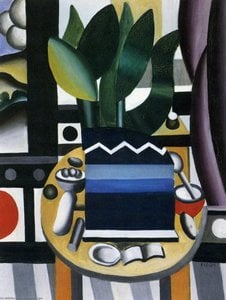
The canvas unfolds as a rhythmic dance of color and shape, dominated by a striking palette of ochre, crimson, and black. These are not merely decorative choices; they are colors chosen to convey the duality of progress—the strength of new construction paired with the inevitable decay of the old world. To gaze upon this work is to feel the pulse of a changing civilization, where every circle and line serves as a building block for a new visual language.

The Bold Embrace of Orphism

Within the lineage of modern art, "Abstract Composition (Sheets)" firmly establishes Léger within the vibrant movement known as Orphism. While his contemporaries in Cubism were often preoccupied with the fragmentation of objects into multiple perspectives, Léger and his peers prioritized the pure, emotive power of color and geometric abstraction. This piece is a masterclass in that philosophy, utilizing repetitive circular forms that appear to float and rotate across the surface, creating an incredible sense of depth and kinetic movement.

The technique employed here is nothing short of sculptural. Léger utilized encaustic paint—a rich mixture of pigment and beeswax—to achieve a textured, layered surface. This method allows the light to interact with the painting in a way that traditional oils cannot, imbuing the bold hues with a palpable, physical energy. Each meticulously placed circle contributes to a carefully orchestrated balance, ensuring that despite the abstraction, the composition feels grounded and intentional. For the discerning collector or interior designer, this texture offers a sophisticated tactile quality that brings a sense of history and substance to any modern space.

A Legacy of Modernity and Motion

To understand the emotional weight of this work, one must consider the shadows cast by the Great War. The devastation wrought upon Europe during Léger's creative period fueled a deep-seated need to find order within chaos. Through his "tubism" and later abstract styles, Léger integrated the dynamism of the machine age into a visual language that felt both futuristic and deeply rooted in the observable world. He did not retreat from reality into pure abstraction; rather, he found the soul of modernity within its very gears and pistons.

For those seeking to adorn a space with art that inspires contemplation and strength, this reproduction offers more than just aesthetic beauty. It provides a window into a pivotal moment in human history—a time when the world was being rebuilt from the ground up. Whether placed in a minimalist gallery setting or as a bold focal point in a contemporary living room, "Abstract Composition (Sheets)" continues to resonate with the same rhythmic, mechanical heartbeat that first captivated the avant-garde of Paris over a century ago.


Biografía del artista

vida temprana y formación

fernand léger, un pintor, escultor y cineasta francés, nació el 4 de febrero de 1881 en Argentán, Orne, Baja Normandía. Su padre criaba ganado, y Léger inicialmente se formó como arquitecto de 1897 a 1899. Luego se mudó a París en 1900, ganándose la vida como dibujante arquitectónico.

desarrollo artístico

El trabajo temprano de Léger estuvo influenciado por el impresionismo, como se ve en le jardin de ma mère (mi madre's garden) (1905). Después de asistir a la escuela de artes decorativas y la academia Julian, comenzó a trabajar seriamente como pintor a los 25 años. Su estilo evolucionó hacia una forma personal del cubismo, que los críticos denominaron "tubismo" por su énfasis en las formas cilíndricas.

cubismo y el grupo puteaux

En 1910, Léger expuso en el salón de otoño junto a jean metzinger y henri le fauconnier. Se unió al grupo puteaux, también conocido como la sección dorada (la sección de oro), junto con otros artistas como francis picabia y marcel duchamp.

guerra y su influencia en el trabajo de léger

Las experiencias de Léger en la Primera Guerra Mundial impactaron significativamente su obra. Durante su tiempo en el frente, produjo dibujos de piezas de artillería, aviones y soldados compañeros. Su pintura soldier with a pipe (1916) refleja este período.

obra posterior y legado

La obra posterior de Léger, caracterizada por formas mecánicas y elegantes, lo vinculó a la tradición de la pintura figurativa francesa. Sus paisajes animados de 1921 mostraron figuras y animales en formas armoniosas y aerodinámicas. obras clave: museos que exhiben el trabajo de léger:
Fernand Léger

Fernand Léger

1881 - 1955 , Francia

Datos clave

  • Artistas Influenciados Por: ['Pop Art']
  • Artistas Que Influyeron:
    • Cézanne
    • Impresionismo
  • Fecha De Nacimiento: 4 de febrero de 1881
  • Lugar De Nacimiento: Argentan, Francia
  • Movimiento Artístico:
    • Cubismo
    • Tubismo
  • Nacionalidad: Francés
  • Nombre Completo: Fernand Léger
  • Obras Notables:
    • La Mujer Sentada
    • Elemento de Máquina
    • El Gran Desfile
    • Paisajes Animados
Explore obras de arte organizadas por temas, estilos y características.