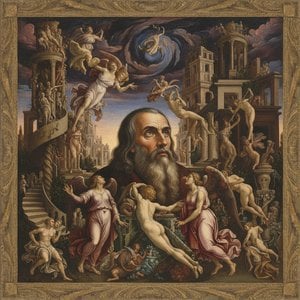
El Greco: A Master of Emotion and Vision
Doménikos Theotokópoulos, universally known as El Greco (meaning “the Greek”), stands as one of the most singular figures in the history of Western art—a painter who defied convention and forged a profoundly personal style that continues to resonate with audiences today. His dramatic canvases pulsated with an intensity rarely achieved by his contemporaries, blending Byzantine traditions with influences from Mannerism and Venetian Renaissance masters like Tintoretto and Titian. This fusion resulted in images brimming with spiritual fervor and psychological depth—a legacy that extends far beyond the confines of his time.
Born in Crete around 1541, El Greco’s early training was steeped in the Orthodox Byzantine tradition, where meticulous detail and symbolic color palettes reigned supreme. He mastered the techniques of icon painting, diligently replicating religious imagery with unwavering precision. However, this disciplined foundation served as a springboard for experimentation—a willingness to push boundaries that would define his artistic trajectory.
Around 1567, he embarked on a transformative journey to Venice, immersing himself in the vibrant atmosphere of the Renaissance epicenter. This exposure ignited his imagination and introduced him to groundbreaking stylistic innovations championed by artists like Titian and Tintoretto—techniques that would fundamentally alter his approach to painting. He skillfully absorbed these influences, incorporating dynamic compositions and luminous color palettes into his oeuvre.
The Dramatic Style of El Greco
El Greco’s distinctive style is instantly recognizable: elongated figures rendered with unsettling grace, bathed in ethereal light—a deliberate departure from the idealized forms favored by Renaissance artists. This technique wasn't merely aesthetic; it served as a conduit for conveying profound emotional states—fear, anguish, ecstasy—with unparalleled eloquence.
Consider his masterpiece, St Paul (1614), housed in the Museo del Prado in Madrid. The painting depicts Saint Paul holding a book and standing before a wall adorned with a sword—a powerful visual metaphor for faith confronting adversity. El Greco’s masterful use of color—particularly reds and yellows—creates an atmosphere of dramatic tension, while his elongated figures convey a sense of spiritual transcendence.
The artist's preoccupation with psychological realism is evident throughout his work. He sought to capture not just the outward appearance of his subjects but also their inner turmoil—a daring ambition that foreshadowed developments in Expressionism and Cubism decades later. El Greco’s canvases are imbued with a palpable emotional energy, inviting viewers to contemplate themes of faith, suffering, and redemption.
Legacy and Influence
El Greco's influence extends far beyond his own lifetime. Poets and writers such as Rainer Maria Rilke and Nikos Kazantzakis drew inspiration from his expressive style—recognizing its ability to convey profound spiritual truths with visceral immediacy. His pioneering approach to painting continues to inspire artists today, demonstrating the enduring power of artistic innovation.
Furthermore, El Greco’s work has captivated audiences across cultures and eras. Museums worldwide showcase reproductions of his iconic paintings—a testament to their timeless beauty and emotional resonance. Exploring El Greco's art offers a unique opportunity to engage with the complexities of human experience and to appreciate the transformative potential of artistic vision.
Preguntas y respuestas
¿Qué orientación tiene "st paul - -" de El Greco?
"st paul - -" de El Greco es una composición en Formato vertical. Se recomienda revisar las proporciones antes de elegir un tamaño de impresión.
¿Puedo ver una radiografía de "st paul - -" de El Greco?
"st paul - -" puede examinarse capa por capa en la página Radiografía de la obra, un visor inspirado en una mesa de luz de restauración que ofrece once lecturas ópticas de la imagen.
¿Cómo puedo ver "st paul - -" de El Greco en formato de presentación?
Disponible una presentación de diapositivas: la página Galería de imágenes de "st paul - -" de El Greco.



 Ver en contexto
 Comprar pintura hecha a mano
 Enviar
 Compartir
 Detalles
 Guía
Guía

 Descargar
 Similares
 Radiografía
 Presentación de diapositivas
 Q&A
Q&A Estadísticas


 Ver más






































 La opción de vidrio solo está disponible en tamaños inferiores a 110 cm.