A Study in Isolation: Unpacking Egon Schiele’s “Untitled (4015)”
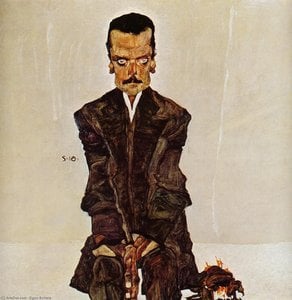
Egon Schiele's "Untitled (4015)," a stark black and white drawing, isn’t merely a depiction of a man seated before a mirror; it’s a profoundly unsettling exploration of vulnerability, mortality, and the anxieties simmering beneath the surface of early 20th-century consciousness. Created around 1916, during a period marked by immense personal turmoil and the looming shadow of World War I, this work exemplifies Schiele's signature style – characterized by elongated figures, feverish lines, and an unnerving intensity that pierces directly into the viewer’s psyche. The drawing captures a man in a state of quiet desperation, his posture suggesting both resignation and a barely contained struggle. The choice of black and white amplifies the emotional weight, stripping away any potential distraction from color and focusing attention squarely on form and expression.
Form and Technique: Schiele’s Expressive Lineage
Schiele's technique is immediately recognizable. The drawing isn’t rendered with smooth, polished surfaces; instead, it’s built up through a rapid succession of short, agitated lines – a deliberate rejection of academic precision in favor of raw emotionality. Notice the skeletal quality of the figure, accentuated by the loose application of charcoal. The sketchy appearance isn't accidental; it mirrors Schiele’s own internal state—a sense of fragility and instability. The man’s face is particularly arresting, his features gaunt and shadowed, conveying a profound sadness or perhaps even a touch of madness. The tennis racket held loosely in his hand adds an intriguing layer of complexity – a symbol of potential release, yet ultimately rendered inert by the scene's overall atmosphere of confinement.
Symbolism and Context: Echoes of Mortality
To understand “Untitled (4015),” it’s crucial to consider Schiele’s personal life during this period. His father’s death from syphilis had a devastating impact, fueling an obsession with illness, decay, and the inevitability of mortality – themes that permeate much of his oeuvre. The mirror itself is a potent symbol, reflecting not just the man's physical appearance but also his internal self-awareness and perhaps even a confrontation with his own perceived flaws. The drawing resonates with broader anxieties of the time—the disillusionment following the rapid social and technological changes of the era, coupled with the horrors unfolding on the European battlefields. It’s a visual embodiment of the psychological strain experienced by many during this tumultuous period.
A Legacy of Emotional Intensity
Schiele's work continues to captivate and disturb viewers today precisely because it refuses easy interpretation. “Untitled (4015)” isn’t a portrait in the traditional sense; it’s a psychological study, a raw and unflinching portrayal of human vulnerability. It speaks to our own anxieties about isolation, mortality, and the struggle to find meaning in a chaotic world. Reproductions of this powerful drawing offer a unique opportunity to engage with Schiele's intensely personal vision – a glimpse into the mind of an artist grappling with profound loss and existential questions. Consider how this piece might complement your interior design aesthetic; its stark simplicity and emotional depth can serve as a focal point, prompting contemplation and adding a layer of intellectual richness to any space.
- Key Features: Expressive charcoal drawing, elongated figure, skeletal portrayal, agitated lines, mirror motif, tennis racket.
- Historical Context: Early 20th century, World War I, anxieties of the modern condition.
- Symbolism: Mortality, isolation, self-awareness, potential for release (represented by the racket).
Explore more about Egon Schiele and his work on our website: Egon Schiele and view a detailed reproduction of “Untitled (4015)” here: “Untitled (4015)”



 Vista previa
 Encargar reproducción pintada a mano
 Compartir
 Compartir
 Ver detalles
 Guía
Guía

 Descargar
 Ver artículos similares
 Radiografía
 Presentación de diapositivas
 Estadísticas

 Leer más






































 La opción de vidrio solo está disponible en tamaños inferiores a 110 cm.