A Cry from Within: Decoding Egon Schiele’s Untitled (792)
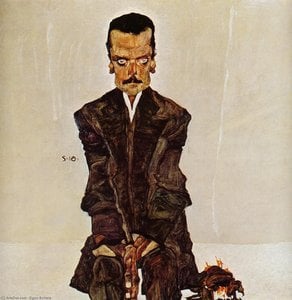
Egon Schiele's untitled (792) is not merely a painting; it’s a visceral outpouring of emotion, a raw and unflinching exploration of the human condition rendered in swirling lines and unsettling color. The work depicts a solitary female figure, dramatically posed with arms raised – an ambiguous gesture that can be interpreted as supplication, ecstasy, or even despair. Her body, painted in a striking shade of yellow, dominates the canvas, its form both vulnerable and defiant. This isn’t a celebration of the nude in the classical sense; rather, it's a psychological portrait, a window into an interior landscape fraught with tension and longing. The presence of two figures in the background, seemingly detached observers or perhaps participants in her emotional turmoil, adds to the painting’s enigmatic quality.
The Expressionist Tempest: Style and Technique
Schiele was a pivotal figure in Austrian Expressionism, a movement that sought to convey subjective emotion and experience rather than objective reality. untitled (792) exemplifies this approach through its distorted forms, jarring color palette, and energetic brushwork. The artist eschews traditional notions of beauty and anatomical accuracy, prioritizing instead the conveyance of inner turmoil. His lines are often jagged and angular, creating a sense of unease and instability. The yellow hue enveloping the figure is particularly significant; it can be seen as representing illness, decay, or perhaps even a feverish intensity of feeling – all themes frequently explored in Schiele’s oeuvre. He wasn't interested in replicating what he *saw*, but rather translating what he *felt* onto the canvas. This painting isn’t about precise representation; it’s about emotional resonance.
A Life Etched in Art: Historical Context and Personal Turmoil
To understand Schiele’s work, one must consider the context of his tragically short life (1890-1918). Born into a world grappling with societal upheaval and personal loss – including the early death of his father to syphilis and a complex upbringing under the control of an uncle – Schiele channeled his experiences into art. His work often reflects themes of sexuality, mortality, and alienation. He was deeply influenced by Gustav Klimt, who served as a mentor, but quickly surpassed his teacher in terms of radical experimentation and emotional intensity. Schiele’s willingness to confront taboo subjects and depict the human body with such unflinching honesty led to controversy during his lifetime; he even faced obscenity charges for his work. Yet, this very boldness is what continues to captivate audiences today.
The Language of Gesture: Symbolism and Emotional Impact
The raised arms in untitled (792) are a powerful symbol open to multiple interpretations. They could represent a reaching out for salvation, a desperate plea for connection, or even an expression of liberation. The figure’s nakedness isn’t simply about physical exposure; it symbolizes vulnerability and emotional rawness. The painting doesn’t offer easy answers or comforting resolutions. Instead, it invites the viewer to confront their own anxieties and desires. It is a work that lingers in the mind long after viewing, prompting introspection and challenging conventional notions of beauty and representation. The overall effect is profoundly moving – a testament to Schiele's ability to translate the complexities of the human psyche onto canvas.
Concluding Reflections: An Enduring Legacy
Schiele’s untitled (792) remains an unforgettable image, a haunting reminder of the artist’s profound engagement with existential questions. Its unsettling beauty derives from its refusal to indulge in sentimentality; instead, it confronts us with the uncomfortable truths of human experience. By stripping away illusion and embracing distortion, Schiele achieved a level of psychological depth rarely seen in his contemporaries, securing his place as one of the most influential figures of Expressionism and an artist whose work continues to resonate powerfully with audiences worldwide.
Preguntas y respuestas
¿Presenta "Título traducido: Untitled (792)" un fuerte contraste entre luces y sombras?
El contraste entre luces y sombras de "Título traducido: Untitled (792)" se registra como Declaración. El contraste describe la intensidad con la que difieren las zonas claras y oscuras.
¿Qué tono emocional transmite el estilo Expressionismo de "Título traducido: Untitled (792)"?
"Título traducido: Untitled (792)" transmite un tono emocional Melancólico dentro del movimiento Expressionismo.
¿En qué estancia se sugiere exhibir "Título traducido: Untitled (792)", considerando su paleta de colores?
Con su paleta de Tonos neutros, "Título traducido: Untitled (792)" de Egon Schiele es ideal para una Salón principal. Sus colores son parte de la razón de esta sugerencia.



 Ver en contexto
 Comprar pintura hecha a mano
 Enviar
 Compartir
 Detalles
 Guía
Guía

 Descargar
 Similares
 Radiografía
 Presentación de diapositivas
 Estadísticas
 Ver más






































 La opción de vidrio solo está disponible en tamaños inferiores a 110 cm.