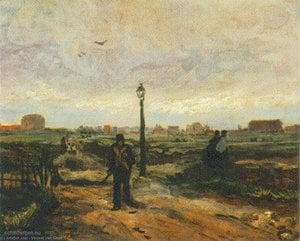
The Vibrant Pulse of Urban Life in Edouard Cortès' St. Martin
To stand before Edouard Cortès’ depiction of St. Martin is to be instantly enveloped by the exhilarating, yet strangely comforting, rhythm of city life itself. This painting is far more than a mere snapshot of a bustling Parisian thoroughfare; it is a vibrant meditation on human connection and the ceaseless energy that defines urban existence. Cortès, known as the “Parisian Poet of Painting,” possessed an unparalleled gift for capturing not just what Paris looked like, but how it felt to inhabit its winding streets. The scene explodes with life—pedestrians meandering along the sidewalk, the gleam of passing automobiles, and the occasional flash of a bicycle wheel—all woven together under the watchful gaze of the magnificent Porte St. Martin archway, which anchors the entire composition.
A Masterclass in Post-Impressionist Color and Movement
Stylistically, this work is a quintessential example of Post-Impressionism. Cortès moves beyond the fleeting immediacy of pure Impressionism, imbuing his subject matter with a deeper sense of structure, emotional resonance, and vivid color theory. Observe the palette: it is dominated by warm, golden tones that seem to emanate from the very cobblestones beneath the tires. These colors do not just decorate the scene; they evoke a profound sense of joie de vivre, a joyous appreciation for being alive in this moment. The technique itself speaks volumes through its bold and expressive brushstrokes. They are visible upon close inspection, lending a dynamic, almost palpable energy to the canvas, suggesting movement even where objects appear stationary.
Compositional Depth: Light, Shadow, and Human Detail
Cortès’ genius lies in his masterful handling of depth and light. The interplay between deep shadows cast by the architecture and the bright highlights catching on passing vehicles creates a remarkable dimensionality. Your eye is naturally drawn through the composition, guided first to the focal point—the grand archway—and then allowed to wander down the receding lines of the street. Beyond the major elements, notice the subtle details: the casually placed handbags near the foreground corners, the variety of vehicles from classic cars to motorcycles. These small inclusions ground the monumental scene in relatable human experience, suggesting a life lived fully and without pretense.
Bringing Parisian Energy Home
For the collector or designer seeking an artwork that breathes narrative into a space, St. Martin offers unparalleled emotional impact. It is art that refuses to be passive; it demands engagement. Owning a reproduction of this piece means inviting a piece of historical Parisian dynamism into your own home or gallery. It speaks to a timeless human condition—the beautiful chaos of gathering in public spaces. Whether you are drawn to the warmth of its golden hues, the energy of its depicted motion, or the sheer romance of its subject matter, Cortès’ vision ensures that this painting remains an enduring celebration of life in the great city.



 Ver en contexto
 Cambiar a Impresión
 Enviar
 Compartir
 Detalles

 Descargar
 Similares
 Radiografía
 Presentación de diapositivas
 Estadísticas

 Ver más






































 La opción de vidrio solo está disponible en tamaños inferiores a 110 cm.