Moonlight: A Study in Tranquil Luminosity
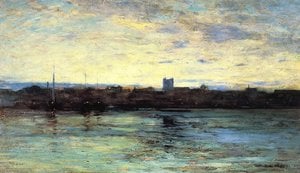
Dwight William Tryon’s “Moonlight,” painted in 1887, isn't merely a depiction of a rural landscape; it’s an immersion into a profound sense of quietude and the evocative power of light. Born in Hartford, Connecticut, during a period when American art was grappling with its own identity, Tryon emerged from a childhood deeply rooted in the rhythms of rural life – a formative experience that would profoundly shape his artistic vision. He eschewed the prevailing trends of the time, choosing instead to embrace the principles of tonalism, a style characterized by subdued colors and atmospheric effects, prioritizing mood and emotion over precise representation. This decision led him away from the bright palettes and detailed renderings favored by many of his contemporaries, establishing “Moonlight” as a cornerstone of his distinctive oeuvre. The painting captures a serene nighttime scene – rolling hills bathed in the soft glow of the moon, punctuated by scattered trees and hinting at a distant farmhouse nestled within the landscape. It’s a scene that invites contemplation, a moment suspended between darkness and light, reality and dream.
The Language of Tone: Technique and Composition
Tryon's mastery lies not in meticulous detail but in his skillful manipulation of tone – the subtle variations in value that create depth, form, and atmosphere. He achieves this through loose, expressive brushstrokes, layering washes of gray and white to build up the forms of the hills and trees. Notice how the darker tones recede into the distance, creating a convincing illusion of space and atmospheric perspective. The composition is deliberately horizontal, emphasizing the breadth of the landscape and drawing the eye across the scene. A carefully considered break in the treeline directs the viewer’s gaze towards the luminous center, where the moon hangs suspended in the sky. This strategic arrangement guides the viewer's eye through the painting, fostering a sense of peaceful exploration. The use of impasto – thick application of paint – adds textural interest to the foreground, grounding the scene and anchoring it within the viewer’s perception.
Symbolism and the Nocturne
The symbolism embedded within “Moonlight” is rich and layered. Moonlight itself has long been associated with mystery, introspection, and tranquility—qualities Tryon expertly captures in this work. The muted palette reinforces these associations, creating a mood of quiet contemplation. The distant farmhouse suggests a sense of rural simplicity and connection to the land, while the scattered trees evoke a feeling of solitude and isolation. The painting’s overall effect is one of profound stillness – a moment frozen in time, inviting the viewer to step into its serene embrace. It's not simply a representation of a landscape; it’s an evocation of a state of being. The choice of a nighttime scene further amplifies this symbolism, suggesting a realm beyond the everyday, where thoughts and emotions can freely roam.
Historical Context: Tonalism and American Identity
“Moonlight” emerged during a pivotal moment in American art history – the rise of tonalism in the late 19th century. Influenced by the Barbizon School painters of France, American tonalists sought to capture the essence of nature through subtle color gradations and atmospheric effects, rejecting the academic emphasis on realism and detailed representation. Tryon’s work exemplifies this movement perfectly, demonstrating a deep understanding of light and shadow and a commitment to expressing mood and emotion rather than simply depicting visual reality. His decision to focus on American landscapes—particularly those imbued with the quiet beauty of rural life—contributed to the development of a distinctly American artistic voice. The painting reflects a desire to capture the spirit of the nation, rooted in its connection to the land and its appreciation for simple pleasures.
A Legacy of Tranquility: Reproductions and Interior Design
Today, “Moonlight” stands as a testament to Tryon’s artistic vision—a timeless masterpiece that continues to resonate with viewers across generations. High-quality reproductions capture the painting's subtle nuances and atmospheric depth, making it an ideal addition to any home or office space. The painting’s calming palette and evocative imagery create a sense of serenity and tranquility, transforming any room into a haven of peace. Consider incorporating “Moonlight” into your interior design scheme—perhaps above a fireplace or in a study—to infuse your surroundings with its quiet beauty and timeless appeal. Its enduring power lies not just in its aesthetic qualities but also in its ability to transport the viewer to a place of profound stillness and contemplation.
Preguntas y respuestas
¿Hay una presentación de diapositivas para "Moonlight" de Dwight William Tryon?
El diaporama de "Moonlight" puede verse en la página Presentación de diapositivas de la obra.
¿En qué año se creó "Moonlight"?
"Moonlight" data de 1887. La fecha sitúa la obra dentro de la trayectoria de Dwight William Tryon y de su época.
¿Cuál es el tono emocional de "Moonlight" de Dwight William Tryon?
"Moonlight" se asocia con un sentimiento Tranquil. El tono emocional describe la impresión que transmite la obra.
¿Qué tono predominante recorre "Moonlight" de Dwight William Tryon?
El tono dominante de "Moonlight" de Dwight William Tryon es Green to Violet Spectrum. El tono es la base cromática de la paleta.
¿A qué edad creó Dwight William Tryon "Moonlight"?
Cuando se creó "Moonlight" en 1887, Dwight William Tryon —nacido/a en 1849— tenía 38 años.
¿Quién es el artista detrás de "Moonlight"?
"Moonlight" se atribuye a Dwight William Tryon.
¿Cómo se recomienda imprimir "Moonlight": qué tamaño y qué orientación?
Para "Moonlight", la configuración de impresión recomendada es un tamaño de Medium y una orientación Panoramic.



 Vista previa
 Encargar reproducción pintada a mano
 Compartir
 Compartir
 Ver detalles
 Guía
Guía

 Descargar
 Ver artículos similares
 Radiografía
 Presentación de diapositivas
 Estadísticas


 Leer más






































 La opción de vidrio solo está disponible en tamaños inferiores a 110 cm.