Primeros años y educación
David Hockney, un renombrado pintor, dibujante, grabador, diseñador de escenarios y fotógrafo inglés, nació el 9 de julio de 1937 en Bradford, Inglaterra. Fue el cuarto de cinco hijos de Laura y Kenneth Hockney, este último un objetor de conciencia durante la Segunda Guerra Mundial. Su educación temprana tuvo lugar en la escuela primaria Wellington, seguida por la Escuela Gramática de Bradford y, posteriormente, asistió al Colegio de Arte de Bradford.
Carrera y contribuciones
La carrera artística de Hockney floreció en la década de 1960 como una figura destacada del movimiento Pop Art. Su obra a menudo presentaba colores vibrantes, líneas audaces e imágenes reconocibles, convirtiéndolo en uno de los artistas británicos más influyentes del siglo XX.
- A Bigger Splash (1966), una pintura que muestra el estilo único de Hockney, es una pieza ejemplar del Pop Art.
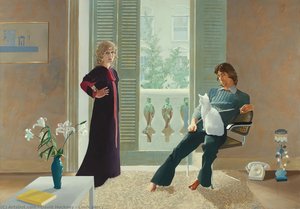
- Sus retratos dobles, como American Collectors (Fred and Marcia Weisman), demuestran su habilidad para capturar la esencia de sus sujetos.
- La exploración del amor gay en su retrato, como se ve en We Two Boys Together Clinging (1961), muestra su apertura y disposición a desafiar las normas sociales.
Evolución artística e influencias
Hockney experimentó con diversos medios y estilos a lo largo de su carrera. Inicialmente asociado al Pop Art, evolucionó hacia la exploración de la fotografía, el dibujo y la pintura paisajística. Sus viajes a California en la década de 1970 influyeron profundamente en su obra, llevando a una serie de pinturas vibrantes que capturan la luz y los colores del sur de California. Su interés por la perspectiva y la representación del espacio se evidencia en sus paisajes, donde experimentó con diferentes técnicas para transmitir la profundidad y el movimiento. La influencia de artistas como Henri Matisse y Pablo Picasso es palpable en su enfoque innovador de la forma y el color.
Logros y reconocimiento
A lo largo de su ilustre carrera, Hockney ha recibido numerosos reconocimientos:
- Fue nombrado Order of the Companion of Honour (CH) en 2018.
- Fue elegido Fellow of the Royal Society (FRS) en 2003.
- Recibió la Laureate of the Praemium Imperiale para pintura en el año 2000.
Además de estos prestigiosos honores, sus obras se encuentran en las colecciones de los museos más importantes del mundo y han sido objeto de numerosas exposiciones internacionales.
Legado e impacto histórico
El profundo impacto de David Hockney en el mundo del arte, particularmente en el ámbito del Pop Art, es innegable. Su estilo innovador y su disposición a explorar diversos temas han consolidado su posición como uno de los artistas británicos más influyentes del siglo XX. Su capacidad para capturar la esencia de la vida moderna, ya sea a través de sus vibrantes pinturas de piscinas o sus retratos íntimos, ha dejado una huella imborrable en la historia del arte. Su continua experimentación con nuevos medios y tecnologías lo mantiene como un artista relevante e influyente en el siglo XXI.



 Vista previa
 Encargar reproducción pintada a mano
 Compartir
 Compartir
 Ver detalles
 Guía
Guía

 Descargar
 Ver artículos similares
 Radiografía
 Presentación de diapositivas
 Estadísticas

 Leer más






































 La opción de vidrio solo está disponible en tamaños inferiores a 110 cm.