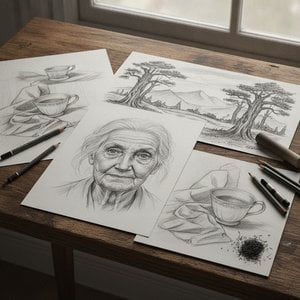
The Genesis of a Vision: David Bomberg's 'Sketch'
David Bomberg’s “Sketch,” painted in 1948, isn’t merely a depiction of a scene; it’s an embodiment of the artist’s evolving vision during a pivotal period in British art. Born into a Polish-Jewish family in Birmingham and deeply influenced by the avant-garde movements swirling around London – Cubism, Futurism, and the radical ideas championed by Roger Fry – Bomberg sought to translate these complex influences into a distinctly personal language. This particular work, created shortly after his expulsion from the Slade School of Art for his perceived “audacity,” reflects both a rejection of academic constraints and an embrace of dynamic abstraction. The painting’s raw energy and fragmented forms speak volumes about the anxieties and transformations shaping the post-war artistic landscape.

A Symphony of Color and Geometry
Bomberg’s technique in “Sketch” is immediately arresting. He employs a bold, almost aggressively simplified palette dominated by vibrant reds, oranges, and yellows – colors that evoke both heat and intensity. These hues are layered and blended with remarkable skill, creating a sense of depth and movement despite the painting's predominantly geometric structure. The composition itself is fractured, composed of interlocking planes and angular shapes that seem to vibrate with energy. This deliberate fragmentation isn’t chaotic; rather, it mirrors the artist’s exploration of form and his desire to capture not just what he *saw*, but how he *felt* about what he saw. The use of thick impasto – applying paint in heavy layers – adds a tactile quality to the work, inviting the viewer to engage with its surface.
- Color Palette: Primarily reds, oranges, and yellows; punctuated by blues and greens.
- Technique: Bold impasto, layered application of paint, geometric abstraction.
- Composition: Fragmented planes and angular shapes creating a sense of dynamism.
Roots in the Whitechapel Boys and Beyond
Bomberg was part of the “Whitechapel Boys,” a group of young artists who challenged the established artistic conventions of early 20th-century London. This collective, including Mark Gertler and Stanley Spencer, were deeply influenced by the avant-garde movements emerging from Paris and Italy. His time at the Slade School of Art, under the tutelage of Henry Tonks, provided a crucial foundation, but Bomberg quickly surpassed his teacher’s more traditional approach. His work reflects this trajectory, incorporating elements of Cubism – particularly in its emphasis on multiple perspectives – alongside the dynamism of Futurism and the emotional intensity of Expressionism. Further research reveals that Bomberg's exploration of Jerusalem Church (as documented in a separate WahooArt article) demonstrates his continued interest in capturing spiritual themes through abstract forms.
Historical Context:** The painting was created during a period of significant social and political upheaval following World War I, reflecting the anxieties and uncertainties of the time.
Influences: Cubism, Futurism, Roger Fry’s Post-Impressionist exhibitions.
Decoding the Emotional Landscape
“Sketch” is more than just a visually striking composition; it's an exploration of emotional states. The intense colors and fragmented forms evoke feelings of both excitement and unease. Some art historians interpret the painting as a reflection of Bomberg’s personal struggles, particularly his experiences in the trenches during World War I. The dynamism of the composition suggests a restless spirit, while the underlying geometric structure hints at an attempt to impose order on chaos. Ultimately, “Sketch” invites viewers to contemplate the complexities of human experience and the power of art to capture the intangible.
Preguntas y respuestas
¿De qué trata "Sketch" y qué atmósfera transmite?
"Sketch" de David Bomberg representa horse, landscape, color, movement, composition, figure, red background, con un ambiente Calm. El tema y la atmósfera describen juntos la obra.
¿En qué año y bajo qué movimiento se realizó "Sketch"?
"Sketch" fue creada en 1948 como una obra del movimiento Early Modern. La fecha y el movimiento sitúan la obra en la historia del arte.
¿Quién es el autor de "Sketch" y a qué movimiento pertenece?
Detrás de "Sketch" se encuentran David Bomberg y el movimiento Early Modern.



 Vista previa
 Encargar reproducción pintada a mano
 Compartir
 Compartir
 Ver detalles
 Guía
Guía

 Descargar
 Ver artículos similares
 Radiografía
 Presentación de diapositivas
 Estadísticas


 Leer más






































 La opción de vidrio solo está disponible en tamaños inferiores a 110 cm.