A Whirlwind of Color and Form: David Bomberg’s “Circus”
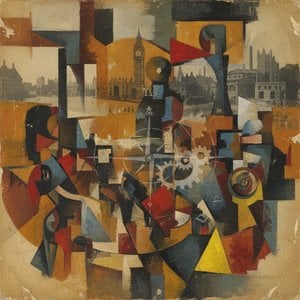
David Bomberg's "Circus (Abstract Composition)," painted in 1921, isn’t merely a depiction of a traveling show; it’s an explosion of energy, emotion, and the restless spirit of early modernism. This vibrant canvas, now housed at the Ashmolean Museum in Oxford, captures a fleeting moment within a chaotic yet strangely ordered spectacle – a testament to Bomberg's unique ability to distill complex experience into powerful visual form. The painting immediately assaults the senses with its bold palette: assertive blues and reds clash dynamically against yellows and whites, creating an atmosphere of both excitement and underlying tension.
Bomberg’s style during this period was deeply influenced by the avant-garde movements sweeping through Europe. He absorbed the geometric abstraction of Cubism – evident in the fragmented forms suggesting figures and structures – while simultaneously embracing the dynamism and expressive power of Futurism, particularly its fascination with movement and speed. The painting's composition isn’t static; it feels like a captured rush, a snapshot of a scene perpetually in motion. Notice how the figures are reduced to angular shapes, almost dissolving into the swirling colors, mirroring the fragmented reality presented by Cubist principles.
The Artist and His Time
Born in Birmingham in 1890, David Bomberg’s early life was shaped by his Polish-Jewish heritage and a challenging upbringing. He initially trained as a lithographer but quickly gravitated towards painting, finding himself drawn to the radical artistic currents of the time. He became part of the “Whitechapel Boys,” a group of East End artists who pushed against established conventions and experimented with new forms of expression. This group, including Mark Gertler and Stanley Spencer, formed a vital network of support and influence during a period of significant social and political upheaval in Britain.
Bomberg’s artistic journey was marked by experimentation and controversy. His early work, particularly his engagement with Cubism and Futurism, drew criticism from some quarters who viewed these movements as overly abstract or even decadent. However, Bomberg remained steadfast in his pursuit of a new visual language, reflecting the anxieties and aspirations of a rapidly changing world. His expulsion from the Slade School of Art in 1913, due to his perceived disregard for traditional artistic methods, further solidified his position as an outsider artist challenging established norms.
Decoding the Composition: Symbolism and Emotion
While seemingly abstract, “Circus” is rich with symbolic potential. The figures themselves – a jumble of shapes suggesting people and animals – represent not individual portraits but rather archetypal elements of the circus experience: performers, spectators, and the spectacle itself. The swirling colors aren’t simply decorative; they convey a sense of disorientation, excitement, and perhaps even underlying unease. The dominant blues could symbolize both the vastness of the sky and the melancholy associated with transient experiences.
Consider the elephant in the center of the composition. It's not rendered realistically but rather as a powerful, simplified form – a symbol of strength, memory, and perhaps even the weight of tradition. The overall effect is one of controlled chaos, inviting the viewer to contemplate the complexities of human experience within a world of illusion and spectacle. Bomberg masterfully uses color and form to evoke a visceral response, capturing not just what he saw but also how he *felt* about it.
A Legacy of Innovation
“Circus (Abstract Composition)” stands as a pivotal work in David Bomberg’s oeuvre and a significant example of early British abstraction. It demonstrates his willingness to embrace radical experimentation, blending influences from Cubism, Futurism, and his own unique artistic vision. His exploration of form, color, and emotion paved the way for subsequent generations of artists, solidifying his place as a key figure in the development of modern art in Britain. Reproductions of this dynamic painting continue to resonate with viewers today, offering a glimpse into the turbulent yet exhilarating world of early 20th-century artistic innovation.
Preguntas y respuestas
¿Qué técnica se utilizó para "Circus (Abstract Composition)" y cuándo fue creado?
"Circus (Abstract Composition)" fue creada en 1921 mediante la técnica de Acrylic On Canvas. El material y la fecha describen cómo y cuándo se realizó la obra original.
¿Qué técnica se utilizó para "Circus (Abstract Composition)" de David Bomberg?
David Bomberg utilizó la técnica de Acrylic On Canvas para "Circus (Abstract Composition)". La técnica define la naturaleza material de la obra original.
¿En qué año se creó "Circus (Abstract Composition)" de David Bomberg?
"Circus (Abstract Composition)" data de 1921. La fecha sitúa la obra dentro de la trayectoria de David Bomberg y de su época.
¿A qué artista se le atribuye "Circus (Abstract Composition)"?
"Circus (Abstract Composition)" se atribuye a David Bomberg.
¿Permaneció "Circus (Abstract Composition)" en el país de origen de su artista?
Sí, la obra se encuentra en el país de origen del artista. David Bomberg nació en Reino Unido, y el original de "Circus (Abstract Composition)" se encuentra en un museo de Reino Unido.
¿A qué edad creó David Bomberg "Circus (Abstract Composition)"?
Cuando se creó "Circus (Abstract Composition)" en 1921, David Bomberg —nacido/a en 1890— tenía 31 años.
¿Dónde se recomienda exhibir el formato Landscape de "Circus (Abstract Composition)"?
Con su formato Landscape, se sugiere una reproducción de "Circus (Abstract Composition)" para un Living Room.



 Vista previa
 Cambiar a formato impreso
 Compartir
 Compartir
 Ver detalles
 Guía
Guía

 Descargar
 Ver artículos similares
 Radiografía
 Presentación de diapositivas
 Estadísticas


 Leer más






































 La opción de vidrio solo está disponible en tamaños inferiores a 110 cm.