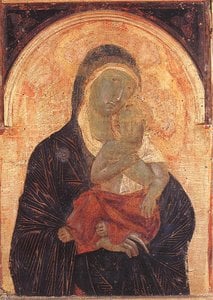
rompiendo el estilo italo-bizantino
Cimabue, nacido alrededor de 1240 y fallecido en 1302, fue un influyente pintor y diseñador de mosaicos italiano de Florencia, también conocido como
cenni di pepo. Pionero en romper con el estilo italo-bizantino, Cimabue es celebrado por introducir proporciones y sombreado más realistas en su obra, marcando un significativo cambio hacia el realismo en el arte medieval.
vida temprana y formación
Se sabe poco sobre la vida temprana de Cimabue. Una fuente que relata su carrera es la
Vida de los más excelentes pintores, escultores y arquitectos de Giorgio Vasari, pero su exactitud es incierta. Nació en Florencia y murió en Pisa. Según el historiador del arte Pietro Tosca, la obra más temprana atribuida a Cimabue, la crucifixión en la iglesia de
San Domenico en Arezzo, data alrededor de 1270 y muestra una desviación del estilo bizantino.
obras notables
* Maestà (originalmente expuesta en la iglesia de
San Francesco en Pisa, ahora en el Louvre): Esta obra estableció un estilo que fue seguido posteriormente por numerosos artistas, incluyendo
Duccio di Buoninsegna en su
Rucellai Madonna (erróneamente atribuida a Cimabue en el pasado). * Flagelación (
Colección Frick): Una pintura de taller que quizás sea atribuible a un período ligeramente posterior. * Mosaicos para el
Baptisterio de Florencia (ahora en gran parte restaurado): Actualmente en mal estado debido a la oxidación de los colores más brillantes.
influencia y legado
El arte de Cimabue jugó un papel crucial en la transición del estilo bizantino a representaciones más realistas en la pintura italiana, y su influencia en artistas posteriores fue profunda. Sus obras, caracterizadas por una combinación de técnicas tradicionales e innovadoras, marcan un importante capítulo en la historia del arte, conectando el período medieval con los estilos renacentistas.
Descubra el mundo del arte con WahooArt.com, donde puede encontrar una vasta colección de obras de arte, incluyendo las de Cimabue y otros artistas reconocidos.



 Ver en contexto
 Comprar pintura hecha a mano
 Enviar
 Compartir
 Detalles

 Descargar
 Similares
 Radiografía
 Presentación de diapositivas
 Stats
Stats

 Ver más






































 La opción de vidrio solo está disponible en tamaños inferiores a 110 cm.