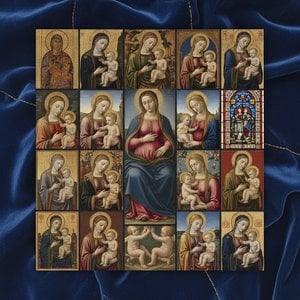
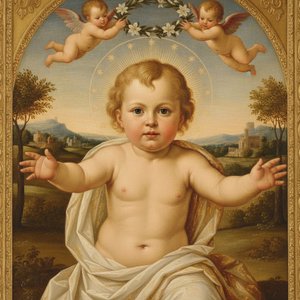
A Regal Vision of Faith: The Luminous World of Carlo Crivelli
In the quiet sanctity of the late 15th century, few artists could command the eye with as much decorative splendor and spiritual intensity as Carlo Crivelli. His masterpiece, "Virgin and Child Enthroned," completed around 1476, stands as a breathtaking portal into the Late Gothic soul. This is not merely a painting; it is an immersive experience of divine presence. As one gazes upon this exquisite work, the viewer is immediately struck by a sense of profound majesty. The Virgin Mary, crowned and richly dressed as the Queen of Heaven, sits regally upon a marble throne, cradling the Christ Child in her arms. The composition radiates a celestial calm, yet it is charged with a meticulous, almost hyper-real detail that pulls the observer into a world where the sacred and the material intersect.
Crivelli’s unique artistic journey provides the essential backdrop for such a captivating creation. Born in Venice around 1435, he was steeped in the Venetian tradition, absorbing the luminous color palettes and linear precision of masters like Vivarini and Mantegna. However, as he moved toward the Marche region, his style evolved into something entirely singular. While his contemporaries in Florence were embracing the sweeping humanism of the High Renaissance, Crivulously embraced a more conservative, decorative Late Gothic aesthetic. This choice allowed him to master the trompe l’oeil technique—a skillful manipulation of perspective that creates an illusion of three-dimensional reality. Through thin, layered glazes of tempera on wood, he achieved a textural depth so profound that the viewer can almost feel the weight of the crown and the smoothness of the marble throne.
Symbolism and the Art of Detail
Every element within this composition serves a higher theological purpose, woven into a tapestry of symbolic meaning. The presence of the apples, positioned with deliberate care near the edges of the frame, acts as a poignant reminder of the Fall of Man, contrasting sharply with the purity of the Virgin and the promise of salvation embodied by the Christ Child. This interplay between sin and redemption is central to the emotional impact of the piece. Crivelli’s attention to detail—from the intricate patterns on the garments to the subtle shadows cast by the figures—creates a sense of "materiality" that makes the divine feel tangibly present in our own world.
For the discerning collector or interior designer, this artwork offers more than just historical significance; it provides a focal point of unparalleled elegance. The painting’s ability to balance heavy, ornamental detail with a serene, meditative atmosphere makes it a versatile choice for sophisticated spaces. Whether placed in a gallery-style setting or as a centerpiece in a classically designed room, a high-quality reproduction of this work brings with it an aura of timelessness and intellectual depth. It is a piece that invites long periods of contemplation, rewarding the viewer with new discoveries of light and shadow upon every encounter.



 Vista previa
 Cambiar a formato impreso
 Compartir
 Compartir
 Ver detalles
 Guía
Guía

 Descargar
 Ver artículos similares
 Radiografía
 Presentación de diapositivas
 Estadísticas


 Leer más






































 La opción de vidrio solo está disponible en tamaños inferiores a 110 cm.