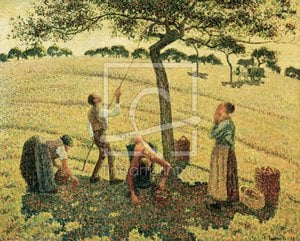
Camille Pissarro: Una Vida en el Arte
Primeros Años y Formación
Jacob Abraham Camille Pissarro nació el 10 de julio de 1830, en Charlotte Amalie, San Tomás (entonces las Islas Vírgenes Occidentales danesas, ahora las Islas Vírgenes de EE. UU.). Su padre, Frederick Abraham Gabriel Pissarro, era de ascendencia judía portuguesa con nacionalidad francesa, y su madre, Rachel Manzano-Pomié, provenía de una familia judía francesa. Su crianza fue algo poco convencional debido a la herencia mixta y las circunstancias de sus padres. Recibió su formación artística temprana en la Academia Savary en Passy, cerca de París, donde desarrolló una apreciación por los maestros del arte francés y fue animado a dibujar de la naturaleza.
A los 17 años, Pissarro regresó a San Tomás y continuó dibujando durante sus descansos mientras trabajaba como empleado de carga. Este período le inculcó una aguda observación de la vida cotidiana y el mundo natural – temas que se convertirían en centrales en su arte.
Desarrollo Artístico e Influencias
En 1855, Pissarro se mudó a París, trabajando como asistente del pintor danés Anton Melbye. Estudió las obras de Gustave Courbet, Jean-Baptiste-Camille Corot, Honoré Daumier, y Charles-François Daubigny, cuyos estilos influyeron profundamente en su trabajo temprano. Encontró la educación artística formal en instituciones como la École des Beaux-Arts sofocante y buscó instrucción alternativa de Corot.
Inicialmente, los cuadros de Pissarro se adherían a los estándares tradicionales, expuestos en el Salón de París. Su primer cuadro fue aceptado en 1859. Sin embargo, pronto comenzó a experimentar con pinceladas más sueltas y un enfoque en capturar los efectos fugaces de la luz – señuelos del Impresionismo.
Contribución al Impresionismo y Más Allá
Camille Pissarro se considera una figura fundamental tanto en el Impresionismo como en el Postimpresionismo. Fue el único artista que expuso en todas las ocho exposiciones impresionistas de París (1874-1886), actuando como una fuerza estabilizadora dentro del grupo. No fue solo un exhibidor; activamente animó y apoyó a sus compañeros artistas, lo que le valió el apodo de “el padre figura” del movimiento.
Más tarde en su carrera, Pissarro exploró el Neoimpresionismo, influenciado por Georges Seurat y Paul Signac, empleando una técnica puntillista durante un período antes de regresar a un estilo más personal.
Logros Principales y Temas
- Paisajes: Pissarro es reconocido por sus representaciones de paisajes rurales y urbanos, a menudo centrándose en escenas de la vida cotidiana.
- Escenas de Vida Parisina: Capturó las bulliciosas calles y el vibrante ambiente de París durante un período de rápidos cambios.
- Vida Campesina: Sus cuadros frecuentemente retratan la vida y el trabajo de los campesinos, reflejando su conciencia social.
- Influencia en Artistas Jóvenes: Pissarro orientó y profundizó en el desarrollo artístico de Paul Cézanne, Vincent van Gogh, y Paul Gauguin.
Significado Histórico y Legado
El legado de Camille Pissarro se extiende más allá de sus hermosos cuadros. Fue un defensor de la libertad artística e innovación, desempeñando un papel crucial en el desarrollo del arte moderno. Su compromiso con pintar *en plein air* (al aire libre) y capturar la experiencia inmediata revolucionó la pintura de paisajes. Su disposición a experimentar con diferentes estilos y técnicas demuestra su curiosidad intelectual y su valentía artística.
Hoy en día, las obras de Pissarro se conservan en importantes museos de todo el mundo, incluido el Museo Kunstsalon Franke Schenk y el Museo Frieder Burda, continuando inspirando a artistas y amantes del arte por igual. Sigue siendo una figura celebrada cuya contribución continúa siendo estudiada y apreciada.



 Vista previa
 Encargar reproducción pintada a mano
 Compartir
 Compartir
 Ver detalles

 Descargar
 Ver artículos similares
 Radiografía
 Presentación de diapositivas
 Estadísticas

 Leer más






































 La opción de vidrio solo está disponible en tamaños inferiores a 110 cm.