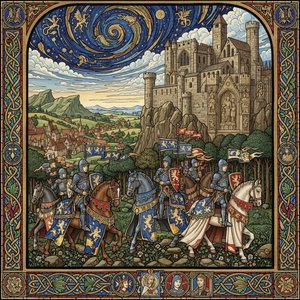
Bernardo Daddi: Un Puente Entre el Gótico y el Renacimiento Florentino
Bernardo Daddi, nacido en Florencia alrededor de 1290 y fallecido en 1348, se erige como una figura fundamental en la transición del tardogótico al floreciente Renacimiento italiano. No fue un ícono revolucionario que rompió convenciones establecidas de forma abrupta, sino más bien un artesano maestro que, con sutileza pero profundamente, modificó el paisaje artístico de su tiempo, particularmente dentro de la vibrante ciudad de Florencia. A menudo descrito como el “pintor principal” de Florencia durante su generación, el legado de Daddi no reside en rupturas radicales, sino en una evolución medida – una refinación cuidadosa de las técnicas existentes y una dedicación al realismo que marcó un paso crucial hacia los ideales humanistas del Renacimiento.
Primeros Años y Raíces Artísticas
La fecha exacta de nacimiento de Daddi permanece envuelta en cierta oscuridad, aunque los registros indican que fue mencionado por primera vez en 1312. Se cree ampliamente que su viaje artístico comenzó bajo la tutela de Giotto di Bondone, uno de los artistas más influyentes de la época. La insistencia de Giotto en el naturalismo y la expresión emocional sin duda moldeó el estilo temprano de Daddi. Sus primeras obras demuestran una clara conexión con los seguidores de Giotto – maestros como el “Maestro de Santa Cecilia” y otros pintores florentinos del primer cuarto del siglo XIV—reflejando una línea directa de influencia artística. Estas piezas iniciales exhiben una fidelidad estilística, utilizando técnicas comunes en la tradición gótica mientras sugieren un surgimiento creciente de sensibilidad para representar la forma humana y la emoción. El meticuloso detalle y los colores vibrantes característicos de este período sugieren una sólida base en las prácticas establecidas, pero con una sensibilidad emergente para representar la forma humana y la emoción.
Un Estilo Definido por el Realismo y los Retablos Portátiles
El estilo artístico de Daddi representa un desplazamiento significativo del arte gótico, caracterizado por imágenes estilizadas, a menudo altamente simbólicas. Buscó lograr una representación más precisa y creíble de la realidad—un principio central del Renacimiento. Este cambio se evidencia particularmente en sus obras a menor escala, donde empleó hábilmente técnicas para representar texturas, draperías y expresiones faciales con un detalle notable. Crucialmente, Daddi desempeñó un papel clave en la popularización del formato de retablo portátil. Estas composiciones policromas, diseñadas para ser exhibidas en iglesias y capillas, permitieron una mayor complejidad narrativa y riqueza visual que los murales tradicionales. El estilo posterior de Daddi, influenciado por Maso di Banco, demuestra un refinamiento creciente—una elegancia sutil que oculta cierta precisión académica. Esta combinación de belleza lírica y habilidad técnica es lo que distingue su obra y aseguró su posición como pintor florentino principal.
Influencias y Legado Duradero
El desarrollo artístico de Daddi no estuvo únicamente arraigado en las enseñanzas de Giotto; también fue influenciado por el arte sienés de Lorenzetti, cuya insistencia en la virtud cívica y la representación naturalista resonó con sus propias sensibilidades estéticas. Su última obra conocida data de 1347, y lamentablemente, falleció poco después. A pesar de una cierta “precisión académica y mecánica” notada por algunos críticos—una característica quizás derivada del volumen de su taller—el legado de Daddi aseguró su posición como uno de los pintores florentinos más importantes de su tiempo. Sus contribuciones al desarrollo de retablos portátiles y su dedicación a la representación realista sentaron las bases para futuras generaciones de artistas italianos.
Obras Destacadas y Colecciones de Museos
El impacto artístico de Bernardo Daddi ha dejado una huella imborrable en las colecciones de algunos de los museos más prestigiosos del mundo. La Galería Uffizi en Florencia alberga un triptico significativo de 1328, que ofrece una visión convincente de sus habilidades compositivas y su narración visual. Igualmente notable es el “Martirio de San Esteban” que se encuentra dentro de la Pinacoteca Vaticana—una predela compuesta por ocho paneles pintados alrededor de 1345. Más allá de estas obras icónicas, la influencia de Daddi puede verse en numerosas piezas dispersas a través de instituciones como la Galería Nacional de Arte y el Museo Walters. Su “Crucifijo Procesional”, por ejemplo, ejemplifica su capacidad para capturar el movimiento y el detalle dentro de un formato relativamente pequeño. La Courtauld Institute of Art alberga varios paneles del "Coronación de la Virgen", que demuestran su maestría en representar figuras religiosas y sus alrededores.
Recursos Útiles



 Ver en contexto
 Cambiar a impresiones
 Enviar
 Compartir
 Detalles
 Guía
Guía

 Descargar
 Similares
 Radiografía
 Presentación de diapositivas
 Q&A
Q&A Estadísticas


 Ver más






































 La opción de vidrio solo está disponible en tamaños inferiores a 110 cm.