Encargar reproducción pintada a mano Ver versión en imagen digital Compartir
Ver detalles Guía Añadir a favoritos Descargar Ver artículos similares Presentación de diapositivas Estadísticas

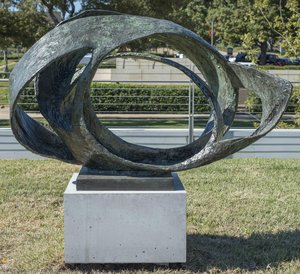
Rhythmic Form

Barbara Hepworth’s ‘Rhythmic Form,’ a monumental 1949 rosewood sculpture, embodies surrealist ideals and explores duality through its central hole – a captivating dialogue between space and spirit. Discover this iconic piece and own a masterpiece of British modernism.

Descubre a Barbara Hepworth (1903-1975), pionera de la escultura moderna británica. Explora su legado abstracto y sus obras icónicas en el Hepworth Wakefield.

La obra de arte que se muestra en esta página está protegida por las leyes de propiedad intelectual, lo que significa que no podemos crear ni vender legalmente una reproducción idéntica. Esta protección se hace cumplir en virtud de acuerdos internacionales como el Convenio de Berna y por las leyes nacionales, incluidas aquellas establecidas por el Ley de derechos de autor de los EE. UU. - Título 17.

Este método cumple plenamente con las normativas de derechos de autor, ya que no implica la copia ni la duplicación de la obra protegida. En su lugar, se trata de una reinterpretación creativa: una nueva pintura influenciada por la original, pero que no es idéntica a ella.

Giclée / Impresión de arte

Impresiones giclée o en lienzo de calidad de museo con producción rápida y opciones de acabado flexibles. ( Encargar reproducción pintada a mano Ver versión en imagen digital)

Estándar
personalizado
CM
INCH

Elija entre nuestros tamaños predefinidos que respetan las proporciones originales de la obra.

ancho
altura

Introduzca el ancho y el alto que necesite para adaptarse a su marco o pared. Una impresión solo puede recortarse, nunca hacerse más grande que la imagen original, por lo que un tamaño con una forma distinta perderá parte de la obra. Le enviaremos una maqueta digital para su aprobación antes de realizar cualquier impresión. La imagen que se muestra en esta página no refleja el recorte real; solo la maqueta lo hace.

Envío a todo el mundo () en 2 semanas en lugar de las 4/5 semanas estándar. (22 octubre)

Envío exprés gratuito a todo el mundo
Lienzo de lino de alta calidad
Seguro de envío completo
Garantía de reembolso de impuestos aduaneros
Garantía de fidelidad cromática exacta
Política de devolución de 100 días (solo por defectos)
Garantía de devolución del 100% del dinero
Oferta por volumen

Precio total

€ 60

Rhythmic Form

Giclée / Impresión de arte

Tamaño de la reproducción

-

Precio total

€ 60

Datos clave

  • Medium: Wood Sculpture
  • Movement: Modernism
  • Notable elements or techniques: Hole; Spatial Bond
  • Artistic style: Abstraction
  • Title: Rhythmic Form

Cuestionario de arte

Cada pregunta tiene una única respuesta correcta.

Pregunta 1:
What artistic movement is Barbara Hepworth most associated with?
Pregunta 2:
The sculpture 'Rhythmic Form' utilizes what technique primarily?
Pregunta 3:
'Rhythmic Form' draws inspiration from the work of which sculptor?
Pregunta 4:
What is described as a 'soaring upright' characteristic of 'Rhythmic Form'?
Pregunta 5:
Hepworth’s early sculptures were largely focused on exploring what?

Rhythmic Form: A Dialogue Between Space and Spirit

Barbara Hepworth’s “Rhythmic Form,” created in 1949, stands as a testament to the profound influence of Surrealist ideas on British sculpture during World War II. More than just an aesthetically pleasing object, it embodies Hepworth's unwavering belief that sculpture could translate thought into tangible form—a conviction deeply rooted in her engagement with artists like Arp and Brancusi who championed direct carving and explored the relationship between art and nature. The piece itself is a striking example of Hepworth’s signature style: monumental forms sculpted from wood, meticulously shaped to evoke movement and resonance. Its central hole isn't merely an incision; it’s a deliberate gesture that seeks to unify opposing forces—a visual metaphor for Hepworth’s exploration of duality and balance within the creative process.
  • Material & Technique: Crafted from Rosewood, “Rhythmic Form” utilizes a technique honed during Hepworth's formative years in Paris – a method characterized by careful consideration of material properties and an intuitive understanding of how form interacts with space. The sculptor’s hand meticulously removes wood shavings to reveal the underlying structure, resulting in a surface that is both smooth and subtly textured.
  • Historical Context: Hepworth's work emerged from a period marked by significant artistic experimentation and intellectual ferment. The Unit One group—which included Nicholson, Gabo, and Nash—challenged conventional sculptural approaches, prioritizing abstraction and responding to the anxieties of wartime Britain with an embrace of geometric forms and organic shapes.
  • Symbolism & Inspiration: Hepworth drew inspiration from Neolithic Menhirs – monolithic stones erected as memorials to ancient rituals – recognizing their ability to convey timelessness and spiritual significance. She likened her sculptures to these stones, emphasizing the desire for them to “furnish a means of egress for the soul,” reflecting her belief in sculpture’s capacity to transcend mere visual representation.
  • Hepworth's Philosophy: Hepworth famously described sculpture as "the plastic projection of thought," highlighting its role in capturing intangible ideas and emotions. She insisted that the work should “put no pressure on anything,” signifying a rejection of didacticism and an affirmation of art’s autonomy—a stance that aligns with her broader philosophical commitment to embracing spontaneity and responding authentically to the material at hand.
  • Legacy & Influence: Hepworth's pioneering approach to sculpture continues to inspire artists today, particularly those interested in exploring spatial relationships and investigating the interplay between form and gesture. Her enduring impact is evident in the work of subsequent sculptors who adopted similar techniques and pursued similar conceptual concerns—a legacy cemented by her inclusion in Tate’s collection and celebrated as a cornerstone of British Modernism.
Image Description: The image showcases “Rhythmic Form,” a wooden sculpture featuring a prominent central hole. Its smooth, polished surface contrasts with subtle textural variations created during the carving process. Positioned on a neutral white background, the photograph emphasizes the sculpture’s geometric form and its harmonious integration into space—a visual embodiment of Hepworth's artistic vision. Size: Unknown Date: 1949

Preguntas y respuestas

¿Cómo puedo ver "Rhythmic Form" de Barbara Hepworth en formato de presentación?

Hay una presentación de diapositivas disponible: la página Presentación de diapositivas de "Rhythmic Form" de Barbara Hepworth.

¿Se puede reproducir libremente la imagen de "Rhythmic Form" de Barbara Hepworth?

En cuanto a los derechos de autor, "Rhythmic Form" es aún protegido por derechos de autor.

¿Quién vende copias pintadas a mano de "Rhythmic Form" de Barbara Hepworth?

"Rhythmic Form" está disponible como una reproducción al óleo pintada a mano sobre lienzo de lino. El pedido puede realizarse en su página de Reproducción pintada a mano, con una variedad de tamaños para elegir.


Biografía del artista

Primeros años y educación

Dame Barbara Hepworth, una reconocida escultora e artista inglesa, nació el 10 de enero de 1903 en Wakefield, Yorkshire. Asistió a la Escuela de Arte de Leeds desde 1920 y posteriormente ganó una beca del condado para estudiar en el Royal College of Art (RCA) en Londres desde 1921 hasta que fue galardonada con el diploma en 1924.

Carrera artística

  • El trabajo de Dame Barbara Hepworth ejemplifica el modernismo, particularmente la escultura moderna. Fue una de las pocas artistas femeninas en lograr prominencia internacional.
  • En 1933, cofundó el movimiento artístico Unit One con Ben Nicholson, Paul Nash y otros, buscando unir el surrealismo y la abstracción en el arte británico.
  • El trabajo temprano de Hepworth se caracterizó por la abstracción y su participación con el movimiento artístico parisino, Abstraction-Création.

Obras notables y exposiciones

Legado y colecciones de museos

Barbara Hepworth's work is widely recognized, with her sculptures and paintings forming part of various museum collections worldwide. The Hepworth Wakefield, named after the artist, houses numerous masterpieces from renowned artists, including Hepworth's own works. (descubra más sobre The Hepworth Wakefield en WahooArt)

Conclusión

Dame Barbara Hepworth's pioneering work in modern British sculpture has left an indelible mark on the art world. Her legacy continues to inspire artists and art enthusiasts alike, with her works remaining a testament to her innovative spirit and artistic genius. más sobre Barbara Hepworth en Wikipedia
Barbara Hepworth

Barbara Hepworth

1903 - 1975 , Reino Unido

Datos clave

  • Artistas Influyentes: ['Abstracción-Creación']
  • Fecha De Nacimiento: 10 de enero de 1903
  • Legado Artístico: Inspiró a artistas y entusiastas.
  • Lugar De Nacimiento: Wakefield, Reino Unido
  • Movimiento Artístico: Modernismo, Escultura moderna
  • Nacionalidad: Británica
  • Nombre Completo: Barbara Hepworth
  • Nombres Alternativos: Dame Barbara Hepworth
  • Obras Notables:
    • Oval Form (Trezion)
    • Two Forms
    • Totem
Explore obras de arte organizadas por temas, estilos y características.