Cambiar a formato impreso Encargar reproducción pintada a mano Compartir
Ver detalles Guía Añadir a favoritos Descargar Ver artículos similares Presentación de diapositivas Estadísticas

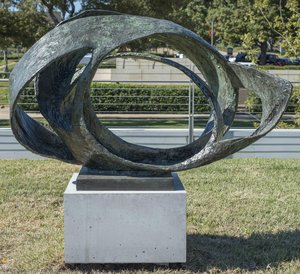
Prototype for Maquette, Three Forms in Echelon

Barbara Hepworth's 'Prototype for Maquette, Three Forms in Echelon' is an iconic abstract sculpture embodying modernism’s elegance and exploration of form & space. Discover its layered composition & artistic significance.

Descubre a Barbara Hepworth (1903-1975), pionera de la escultura moderna británica. Explora su legado abstracto y sus obras icónicas en el Hepworth Wakefield.

Adquiera una imagen digital de alta resolución y optimizada, muy superior a la vista previa en línea.

Cada archivo es preparado meticulosamente por nuestros especialistas internos mediante el uso de herramientas avanzadas y un experto retoque manual. Nos aseguramos de que cada imagen posea una claridad excepcional, una precisión cromática impecable y un detalle minucioso.

El archivo final se entrega por correo electrónico en un plazo de 72 horas, optimizado para su uso inmediato en entornos profesionales, editoriales y de impresión. Esta es la misma calidad en la que confían los estudios de diseño, las editoriales y las galerías de primer nivel.

Imagen Digital

Descarga un archivo de alta resolución para exhibición personal, impresión y proyectos creativos. ( Cambiar a formato impreso Encargar reproducción pintada a mano)

Precio total

$ 24,90

Incluido en cada pedido de imágenes digitales

Entrega digital experta, garantizada.

Al elegir WahooArt.com, no solo está adquiriendo una imagen; está recibiendo una obra de arte digital mejorada profesionalmente, elaborada con precisión y respaldada por una garantía de satisfacción. Esto es todo lo que incluye su pedido, automáticamente:

shipping_icon
Entrega inmediata por email

Recibirá su archivo de imagen digital en alta resolución por correo electrónico en un plazo de 72 horas tras realizar su pedido, listo para su uso inmediato.

canvas_icon
Archivo digital optimizado por IA

Su obra de arte se optimiza profesionalmente mediante herramientas avanzadas de IA y edición manual, garantizando el máximo detalle, claridad y precisión cromática.

insurance_icon
Reenvío gratuito de por vida

¿Has borrado o perdido tu archivo por error? No te preocupes: te lo volveremos a enviar en cualquier momento, sin coste adicional.

tax_icon
Sin gastos de importación, siempre

Disfrute de su obra de arte al instante sin aduanas, aranceles ni gastos de envío; las descargas digitales siempre están libres de impuestos.

color_icon
Garantía de precisión de color

Garantizamos que su imagen digital refleje los colores originales con la mayor fidelidad posible, mediante el uso de herramientas profesionales y gestión del color.

return_icon
Garantía de satisfacción de 100 días

Si no está satisfecho con su imagen digital, la revisaremos o le reembolsaremos el 100% en un plazo de 100 días, sin preguntas.

guarantee_icon
100% Garantía de devolución de dinero

¿No está satisfecho? Obtenga un reembolso completo dentro de los 100 días posteriores a la recepción de su archivo digital, sin preguntas.

discount_icon
Descuentos por volumen

Compra 3 imágenes, ahorra 10% - Compra 5, ahorra 15% - Compra 10+, ahorra 20%. Ideal para proyectos creativos, galerías y agencias.

Datos clave

  • Subject or theme: Organic shapes, balance
  • Location: Tate St Ives
  • Notable elements: Echelon arrangement, curved forms
  • Movement: Modernism
  • Artist: Barbara Hepworth
  • Influences: Abstraction-Création
  • Medium: Wood/Stone Sculpture

Cuestionario de arte

Cada pregunta tiene una única respuesta correcta.

Pregunta 1:
What is the primary material used in Barbara Hepworth’s sculpture, ‘Prototype for Maquette, Three Forms in Echelon’?
Pregunta 2:
The sculpture's arrangement follows which compositional principle?
Pregunta 3:
What artistic movement is Barbara Hepworth most closely associated with?
Pregunta 4:
The photograph’s lighting appears to be...
Pregunta 5:
Based on the description, what is a possible symbolic interpretation of the sculpture’s forms?

A Sculptural Meditation on Form and Space

Barbara Hepworth’s “Prototype for Maquette, Three Forms in Echelon,” a deceptively simple yet profoundly resonant sculpture, stands as a testament to the artist's pioneering approach to modern abstraction. Created in 1961 during a period of intense experimentation and exploration within her studio at St Ives, Cornwall, this piece isn’t merely a collection of shapes; it’s an invitation to contemplate the relationship between form, space, and the inherent qualities of materials – specifically, the cool, tactile embrace of stone or wood.

The sculpture presents three distinct, organically curved forms arranged vertically on a stark white background. These aren't representational figures; instead, they embody an elemental language, suggesting echoes of natural forms—waves, rocks, or perhaps even the contours of the human body—without ever explicitly depicting them. The arrangement follows an echelon pattern, each form subtly offset from the one below, creating a dynamic sense of upward movement and spatial depth. This deliberate asymmetry is key to Hepworth’s aesthetic; she sought to disrupt traditional notions of balance and harmony, favoring instead a more intuitive and expressive approach.

Materiality and Technique: A Dance Between Hand and Stone

Hepworth's process was deeply rooted in the materiality of her chosen medium. She rarely used preparatory sketches, preferring to work directly from intuition and feeling, allowing the stone or wood to guide the form. The “Prototype” itself is a crucial stage in this process – a preliminary model intended to refine the composition and explore the interplay of light and shadow before committing to a larger-scale version. The matte texture of the sculpture, achieved through careful carving and polishing, invites tactile engagement; one can almost feel the cool smoothness of the stone beneath their fingertips.

Her technique involved a subtractive approach – carefully removing material to reveal the underlying form—combined with an understanding of how light interacts with different surfaces. The subtle tonal shifts within the sculpture’s surface, achieved through meticulous polishing and manipulation of the grain, create a sense of depth and volume, drawing the eye upwards and inviting contemplation. The stark white background serves not as a distraction but as a crucial element in highlighting the forms' inherent qualities, emphasizing their purity and simplicity.

Symbolism and Emotional Resonance

Hepworth’s work consistently explores themes of human connection to nature and the inner self. These three abstract forms can be interpreted as representing interconnectedness—a visual metaphor for the flow of life forces or perhaps a meditation on the fundamental building blocks of existence. The vertical arrangement evokes a sense of aspiration, reaching towards something beyond the immediate, while the subtle curves suggest fluidity and movement.

Considering Hepworth’s broader body of work, this “Prototype” shares affinities with her earlier explorations of ‘Form and Function,’ where she sought to create sculptures that were both aesthetically pleasing and responsive to their environment. It's a piece that speaks to the enduring power of abstraction—its ability to evoke profound emotions and ideas through purely visual means. The sculpture’s quiet intensity invites viewers to engage in a personal dialogue with its forms, prompting reflection on the nature of beauty, space, and our relationship to the world around us.

Further Exploration


Biografía del artista

Primeros años y educación

Dame Barbara Hepworth, una reconocida escultora e artista inglesa, nació el 10 de enero de 1903 en Wakefield, Yorkshire. Asistió a la Escuela de Arte de Leeds desde 1920 y posteriormente ganó una beca del condado para estudiar en el Royal College of Art (RCA) en Londres desde 1921 hasta que fue galardonada con el diploma en 1924.

Carrera artística

  • El trabajo de Dame Barbara Hepworth ejemplifica el modernismo, particularmente la escultura moderna. Fue una de las pocas artistas femeninas en lograr prominencia internacional.
  • En 1933, cofundó el movimiento artístico Unit One con Ben Nicholson, Paul Nash y otros, buscando unir el surrealismo y la abstracción en el arte británico.
  • El trabajo temprano de Hepworth se caracterizó por la abstracción y su participación con el movimiento artístico parisino, Abstraction-Création.

Obras notables y exposiciones

Legado y colecciones de museos

Barbara Hepworth's work is widely recognized, with her sculptures and paintings forming part of various museum collections worldwide. The Hepworth Wakefield, named after the artist, houses numerous masterpieces from renowned artists, including Hepworth's own works. (descubra más sobre The Hepworth Wakefield en WahooArt)

Conclusión

Dame Barbara Hepworth's pioneering work in modern British sculpture has left an indelible mark on the art world. Her legacy continues to inspire artists and art enthusiasts alike, with her works remaining a testament to her innovative spirit and artistic genius. más sobre Barbara Hepworth en Wikipedia
Barbara Hepworth

Barbara Hepworth

1903 - 1975 , Reino Unido

Datos clave

  • Artistas Influyentes: ['Abstracción-Creación']
  • Fecha De Nacimiento: 10 de enero de 1903
  • Legado Artístico: Inspiró a artistas y entusiastas.
  • Lugar De Nacimiento: Wakefield, Reino Unido
  • Movimiento Artístico: Modernismo, Escultura moderna
  • Nacionalidad: Británica
  • Nombre Completo: Barbara Hepworth
  • Nombres Alternativos: Dame Barbara Hepworth
  • Obras Notables:
    • Oval Form (Trezion)
    • Two Forms
    • Totem