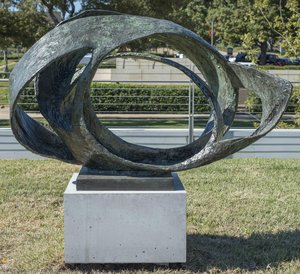
Barbara Hepworth: A Sculptural Dialogue with Form, Space & The Human Condition
Dame Barbara Hepworth (1903–1975) stands as an undeniable titan of modernist sculpture, a figure whose pioneering spirit reshaped the landscape of British art and continues to inspire artists globally. Her oeuvre transcends mere representation; instead, Hepworth sought to distill emotion and experience into geometric forms that engage with fundamental concepts of space and materiality—a radical departure from traditional artistic conventions.
Born in Wakefield, Yorkshire, Hepworth’s early life was marked by a profound engagement with the natural world. Influenced by her father's profession as a geologist, she developed an acute sensitivity to geological strata and textures, which would become recurring motifs in her sculptures. This formative experience instilled within her a fascination for exploring how forms interact with each other and with their surroundings—a preoccupation that would define her artistic trajectory.
Hepworth’s formal training at Leeds School of Art and subsequently the Royal College of Art cemented her commitment to abstraction, though she skillfully blended Surrealist influences with geometric precision. Notably, Hepworth co-founded Unit One Art Movement alongside Ben Nicholson, Paul Nash, and others in 1933—a collective endeavor dedicated to uniting Surrealism and Abstraction in British art.
Her breakthrough came with the creation of “Oval Form (Trezion)” in 1937 – a monumental bronze sculpture that embodies Hepworth’s core aesthetic principles. This piece, alongside "Two Forms," exemplifies her masterful manipulation of negative space—a technique she championed as crucial to conveying emotional depth and spiritual contemplation.
Hepworth's artistic vision extended beyond mere sculptural form; it encompassed an exploration of the human condition. Her sculptures grapple with themes of vulnerability, resilience, and connection to nature—reflecting her deeply held Christian faith. The deliberate simplicity of Hepworth’s forms serves as a powerful conduit for conveying profound ideas about existence and spirituality.
Today, Hepworth's legacy resides in the enduring beauty and intellectual rigor of her sculptures. Pieces like “Oval Form” and “Two Forms,” housed at The Hepworth Wakefield and internationally acclaimed museums alike, continue to captivate audiences with their elegant geometry and evocative presence—testaments to Hepworth’s unwavering dedication to pushing artistic boundaries and forging a dialogue between art and human experience.



 Cambiar a formato impreso
 Compartir
 Compartir
 Ver detalles
 Guía
Guía

 Descargar
 Ver artículos similares
 Presentación de diapositivas
 Estadísticas


 Leer más






































 La opción de vidrio solo está disponible en tamaños inferiores a 110 cm.