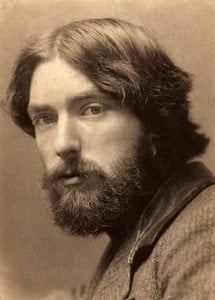
A Portrait of Quiet Intensity: Augustus Edwin John’s “Yvonne”
Augustus Edwin John, a name often associated with the bohemian spirit of late 19th and early 20th-century Wales, gifted us with a remarkable series of portraits that transcend mere likeness. His 1922 painting, "Yvonne," is not simply a depiction of a young woman; it’s an intimate study in observation, capturing a fleeting moment of contemplation and hinting at the complexities beneath a serene surface. The work resides within Nottingham City Museums & Galleries, offering a rare glimpse into John's evolving style and his profound ability to imbue his subjects with personality.
The composition immediately draws the eye to Yvonne’s face – rendered with an almost sculptural precision. John masterfully employs light and shadow to sculpt her features, emphasizing the delicate curve of her cheekbone, the subtle furrow of her brow, and the quiet intensity in her gaze. Her posture is relaxed yet alert, suggesting a thoughtful awareness of herself and the world around her. The muted brown background serves not as a distraction but rather as a deliberate framing device, intensifying the focus on Yvonne’s presence and drawing the viewer into her private space. The loose brushstrokes, characteristic of John's later work, create a sense of immediacy and movement, as if capturing a spontaneous expression.
Impressionistic Realism: Technique and Style
“Yvonne” exemplifies John’s unique blend of realism and impressionism. He was deeply influenced by the Impressionists, particularly their focus on capturing fleeting moments of light and atmosphere. However, unlike many of his contemporaries who embraced pure Impressionism, John retained a strong grounding in traditional draughtsmanship. His meticulous attention to detail—particularly in the rendering of fabric and hair—is evident throughout the painting. The impasto technique – applying paint thickly to create texture – is particularly pronounced in Yvonne’s clothing, adding a tactile quality to the image and further enhancing its visual richness.
The color palette is restrained, dominated by earthy tones – browns, ochres, and subtle greens – which contribute to the painting's overall mood of quiet introspection. John skillfully uses variations in tone to create depth and volume, suggesting the folds of Yvonne’s dress and the contours of her face. The brushwork itself is dynamic and expressive, with visible strokes that convey a sense of energy and spontaneity. This combination of meticulous detail and loose brushwork is what gives “Yvonne” its distinctive character – a harmonious balance between observation and artistic interpretation.
A Welsh Bohemian: Historical Context
To fully appreciate "Yvonne," it’s essential to understand the context in which John was working. Born in Tenby, Wales, he cultivated an unconventional lifestyle, embracing the bohemian spirit of the early 20th century. He spent his formative years studying at the Slade School of Fine Art in London but always maintained a strong connection to his Welsh roots and artistic community. John’s life was marked by both success and personal struggles – including a debilitating head injury sustained during a diving accident – which undoubtedly influenced his art, adding layers of complexity and emotional depth to his work.
The painting itself dates back to 1922, a period when John was at the height of his creative powers. He had established himself as one of Britain’s leading portrait painters, known for his psychologically astute depictions of women. “Yvonne” reflects this mastery, demonstrating his ability to capture not only physical likeness but also the inner life and emotional state of his subject.
Symbolism and Emotional Resonance
While "Yvonne" appears outwardly serene, a closer examination reveals subtle symbolic elements. The woman’s gaze is direct and unwavering, suggesting a quiet strength and resilience. There's an undercurrent of melancholy in her expression, perhaps hinting at the challenges and uncertainties of life. The loose, flowing lines of her dress evoke a sense of movement and freedom, while the muted colors create a feeling of intimacy and privacy. John’s masterful use of light and shadow further enhances this emotional resonance, casting a gentle glow on Yvonne's face and inviting the viewer to contemplate her inner world.
Ultimately, “Yvonne” is more than just a portrait; it’s a meditation on beauty, introspection, and the complexities of human experience. It stands as a testament to Augustus Edwin John’s artistic vision and his ability to capture the essence of his subjects with remarkable sensitivity and insight.
Preguntas y respuestas
¿Qué tan fuerte es el contraste en "Yvonne" de Augustus Edwin John?
El contraste entre luces y sombras de "Yvonne" se registra como Bold. El contraste describe la intensidad con la que difieren las zonas claras y oscuras.
¿Qué orientación tiene "Yvonne" de Augustus Edwin John?
"Yvonne" de Augustus Edwin John es una composición en Portrait. Se recomienda revisar las proporciones antes de elegir un tamaño de impresión.
¿Cómo puedo conseguir una lámina de "Yvonne" de Augustus Edwin John?
"Yvonne" está disponible como una impresión de bellas artes sobre lienzo de algodón o papel de lienzo de archivo. Los pedidos se realizan en esta página, en el tamaño de su elección.
¿Qué emoción transmite "Yvonne" de Augustus Edwin John?
El tono emocional registrado para "Yvonne" de Augustus Edwin John es Melancholic. Este resume el sentimiento que expresa la obra.
¿Cuál es el color dominante de "Yvonne" de Augustus Edwin John?
El Black (#1e1709) es el color predominante de "Yvonne" de Augustus Edwin John.
¿Cuál es el formato y las dimensiones de "Yvonne"?
"Yvonne" de Augustus Edwin John es una composición en Portrait que mide 61 x 41 cm en su formato original.
¿Quién creó "Yvonne" y en qué año?
Augustus Edwin John realizó "Yvonne" en 1922.
¿A qué estilo pertenece "Yvonne"?
"Yvonne" es una obra de Post-Impressionism. El movimiento indica la tradición artística de la que forma parte la obra.



 Vista previa
 Encargar reproducción pintada a mano
 Compartir
 Compartir
 Ver detalles
 Guía
Guía

 Descargar
 Ver artículos similares
 Radiografía
 Presentación de diapositivas
 Estadísticas


 Leer más






































 La opción de vidrio solo está disponible en tamaños inferiores a 110 cm.