Impresiones giclée o en lienzo de calidad de museo con producción rápida y opciones de acabado flexibles. ( Comprar pintura hecha a mano Cambiar a imagen digital)





























Elija entre nuestros tamaños predefinidos que respetan las proporciones originales de la obra.

Introduzca el ancho y el alto que necesite para adaptarse a su marco o pared. Una impresión solo puede recortarse, nunca hacerse más grande que la imagen original, por lo que un tamaño con una forma distinta perderá parte de la obra. Le enviaremos una maqueta digital para su aprobación antes de realizar cualquier impresión. La imagen que se muestra en esta página no refleja el recorte real; solo la maqueta lo hace.
Envío a todo el mundo () en 2 semanas en lugar de las 4/5 semanas estándar. (10 noviembre)
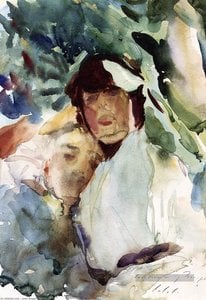
The Peacock Feather
Dimensiones de la reproducción
To gaze upon this depiction of a musician lost in his art is to witness time itself slowing down. The scene captures a young man utterly absorbed by the resonance of his violin, an act so deeply personal it seems to exist outside the clamor of the surrounding world. It is not merely a portrait; it is an immersion into the very spirit of creation. The artist has masterfully rendered this fleeting moment, allowing the viewer to feel the vibration of the bow against the strings and the profound solitude that accompanies true artistic passion. This piece speaks directly to the universal human experience of finding solace and expression through melody.
The technical brilliance of this work lies in its commitment to capturing an atmosphere rather than merely recording a likeness. The style leans heavily into late 19th-century Impressionism, evident in the visible, expressive brushstrokes that give life to every patch of color. Observe how the background dissolves into a dense, swirling tapestry of foliage—a vibrant, almost palpable curtain of greens and shadows. This is not a sharply defined backdrop; rather, it is an emotional echo chamber created through layered washes of paint. The artist prioritizes the interplay of light and shadow, using soft, diffused illumination to gently sculpt the contours of the musician’s face and the rich texture of his attire. It is this masterful handling of *sfumato* effect within a looser framework that gives the painting its dynamic, breathing quality.
Created in 1875, this work situates itself within a vibrant period of artistic transition, echoing the observational spirit championed by masters like Monet and Renoir. While the subject matter evokes the romanticism often associated with Parisian Impressionism, the underlying dedication to capturing human drama connects it to the profound realism found in Italian art traditions. The artist’s ability to blend vigorous technique with an almost lyrical sensitivity suggests a deep understanding of both formal structure and emotional spontaneity. It is a testament to the power of observation filtered through a highly skilled hand.
The symbolism woven into this canvas is rich and multilayered. The solitary musician represents introspection—the necessary withdrawal required for profound self-discovery or artistic breakthrough. His focus suggests a dialogue between man and art, a communion that requires shutting out the external world. Juxtaposed against this intense inner life is the enveloping natural setting. The foliage acts as both a beautiful enclosure and a visual metaphor for the subconscious mind—lush, complex, and sometimes overwhelming. It invites contemplation on themes of passion, melancholy, and the enduring power of art to connect us to something deeper than ourselves.
For collectors or designers seeking an artwork that transcends mere decoration, this piece offers narrative depth. Its vibrant color palette and palpable sense of movement make it a captivating focal point for any room. Owning a reproduction allows one to bring home not just paint on canvas, but a carefully preserved moment of pure artistic feeling—a whisper of late 19th-century passion rendered with modern appreciation for its evocative power.
En "The Peacock Feather", los colores de Earthy acompañan a un sentimiento Passionate.
"The Peacock Feather" data de 1875. Esta fecha sitúa la obra dentro de la trayectoria de Antonio Mancini y de su época.
La emoción Passionate de "The Peacock Feather" acompaña a su estilo Impressionism.

Antonio Mancini (1852-1930) fue un célebre pintor italiano, reconocido por sus conmovedores retratos de la vida cotidiana, centrándose particularmente en las comunidades marginadas de Nápoles. Nacido en Roma, Italia, Mancini demostró un talento artístico notable desde una edad temprana. A los doce años, ingresó al Instituto de Bellas Artes de Nápoles, donde estudió bajo la tutela de figuras influyentes como Domenico Morelli y Filippo Palizzi. Estas experiencias formativas moldearon profundamente su trayectoria artística, sentando las bases para su estilo distintivo arraigado en el Verismo.
La carrera temprana de Mancini se caracterizó por un rápido desarrollo bajo la tutela de Morelli, quien enfatizaba el claroscuro dramático y la pincelada vigorosa. Palizzi perfeccionó aún más las habilidades de Mancini, fomentando un enfoque en la observación realista. Ya en 1872, había expuesto su obra en el Salón de París, demostrando un talento emergente reconocido más allá de Italia. Sus sensibilidades artísticas se vieron significativamente influenciadas por sus encuentros con los pintores impresionistas Edgar Degas y Édouard Manet durante su estancia en París. La amistad con John Singer Sargent, quien declaró famosamente a Mancini como "el pintor vivo más grande", consolidó aún más su reputación dentro de la escena artística europea.
Mancini se convirtió en una figura destacada del movimiento Verista, una respuesta italiana a la estética realista del siglo XIX. Esta filosofía artística priorizaba la representación de la vida tal como era, sin idealización ni romanticismo. Los temas de Mancini solían provenir de las calles de Nápoles: niños pobres, artistas circenses juveniles y músicos. Sus obras más famosas, como *Il Saltimbanco* (1877-78), capturan una sensación de fragilidad y vulnerabilidad en sus retratos de individuos marginados. Empleó una técnica de impasto impactante sobre lienzo, creando superficies texturizadas que agregaban profundidad y realismo a sus pinturas. Su uso del pastel era igualmente magistral, demostrando un dominio audaz del color y la forma.
La vida de Mancini tomó un giro desafiante en 1881 cuando sufrió una enfermedad mental debilitante. Se trasladó a Roma en 1883 y luego a Frascati, donde vivió hasta 1918, enfrentando a menudo períodos de indigencia y dependiendo del apoyo de amigos y mecenas artísticos. A pesar de estas dificultades, Mancini continuó pintando. Tras la Primera Guerra Mundial, sus circunstancias se estabilizaron, lo que llevó a un período de renovada serenidad artística reflejada en sus obras posteriores. Murió en Roma en 1930 y fue enterrado en la Basílica Santi Bonifacio e Alessio en el Aventino.
La contribución de Antonio Mancini al arte italiano radica en su compromiso inquebrantable con el Verismo y su capacidad para capturar la esencia de la vida cotidiana con una sensibilidad y habilidad notables. Sus pinturas, incluyendo *El Niño Pobre* (expuesta en el Salón de 1876 y ahora alojada en el Musée d'Orsay), ofrecen una visión poderosa de las realidades sociales de la Italia del siglo XIX. Su obra está representada en prestigiosas colecciones como la Galleria Nazionale d’Arte Moderna e Contemporanea en Roma y el Museo Civico-Galleria d’Arte Moderna en Turín. La primera exposición dedicada exclusivamente a su obra en los EE. UU. en el Philadelphia Museum of Art (2007-2008) consolidó aún más su lugar en la historia del arte, presentando su visión conmovedora a un público más amplio.

1852 - 1930 , Italia

Transforme sus recuerdos en legados eternos con nuestras reproducciones al óleo hechas a mano. En WahooArt.com, fusionamos la técnica de los grandes maestros con su historia personal para crear obras maestras exclusivas, auténticas y con garantía de satisfacción absoluta.

Explore the ethereal beauty of Impressionist landscapes. Discover how masters like Monet captured fleeting light through color and texture, and learn to curate these timeless, luminous masterpieces for your home collection.

Discover the profound allure of oil on canvas. Explore the mastery of impasto textures, the science of pigment longevity, and expert guides to selecting museum-quality reproductions that elevate your collection with timeless elegance and tactile depth.

Descubra la armonía entre la luz y la forma en el realismo impresionista. Explore la maestría de la pincelada y el impasto hoy mismo.

Transforme sus paisajes en obras maestras con WahooArt. Ofrecemos reproducciones al óleo hechas a mano de grado museo, capturando la esencia del impresionismo con pinceladas auténticas y técnicas clásicas para crear un legado eterno en su hogar. Calidad excepcional garantizada.
 Ver en contexto
 Enviar
 Compartir
 Detalles
 Guía
Guía

 Descargar
 Similares
 Radiografía
 Presentación de diapositivas
 Preguntas y respuestas
 Estadísticas


 Ver más









 La opción de vidrio solo está disponible en tamaños inferiores a 110 cm.