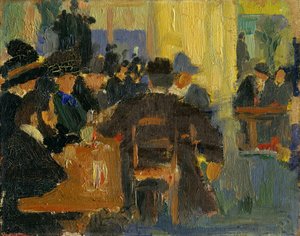
Acrylic On CanvasWallArtCubism
 1913
1913 46.0 x 61.0 cm
 Centro de Arte Moderna Gulbenkian
Adquiera una imagen digital de alta resolución y optimizada, muy superior a la vista previa en línea.
Cada archivo es preparado meticulosamente por nuestros especialistas internos mediante el uso de herramientas avanzadas y un experto retoque manual. Nos aseguramos de que cada imagen posea una claridad excepcional, una precisión cromática impecable y un detalle minucioso.
El archivo final se entrega por correo electrónico en un plazo de 72 horas, optimizado para su uso inmediato en entornos profesionales, editoriales y de impresión. Esta es la misma calidad en la que confían los estudios de diseño, las editoriales y las galerías de primer nivel.
Descarga un archivo de alta resolución para exhibición personal, impresión y proyectos creativos. ( Comprar impresión Comprar pintura hecha a mano)
Al elegir WahooArt.com, no solo está adquiriendo una imagen; está recibiendo una obra de arte digital mejorada profesionalmente, elaborada con precisión y respaldada por una garantía de satisfacción. Esto es todo lo que incluye su pedido, automáticamente:

Recibirá su archivo de imagen digital en alta resolución por correo electrónico en un plazo de 72 horas tras realizar su pedido, listo para su uso inmediato.

Su obra de arte se optimiza profesionalmente mediante herramientas avanzadas de IA y edición manual, garantizando el máximo detalle, claridad y precisión cromática.

¿Has borrado o perdido tu archivo por error? No te preocupes: te lo volveremos a enviar en cualquier momento, sin coste adicional.

Disfrute de su obra de arte al instante sin aduanas, aranceles ni gastos de envío; las descargas digitales siempre están libres de impuestos.

Garantizamos que su imagen digital refleje los colores originales con la mayor fidelidad posible, mediante el uso de herramientas profesionales y gestión del color.

Si no está satisfecho con su imagen digital, la revisaremos o le reembolsaremos el 100% en un plazo de 100 días, sin preguntas.

¿No está satisfecho? Obtenga un reembolso completo dentro de los 100 días posteriores a la recepción de su archivo digital, sin preguntas.

Compra 3 imágenes, ahorra 10% - Compra 5, ahorra 15% - Compra 10+, ahorra 20%. Ideal para proyectos creativos, galerías y agencias.
Amadeo de Souza-Cardoso's "Study A," painted in 1913, isn’t merely a composition of shapes; it’s a vibrant distillation of the artist’s embrace of early modernism and his deep connection to both Portuguese heritage and Parisian avant-garde influences. This captivating work, rendered in oil on canvas, immediately draws the eye with its dynamic interplay of circles – large, dominant forms that command attention alongside a constellation of smaller, intricately arranged shapes. It's a piece brimming with energy, hinting at a restless spirit and a profound engagement with the visual world.
Souza-Cardoso, born in 1887 in Manhufe, Portugal, was a pivotal figure in Portuguese modernism. His artistic journey began with architectural studies but swiftly pivoted to painting, fueled by an innate desire for expressive innovation. He spent formative years in Paris, immersing himself in the revolutionary currents of Cubism, Futurism, and the vibrant experimentation of movements like Orphism – all of which profoundly shaped his distinctive style. “Study A” stands as a testament to this influence; it’s a synthesis of these diverse sources, filtered through Souza-Cardoso's unique vision.
The painting’s composition is deliberately unbalanced, creating a sense of controlled chaos. The central circle, a dominant presence, acts as an anchor, while surrounding it are a multitude of smaller circles – some overlapping, others positioned at sharp angles. This arrangement isn't random; it suggests a dynamic tension between order and disorder, stability and movement. Souza-Cardoso masterfully employs color to heighten this effect. Bold blues and reds dominate the palette, injecting an emotional intensity into the work. These colors aren’t blended smoothly; instead, they are applied with visible brushstrokes, adding texture and reinforcing the painting's sense of immediacy.
Souza-Cardoso’s technique is characterized by a loose, expressive application of paint – a hallmark of his engagement with modernism. He eschews meticulous detail in favor of capturing the essence of form and color. The brushwork itself becomes an integral part of the composition, contributing to the painting's overall dynamism. The use of layering and overlapping creates depth and visual interest, inviting the viewer to explore the intricate details within the larger design.
While Souza-Cardoso himself offered little in the way of explicit interpretation, “Study A” resonates with themes of dynamism, transformation, and perhaps even a hint of anxiety. The circles themselves can be interpreted as representing cycles, movement, or interconnectedness – mirroring the artist’s own restless spirit and his fascination with the ever-changing nature of modern life. The bold colors evoke strong emotions: blue suggesting contemplation and depth, while red conveys passion and energy.
Considering Souza-Cardoso's background in caricature, it is not surprising that this work contains a sense of playful experimentation. It’s a visual puzzle, inviting the viewer to engage with its complexities and discover their own interpretations. “Study A” isn’t simply a painting; it’s an invitation to contemplate the beauty and complexity of the modern world.
Reproductions of “Study A” offer a remarkable opportunity to bring this captivating artwork into your home or office. High-quality reproductions capture the painting’s vibrant colors, dynamic composition, and expressive brushwork with stunning accuracy. Whether you choose a canvas print, an acrylic print, or a fine art paper reproduction, you'll be able to appreciate the artistry of Amadeo de Souza-Cardoso for years to come. Consider framing your chosen reproduction in a manner that complements its bold colors and dynamic composition – a simple black frame will allow the artwork to truly shine.


1887 - 1918 , Portugal

 Ver en contexto
 Enviar
 Compartir
 Detalles

 Descargar
 Similares
 Radiografía
 Presentación de diapositivas
 Ver más