A Deserted Shoreline and the Echoes of War
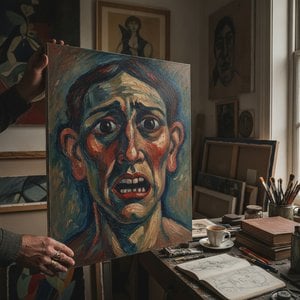
Albert Tucker’s “Memory of Leonski,” painted in 1943, isn't merely a depiction of a beach; it’s a haunting meditation on isolation, morality, and the lingering trauma of World War II. The painting immediately arrests the eye with its stark contrasts – the sun-bleached sand, the deep indigo of the sky, and the solitary figure of Private Edward Leonski sprawled across the shore. Leonski, rendered in a deliberately simplified, almost childlike style, is not presented as a heroic soldier but as a vulnerable, exposed individual, his arms outstretched as if offering an apology or seeking solace. The umbrella he clutches isn’t a symbol of protection from the elements, but rather a fragile shield against an unseen threat – perhaps the memories of violence he carries within him.

The Expressionist Palette and the Melbourne Landscape
Tucker’s distinctive style, rooted in Expressionism and influenced by artists like Van Gogh and Gauguin, is powerfully evident in “Memory of Leonski.” He employs a flattened perspective and bold, gestural brushstrokes to convey a sense of immediacy and emotional intensity. The colors are deliberately muted – ochres, browns, and blues dominate the palette – reflecting the bleakness of wartime Melbourne and the psychological landscape of the subject. The painting’s composition is carefully constructed; the diagonal lines created by Leonski's body and the horizon draw the viewer’s eye into the scene, intensifying the feeling of solitude and vulnerability. The two birds in flight, rendered with a surprising degree of detail amidst the otherwise simplified forms, could be interpreted as symbols of freedom or perhaps simply reminders of a world beyond the immediate crisis.
A Shadowed History: Edward Leonski’s Story
The painting's genesis is inextricably linked to a dark chapter in Melbourne’s history. Private Edward Leonski was an American GI who, in 1942, assaulted and murdered three women – a shocking event that gripped the city with fear and uncertainty. The details of this crime remain largely shrouded in mystery, but Tucker’s painting serves as a poignant memorial to the victims and a stark reminder of the violence that permeated wartime society. The title itself, “Memory of Leonski,” suggests an attempt to grapple with the unsettling legacy of these events, to hold them within the artist's consciousness and translate them into visual form. The Google Arts & Culture entry provides further context, revealing the chilling details of Leonski’s actions and the public’s reaction to them.
Symbolism and Emotional Resonance
Beyond its historical context, “Memory of Leonski” resonates with universal themes of alienation, guilt, and the struggle for redemption. Leonski's nakedness is not presented as erotic but rather as a symbol of vulnerability and exposure – he’s stripped bare, both physically and emotionally. The umbrella, a small gesture against an overwhelming force, speaks to the human desire for protection and control in the face of chaos. The painting evokes a profound sense of melancholy and unease, prompting viewers to contemplate the psychological toll of war and the enduring consequences of violence. It’s a powerful work that lingers long after it has been viewed, inviting repeated contemplation and offering no easy answers.



 Ver en contexto
 Switch to Print
 Enviar
 Compartir
 Detalles

 Descargar
 Similares
 Radiografía
 Presentación de diapositivas
 Stats
Stats


 Ver más






































 La opción de vidrio solo está disponible en tamaños inferiores a 110 cm.